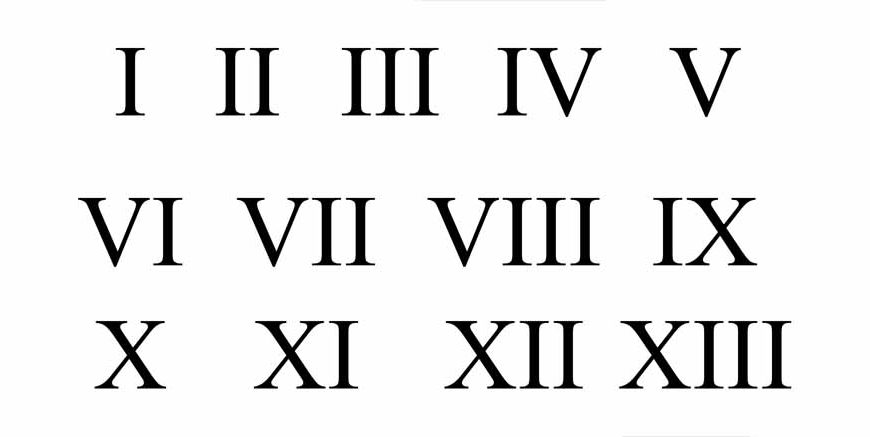
When children first encounter letters that are used as digits on face clocks or on historical monuments, it sometimes sparks confusion in them. They are accustomed to the normal number system, so this Roman numeral concept can be a bit new and complex for them. Thus, it can be challenging for parents to show that these old system symbols are not just random letters but a very clever system that is built on simple addition and subtraction rules. In this blog, we will explore Roman numbers and offer a clear framework for the entire system so that your children can master it with absolute confidence.
Roman Numbers 1 to 20
- 1 – I
- 2 – II
- 3 – III
- 4 – IV
- 5 – V
- 6 – VI
- 7 – VII
- 8 – VIII
- 9 – IX
- 10 – X
- 11 – XI
- 12 – XII
- 13 – XIII
- 14 – XIV
- 15 – XV
- 16 – XVI
- 17 – XVII
- 18 – XVIII
- 19 – XIX
- 20 – XX
Read More – Importance of Math in Everyday Life
Roman Numbers 1 to 100
- 10 – X
- 20 – XX
- 30 – XXX
- 40 – XL
- 50 – L
- 60 – LX
- 70 – LXX
- 80 – LXXX
- 90 – XC
- 100 – C
Roman Numbers 100 to 1000
- 100 – C
- 200 – CC
- 300 – CCC
- 400 – CD
- 500 – D
- 600 – DC
- 700 – DCC
- 800 – DCCC
- 900 – CM
- 1000 – M
The Seven Core Building Blocks of the System
- I = 1
- V = 5
- X = 10
- L = 50
- C = 100
- D = 500
- M = 1000
How to Read Roman Numerals
- XLV
XL = 40
V = 5
Therefore, XLV = 45
- DCCL
D = 500
CC = 200
L = 50
Total = 750
The Core Rules of Addition and Subtraction
The Rule of Placement and Addition
When a symbol of equal or smaller value is placed to the right of a larger symbol, you simply add the values together.
- VI: 5 + 1 = 6
- XX: 10 + 10 = 20
- CL: 100 + 50 = 150
- MD: 1000 + 500 = 1500
The Rule of Precedence and Subtraction
When a smaller symbol is placed to the left of a larger symbol, it means you must subtract the smaller value from the larger one.
- IV: 5 – 1 = 4 (instead of writing IIII)
- IX: 10 – 1 = 9 (instead of writing VIIII)
- XL: 50 – 10 = 40 (instead of writing XXXX)
- CM: 1000 – 100 = 900 (instead of writing DCCCC)
Read More – Teaching Kids About Roman Numerals
Key Milestones: Roman Numbers 1 to 1000 Chart
|
Standard Number |
Classical Symbol |
Breakdown of Logic |
|
10 |
X |
Base symbol for ten |
|
40 |
XL |
Ten subtracted from fifty |
|
50 |
L |
Base symbol for fifty |
|
90 |
XC |
Ten subtracted from one hundred |
|
100 |
C |
Base symbol for one hundred (Centum) |
|
400 |
CD |
One hundred subtracted from five hundred |
|
500 |
D |
Base symbol for five hundred |
|
900 |
CM |
One hundred subtracted from one thousand |
|
1000 |
M |
Base symbol for one thousand |
How to Write Numbers in Roman Numerals
1. Number 27
20 = XX
7 = VII
27 = XXVII
- Number 49
40 = XL
9 = IX
49 = XLIX
3. Number 75
50 = L
20 = XX
5 = V
75 = LXXV
4. Number 124
100 = C
20 = XX
4 = IV
124 = CXXIV
5. Number 999
900 = CM
90 = XC
9 = IX
999 = CMXCIX
Read More – Fun Math Activities for Kids
Making Number Learning Fun and Interactive
At EuroKids, your children will be introduced to these mathematical concepts through activities and engaging lessons. These hands-on learning methods will encourage their curiosity. It will help make complex topics easier to grasp. Through structured and enjoyable educational experiences, your children will develop a strong mathematical foundation that supports academic success. In addition, many other topics are taught, such as number recognition, counting skills and alternative number systems through interactive classroom experiences and activities.
Conclusion
When your children start focusing on these seven basic building blocks and understand the logic of addition and subtraction, then they can easily decipher any classical value. It will help your children sharpen their critical thinking, boost their arithmetic skills and expand their understanding. This will also help build curiosity among children and a strong foundation for future mathematical exploration.
To discover a wide selection of creative maths guides, step-by-step homework tips, and engaging child-friendly activities, explore the EuroKids Blog. If you are looking for an exceptional early education space that promotes critical thinking, logical reasoning, and holistic child development, take a closer look at EuroKids Preschool Admission for your little one.
Frequently Asked Questions
1. What is the absolute highest number you can write with these symbols?
The standard system uses seven basic letters to easily count up to 3999. For numbers larger than that, ancient writers placed a straight horizontal line over a symbol to multiply its baseline value by one thousand.
2. Why does the number four sometimes look like IIII instead of IV on clocks?
Clockmakers often use four lines instead of the subtraction rule to create perfect visual balance on the right side of the clock face, matching the heavy look of the number eight written as VIII on the opposite side.
3. What is the Roman numeral for 500?
The Roman numeral for 500 is D.