Have you ever watched a young child stubbornly choose a new toy at the shop based entirely on its shiny, brightly coloured packaging, only to completely abandon it ten minutes later because it is incredibly boring to play with? It is a universal human trait to be immediately distracted by sparkling, pretty things. We are naturally drawn to visual beauty. However, as parents and educators, we have a massive responsibility to teach children that outer appearances can be highly deceptive. We need to show them that what a person or an object can actually do is far more important than how it looks.
Instead of delivering a dry, boring lecture about shallow behaviour, we can use the power of classic fables to deliver this message perfectly. A beautifully told peacock story strips away the complex social dynamics of the playground and replaces them with a highly visual, easy-to-understand narrative about forest animals. Let us completely break down this famous tale, explore its vibrant characters, and understand exactly how to explain its crucial morals to a developing mind.
The Vain Bird of the Forest
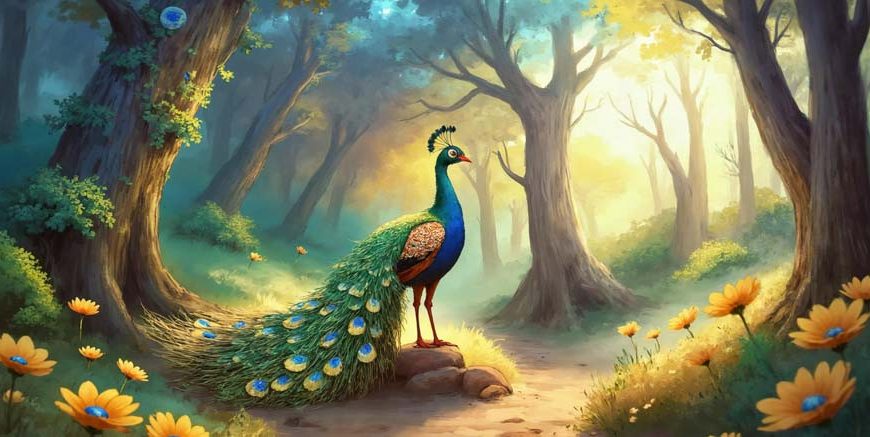
Deep inside a lush, noisy, emerald-green jungle, there lived a magnificent peacock. Without a single doubt, he was the most beautiful creature for miles around. When he confidently strutted through the tall grass, the other animals would often stop what they were doing just to stare.
His body was covered in shimmering blue feathers that looked exactly like polished sapphires. But his absolute pride and joy was his massive, sweeping tail. Whenever he wanted to show off, he would suddenly fan his tail out into a giant, perfect circle. It was a spectacular display of bright gold, deep green, and shimmering bronze, covered in strange, beautiful markings that looked like dozens of staring eyes.
The problem was that the peacock knew exactly how beautiful he was. He spent his entire day standing right at the edge of a clear, still lake, just staring completely obsessively at his own reflection in the water. He refused to play games with the monkeys, he would not speak to the friendly deer, and he completely ignored the singing birds. He believed that because his feathers were the most beautiful, he was automatically better and more important than every single other animal in the entire forest.
Read More – Golden Bird Story
The Encounter With The Humble Crane
One warm, sunny afternoon, a crane decided to land near the lake to catch some slippery fish for his lunch. The crane was a very large, strong bird, but he was not colourful at all. His feathers were a plain, dull, dusty grey. He had a long, sharp beak and thin, spindly legs designed strictly for wading through muddy water.
The peacock took one look at the crane and immediately burst into loud, cruel laughter. He fanned out his glorious, jewelled tail, making sure it caught the bright sunlight, and proudly marched over to the grey bird.
“Look at you!” the peacock sneered loudly. “You are so incredibly dull and boring. Look at my feathers! They are the colours of a brilliant rainbow. I am dressed like a wealthy king, while you are dressed in boring, dusty grey dusters. Do you not feel terribly embarrassed to stand next to someone as magnificent as me?” The crane did not look angry. He simply stopped fishing, calmly swallowed his lunch, and looked directly at the arrogant bird.
The Brilliant Lesson In The Sky
“You are absolutely right,” the crane replied in a quiet, highly confident voice. “Your feathers are undeniably beautiful. They are brighter than the flowers and shinier than the green leaves. But tell me, what can those beautiful feathers actually do for you?”
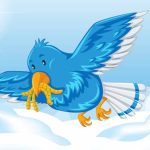
Before the confused peacock could answer, the crane suddenly spread his massive, grey wings. With one powerful, heavy flap, he lifted himself straight off the muddy ground. He soared higher and higher, cutting beautifully through the warm wind until he was circling high up among the fluffy white clouds.
From way up in the bright blue sky, the crane shouted down to the peacock, who was still standing with his feet firmly stuck in the mud. “My plain, grey feathers allow me to touch the clouds and travel across the entire world! Your heavy, jewelled feathers are only good for looking at. They keep you trapped right there in the dirt!” The peacock suddenly felt incredibly foolish. He looked at his heavy, dragging tail and realised that the crane was entirely correct. All the beauty in the world could not help him fly.
Read More – Bedtime Stories for Kids
The Moral of the Peacock Story
When you reach the end of the peacock story, you must ensure the child completely understands the underlying message. The moral is stark, highly logical, and incredibly important: Utility and inner ability are far more valuable than outward physical beauty.
We often say “beauty is only skin deep,” but toddlers struggle to understand abstract metaphors. You have to ground the lesson in their physical, everyday reality. You can ask them a highly practical question to make the moral click.
Ask them to imagine two different pencils. One pencil is painted with bright, shiny glitter and has a massive, colourful rubber on the end, but the lead inside is completely broken, so it cannot draw a single line. The second pencil is totally plain, scratched, and boring yellow, but it writes beautifully and never snaps. Which pencil is actually better to take to school? They will instantly choose the yellow pencil, proving that they logically understand that function beats appearance every single time.
Applying the Lesson to Daily Life
We can easily use this ancient fable to tackle modern playground behaviour. Children frequently judge each other based on superficial things, like who has the newest trainers, the most expensive school bag, or the brightest jacket.
You can use the narrative of the grey crane to explain that true worth comes entirely from our actions. A child’s value is not determined by the label on their shirt, but by how fast they run, how kindly they share their toys, and how bravely they tackle a difficult puzzle. Teaching children to actively look for the ‘crane’ in a situation, the practical, useful, and kind elements rather than just the shiny ones, is a highly effective way to build empathy and resilience.
This logical, exploratory approach perfectly aligns with the Heureka curriculum. Instead of just asking children to passively accept that being vain is bad, we encourage them to actively question the actual, mechanical value of things. We teach them to look closely at their environment and realise that the loudest, brightest objects are often not the most useful tools in the box.
Read More – Short Moral Stories For Kids
Conclusion
Stripping away the distracting, shallow obsession with physical appearance completely changes how a young child interacts with the world around them. When they finally understand the stark difference between looking good and actually doing something good, their entire perspective shifts. They stop demanding the shiniest toys and start valuing the most engaging ones. They stop judging their peers on their clothes and begin valuing them for their kindness and their ideas.
It is genuinely thought-provoking to realise that a simple fable about a heavy bird can so perfectly teach a modern child that true freedom and ability come from what you can physically achieve, not what you look like while standing still. We must continually encourage them to spread their own wings and focus on soaring rather than just showing off. To uncover more fantastic fables, practical parenting advice, and ways to fuel your child’s daily development, explore the EuroKids Blog and start their exciting educational journey today through EuroKids Preschool Admission.
FAQs
Is it wrong for my child to want to dress up and look nice?
Absolutely not. Taking pride in your appearance is entirely fine. The story simply teaches that looking nice should never turn into arrogance, and it should never be valued higher than being kind, capable, and hardworking.
How can I tell if my child understood the actual moral?
Ask them a direct, logical question after the story finishes. For example, “If the peacock and the crane had a race to the top of the mountain, who would win and why?” Their answer will immediately show if they grasped the practical difference between the two birds.
What age group is this specific fable best suited for?
Children between the ages of four and seven get the absolute most out of this narrative. It is the exact developmental stage where they begin noticing physical differences in their peers and start placing heavy value on material objects.