Have you ever stood in front of a mirror and noticed how everything reflects perfectly back at you? If you lift your right hand, your reflection lifts its left hand in the exact same way. In the vast, sometimes confusing world of mathematics, there is one specific number that acts exactly like a magic mirror. It is the number eleven! When you look at its shape, it is just a ‘1’ standing right next to another ‘1’. They look like identical twins standing shoulder to shoulder.
Because of this unique, twin-like shape, learning the 11 table is actually one of the most exciting and straightforward milestones for any young learner. Many children feel a little bit of anxiety when they start memorizing bigger numbers, but this particular number changes everything. It isn’t about heavy memorization or struggling with complex counting; it’s about discovering a beautiful, repeating pattern. Let us pull back the curtain and show your kids exactly how much fun this mathematical magic trick can be.
Unlocking the Basics: What is the 11 Table?
Before we start doing any mental math tricks, we need to make sure kids understand what is actually happening behind the scenes. Multiplication is a big word, but the concept is incredibly simple: it is just a speedy way of doing addition.
Imagine you are planning a party. You buy a colorful box of party favors, and inside that box, there are exactly 11 bouncy balls. If you buy a second box, you now have two boxes of 11. Instead of counting every single bouncy ball one by one on your fingers, you use the 11 table to quickly know you have 22 bouncy balls. You are just adding groups of the same number over and over again. Once children understand that they are just counting groups of boxes, the fear of multiplication completely melts away.
Read More – Maths Tables From 1 To 20
The Famous “Copycat” Trick for the 11 Times Table
Here is where the real fun begins. For the first nine numbers, the 11 times table requires absolutely zero traditional math. All your child has to do is play a game of “Copycat.”
Whenever you multiply this twin number by any single-digit number (from 1 all the way to 9), that single digit simply looks in the mirror and copies itself. You just write the number twice! Look at how friendly and easy this pattern is:
- If you multiply by 2: The 2 copies itself. The answer is 22.
- If you multiply by 4: The 4 copies itself. The answer is 44.
- If you multiply by 7: The 7 copies itself. The answer is 77.
Kids love this rule because it feels like a cheat code in a video game. Within five minutes of learning the copycat rule, a child can confidently shout out the answers to almost the entire chart without hesitating for a single second.
Expanding the 11 Multiplication Table
Of course, the copycat rule only works for single digits. What happens when the numbers get bigger? When you reach the double digits (like 10, 11, and 12), the mirror trick stops working. But do not worry, because there is another secret trick for the rest of the 11 multiplication table. I like to call it the “Sandwich Trick.”
Let’s say you want to figure out what 11 x 12 is.
First, take the number 12 and pull the digits apart like two slices of bread. Put the 1 on the left side and the 2 on the right side, leaving a blank space in the middle. (1 __ 2).
Next, add those two slices of bread together. What is 1 + 2? It is 3!
Finally, take that 3 and put it right in the middle as the sandwich filling.
Your answer is 132!
Let’s try it with 11 x 15.
Pull the 1 and 5 apart. (1 __ 5).
Add them together (1 + 5 = 6).
Put the 6 in the middle.
The answer is 165.
Teaching a child this “Sandwich Trick” makes them feel like a brilliant math detective. It takes something that looks incredibly complicated on paper and turns it into a playful, interactive puzzle.
Read More – Fun Ways to Learn Times Tables
Let’s Practice: The Complete Number Chart
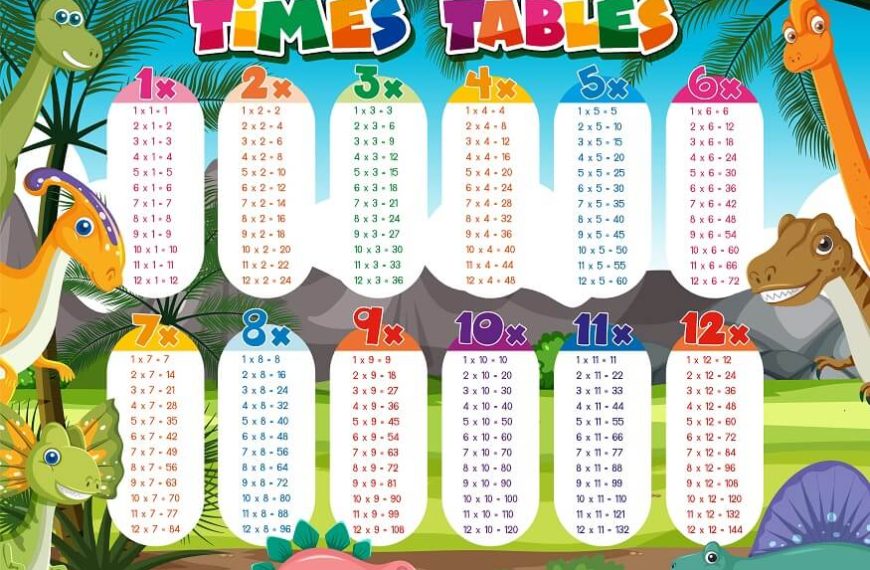
It is always helpful to have a visual guide to practice with at home. You can write this chart down on a piece of bright paper and stick it right onto your refrigerator. Encourage your child to point out the copycat numbers and practice the sandwich trick out loud!
- 11 x 1 = 11
- 11 x 2 = 22
- 11 x 3 = 33
- 11 x 4 = 44
- 11 x 5 = 55
- 11 x 6 = 66
- 11 x 7 = 77
- 11 x 8 = 88
- 11 x 9 = 99
- 11 x 10 = 110 (Just add a zero!)
- 11 x 11 = 121
- 11 x 12 = 132
Bringing the Math into the Real World
The best way to solidify these new skills is to show your child how these numbers exist in their everyday life outside of the classroom.
Do they love playing sports? Tell them that a standard cricket team has exactly 11 players on the field. Ask them, “If there are three cricket teams waiting at the park to play a tournament, how many players are there in total?” They will quickly smile and shout, “33 players!”
Are you at the grocery store? Point to a carton of eggs (which usually holds 12) and tell a funny story. “What if I wanted to buy a carton of eggs for 11 different neighbors?” Watch them use their new sandwich trick to proudly calculate 132 eggs right there in the shopping aisle.
Summary
Mathematics often gets a bad reputation. Many people view it as a cold, rigid list of rules that just have to be forced into our brains. But learning this specific set of numbers proves that idea completely wrong.
Numbers are not just cold symbols on a chalkboard; they are playful, deeply connected puzzles waiting to be solved. When children realize that math is entirely built on friendly shortcuts and beautiful, repeating patterns, their entire perspective shifts. They stop looking at a math worksheet as a terrifying test and start looking at it like a game. Giving a child these mental shortcuts does more than just help them pass a pop quiz; it builds an incredible foundation of academic confidence that they will carry with them for the rest of their lives.
To read more fun, engaging, and educational tips to help your child thrive, explore the EuroKids Blog, and visit our website for all the details on EuroKids Preschool Admission.
FAQs
1. What is the easiest way to memorize this specific times table?
The absolute easiest way is to teach the “Copycat Trick” for numbers 1 through 9. Once they know that 11 multiplied by any single digit is just that exact digit written twice, they already know 90% of the chart!
2. How can I explain 11 x 10 to a young child?
Tell them the “Zero Hero” rule. Any number multiplied by 10 just gets a superhero zero attached to its back. So, take the number 11, stick a zero on the end, and you instantly get 110.
3. At what age should kids start learning this chart?
Most children are ready to tackle this pattern around 7 to 8 years old, usually right after they have comfortably mastered their 2, 5, and 10 tables. Because the pattern is so visual, many kids pick it up incredibly fast!