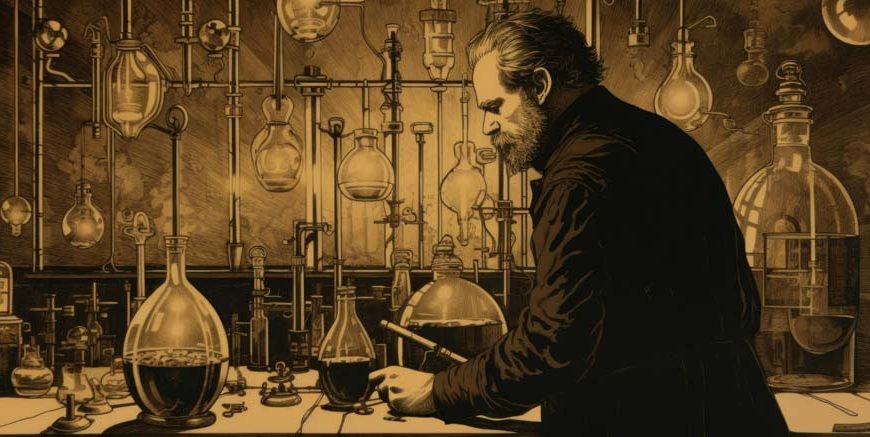
Imagine walking into a pitch-black room at night, reaching out to the wall, and flicking a small plastic switch. Instantly, the entire room floods with brilliant, warm light. We do this dozens of times a day, taking it entirely for granted. Yet, this simple everyday magic trick traces its roots directly back to a self-taught, highly curious genius from nineteenth-century London. If you are currently sitting there wondering who is Michael Faraday, you are about to be introduced to the man who quite literally handed us the keys to the modern world.
He did not come from a wealthy aristocratic family, nor did he possess a fancy university degree. However, his relentless, stubborn curiosity led to massive scientific breakthroughs that now power absolutely everything, from your kitchen fridge to the high speed trains we use to travel across the country.
The story of Michael Faraday: From Bookbinder to Scientist
When we start digging for facts about Michael Faraday, we uncover a brilliant tale of pure, raw determination. Born in 1791 to a poor blacksmith, young Michael received only the most basic, bare-bones school education. To earn a living and help his struggling family, he took up an apprenticeship as a local bookbinder. This hard labour actually turned out to be the luckiest twist of fate in scientific history.
Surrounded every day by piles of dusty, leather-bound books, he quietly read everything he was supposed to be stitching together, taking a massive interest in heavy encyclopaedias and complex science journals. This incredible journey forms the beating heart of any Michael Faraday essay in English: a young boy who literally read his way out of poverty. Eventually, he managed to secure a lowly job washing dirty test tubes and sweeping floors for the famous chemist Humphry Davy at the Royal Institution in London. He watched closely, he listened carefully, and he learned faster than anyone else in the building. This vital piece of Michael Faraday information in English shows growing children that passion, reading, and a willingness to work hard can unlock absolutely any door.
Read More – Famous Scientists and Their Inventions Explained
The Big Spark: Michael Faraday inventions electricity
Before this curious, self-taught bookbinder came along, electricity was mostly viewed as a fascinating, slightly dangerous party trick. Clever scientists knew exactly how to make bright sparks jump across a wooden table, but they had absolutely no idea how to properly control the power or make it do anything genuinely useful.
The real, historical turning point came directly with Michael Faraday inventions electricity. He was absolutely determined to figure out a clever way to make electricity do actual, heavy physical work. In 1821, he built a strange, messy little contraption using a strong magnet, a glass bowl filled with liquid mercury, and a dangling piece of copper wire. When he sent an electrical current running through the wire, it began to spin continuously in tight circles around the heavy magnet. This highly specific Michael Faraday discovery was the world’s very first electric motor. It proved once and for all that invisible, silent electrical energy could be safely transformed into continuous physical movement.
An Essential Michael Faraday inventions list
To truly grasp the sheer, overwhelming scale of his scientific genius, we need to look at a proper, detailed breakdown of his physical creations. If you search for basic Michael Faraday information, his endless list of achievements is genuinely staggering to read. Here is a clear, easy-to-read Michael Faraday inventions list that highlights his most crucial, world-changing work:
- The Electric Motor (1821): As mentioned, this was the very first device to successfully convert raw electrical energy into mechanical motion. Every time you turn on a cooling desk fan, a washing machine, or a modern electric car, you are relying on this exact piece of old technology.
- The Electric Generator (1831): Ten years after his motor, he cleverly figured out the reverse process. By moving a heavy magnet constantly inside a tight coil of copper wire, he created a steady, flowing current of electricity. This simple mechanical movement is still exactly how massive, roaring power stations generate the electricity that lights up our entire planet today.
- The Faraday Cage (1836): He built a wooden room coated entirely in shiny metal foil and blasted the outside with dangerous, high-voltage electricity. The metal skin safely guided the electrical charge completely around the outside, keeping the inside of the room perfectly safe. This is exactly why you are safe sitting inside a metal car during a terrifying lightning storm.
- The Rubber Balloon (1824): While studying different types of floating gases in his laboratory, he accidentally invented the first stretchy rubber balloon by pressing two thin sheets of raw rubber tightly together and dusting the inside with flour, completely changing children’s birthday parties forever!
Read More – GK Questions On Famous Inventions
?The Ultimate Michael Faraday contribution to Our World
The sheer volume of Michael Faraday inventions is deeply impressive, but his most profound gift to humanity was his brilliant ability to explain highly complicated things beautifully and simply. He did not use heavy, confusing mathematics because he never formally learned it at school. Instead, he used his incredible, visual imagination to actually “see” invisible forces.
He vividly imagined “lines of force” stretching out from magnets, completely changing how physicists understand magnetic fields today.
His ultimate “Michael Faraday contribution” was essentially handing humanity the physical keys to the modern electrical age. Without his relentless, messy tinkering in the laboratory, the thick cables delivering power to our homes, local schools, and massive hospitals simply would not exist. He also started the famous Christmas Lectures in London, a tradition of teaching exciting, explosive science to young children that still actively continues today.
Read More – How do you make science interesting for kids?
Conclusion
Looking back at the dusty, quiet London bookshop where it all originally began, it is genuinely thought-provoking to realise that a self-taught teenager with a stubbornly curious mind managed to permanently alter the course of human history. The quiet whirring of a remote-control toy car, the cooling breeze of a ceiling fan in the summer, and the bright, flashing lights of a modern city skyline are all echoing, daily tributes to his relentless experimenting. He beautifully proves that you do not need expensive laboratory equipment or a highly prestigious background to make a massive difference; you just need to ask the right questions and never stop reading the books sitting right in front of you.
Teaching growing children about these incredible historical figures perfectly bridges the gap between old, dusty history books and the flashing, modern gadgets they hold in their hands every single day. To explore more brilliant historical figures and discover highly creative ways to ignite your child’s natural curiosity, dive into the latest educational guides on the EuroKids Blog and secure their vibrant academic journey today via EuroKids Preschool Admission.
FAQs
Did Michael Faraday win a Nobel Prize for his discoveries?
No, he did not. The Nobel Prize was actually established in 1895, several decades after he passed away. Had the prize existed during his lifetime, his incredible contributions to physics and chemistry would have certainly earned him one!
Are Faraday cages still used today?
Yes, absolutely! The thick metal door of your kitchen microwave is a perfect everyday example of a Faraday cage. It is cleverly designed to keep the cooking waves safely trapped inside the box so they do not leak out into the room.
Why is a famous scientist known for inventing balloons?
While trying to safely store strange, floating gases for his chemistry experiments, he cut two round sheets of raw rubber, pressed the sticky edges tightly together, and dusted the inside with flour to stop them from sticking. He accidentally invented the very first stretchy party balloon to hold his gas!