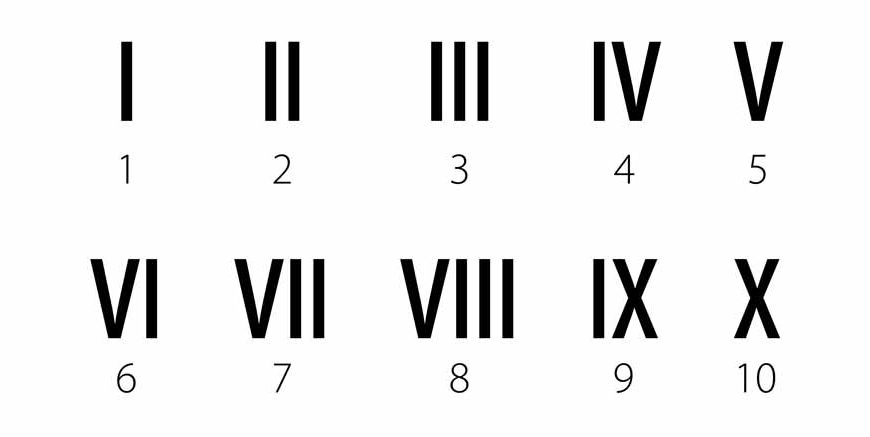
Imagine walking through a beautifully ruined stone castle or picking up an incredibly old, leather-bound adventure book from a dusty library shelf. As you turn the pages or look at the stone carvings, you might notice something quite peculiar. Instead of the familiar, curly numbers we use in our daily maths lessons, you see straight alphabet letters grouped together. These fascinating marks are not spelling mistakes; they are part of a brilliant, ancient counting system!
Thousands of years ago, the Romans created a special code to count their gold coins, measure their massive buildings, and keep track of the days. Today, we are going to become historical codebreakers. We will explore how this system works, specifically focusing on how to decode VIII, while also taking a quick look at the number just before it.
The Building Blocks of Roman Maths
To understand how to read this ancient alphabet code, we first need to look at the basic building blocks. The Romans did not have cheap paper or smooth pens, so they had to carve their numbers into hard stone or scratch them into wax tablets. Drawing curvy shapes like our modern 3 or 8 was incredibly difficult with a sharp chisel. Instead, they cleverly used straight lines.
For our counting adventure today, we only need to memorise two special letters:
- The letter ‘V’ stands for the number 5. A fantastic way to remember this is to hold up your hand, keep your fingers together, and stretch your thumb far out to the side. It makes a perfect ‘V’ shape!
- The letter ‘I’ stands for the number 1. It looks exactly like a single wooden tally stick or one person holding up a single finger.
Read More – Roman Numerals 1 to 20 Chart for Kids
Understanding What VII Means
Before we jump into our main number, let us take a tiny step back and look at the number that comes right before it: VII. If you have ever wondered what VII means, the secret lies in a very simple addition trick.
The Romans had a strict rule: if a smaller letter is placed directly after a bigger letter, you simply add their values together. Let us break down the maths for VII:
First, we start with our big letter ‘V’, which gives us a solid 5.
Next, we move to the right and find an ‘I’, which gives us 1.
Finally, we have another ‘I’, giving us another 1.
If we add them all together (5 + 1 + 1), we arrive at the number seven. So, if you are reading an exciting storybook and you reach Chapter VII, you know you are starting the seventh chapter!
Decoding VIII Roman Numerals
Now that we are expert addition detectives, figuring out how to write our main number is an absolute breeze. If we want to move one step higher than seven, we simply add one more tally mark to the end of our sequence.
When we look at VIII, we follow the exact same rule:
We start with ‘V’ (5).
We add ‘I’ (1).
We add another ‘I’ (1).
We add our final ‘I’ (1).
Add them all together (5 + 1 + 1 + 1), and we easily reach the number eight! Therefore, writing VIII is exactly the same as writing the number 8 in our modern, everyday numbering system.
But why do we stop here? Why not write VIIII for nine? The Romans had a very strict, golden rule for keeping their writing neat: you can never use the exact same letter more than three times in a row. Because of this brilliant rule, VIII is the absolute biggest number we can build using the ‘V’ and ‘I’ combination before the counting rules completely change!
Read More – Teaching Kids About Roman Numerals
Where Can You Spot VIII Today?
Even though the ancient empire faded away thousands of years ago, their clever counting system survived the test of time. You can still spot VIII hiding in plain sight all around us!
Look closely at the face of a traditional grandfather clock or a fancy wristwatch; you will almost always see VIII marking the eight o’clock hour. You will also find it in history books, proudly sitting at the end of a famous king’s name, like King Henry VIII of England, showing that he was the eighth ruler to share that specific royal name.
Conclusion
Learning to crack an ancient numerical code is a wonderful reminder that mathematics is so much more than just answering routine test papers in a classroom. It is a shared, continuous language that beautifully connects us to the people who lived hundreds and thousands of years ago. By understanding what VIII means, you are reading the exact same symbols that ancient builders, mighty emperors, and busy market traders used in their daily lives. It gently shows us that while the physical world constantly changes, human curiosity and our deep need to count, measure, and understand our vast universe always remains exactly the same.
To discover more fascinating historical facts and spark your child’s brilliant imagination, explore the EuroKids Blog and begin an incredible learning adventure with EuroKids Preschool Admission today.
FAQs
How do you write VIII in normal numbers?
In our modern numbering system, the Roman numeral VIII translates exactly to the number 8.
What does VII mean?
VII is the Roman numeral for the number 7, calculated by adding 5 (V) + 1 (I) + 1 (I).
Can I write VIIII to make the number 9?
No, you cannot! The strict rules of this system state that you can never put more than three of the exact same letters in a row.