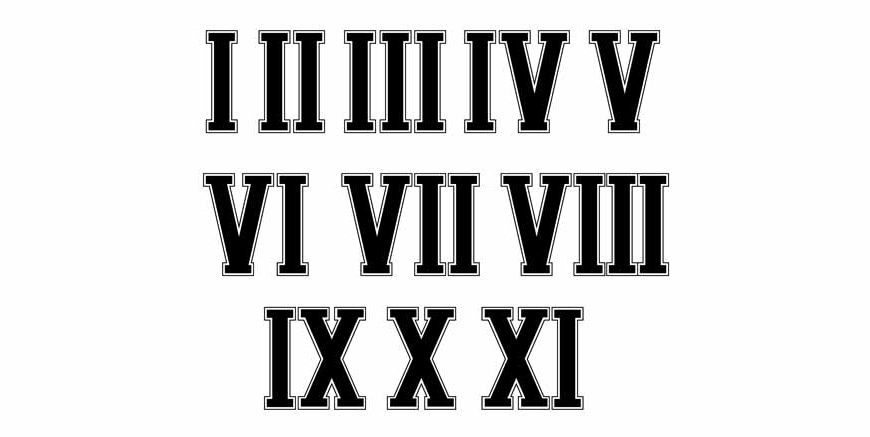
Have you ever stared at a massive grandfather clock in a hallway and wondered why the numbers look like a secret alphabet? Or perhaps you have noticed peculiar, straight letters marking the chapters of your favourite adventure storybook. These are not spelling mistakes; they are echoes from a magnificent, ancient empire! Thousands of years ago, long before we had our modern digits, the Romans invented a brilliant system to count their gold coins, measure their grand buildings, and trade in the bustling markets.
Today, we are going to become historical detectives. We will learn how to crack this ancient code, specifically focusing on roman numbers 1 to 30. It is exactly like learning a magical new language, but instead of forming words, we are building numbers. Get your detective magnifying glasses ready!
The Building Blocks of the Ancient Alphabet Code
To begin our counting adventure, we only need to memorise three special letters from the alphabet. Think of these letters as colourful building blocks. If you know what these three blocks mean, you can build almost anything.
- I stands for 1. It looks just like a single finger pointing up or a single wooden counting stick.
- V stands for 5. If you hold up your entire hand and spread your thumb and first finger far apart, it creates a perfect ‘V’ shape!
- X stands for 10. Imagine crossing two ‘V’s together, one pointing up and one pointing down, or simply crossing your arms in a strong ‘X’ shape.
Using just these three letters, we can easily build all the roman numbers 1 to 30. But just like any fun playground game, there are a few important rules we must follow to play correctly.
Read More – Roman Numerals 1 to 50
The Rules of the Game: Adding and Taking Away
The Romans were very clever, and they liked to keep their writing neat. Their biggest rule is that you can never put more than three of the exact same letters next to each other in a row. So, how do we count?
Adding up: When you put a smaller letter after a bigger one, you simply add them together. For example, VI is 5 + 1, which equals 6. If you want to make 7, you write VII (5 + 1 + 1).
Taking away: But what happens when we reach 4? We cannot write IIII because that breaks the strict rule of three! Instead, the Romans used a brilliant subtraction trick. If you put a smaller letter before a bigger one, you take it away. So, to write 4, you put an I before a V (IV). This literally means “one less than five.” The exact same trick works for 9. Instead of writing VIIII, you write IX, which means “one less than ten.”
Reaching the Top: Roman Number 30
Once you understand the rules of adding and subtracting, climbing the number ladder is an absolute breeze. If X is 10, then twenty is simply two tens placed side by side: XX.
But what about the final destination on our journey today? What is the roman number 30? Because we are allowed to use up to three identical letters in a row, we just place three tens together. Therefore, 30 is perfectly written as XXX. It is a wonderfully satisfying number to write, closing out our sequence beautifully before the maths rules change again for forty!
Roman Numbers 1 to 30 Chart
To help you on your historical adventure, here is a complete decoder chart. You can use this handy guide to practice your new skills. Try finding your age, your house number, or the date of your birthday in the chart below!
|
Number |
Roman Numeral |
Number |
Roman Numeral |
Number |
Roman Numeral |
|
1 |
I |
11 |
XI |
21 |
XXI |
|
2 |
II |
12 |
XII |
22 |
XXII |
|
3 |
III |
13 |
XIII |
23 |
XXIII |
|
4 |
IV |
14 |
XIV |
24 |
XXIV |
|
5 |
V |
15 |
XV |
25 |
XXV |
|
6 |
VI |
16 |
XVI |
26 |
XXVI |
|
7 |
VII |
17 |
XVII |
27 |
XXVII |
|
8 |
VIII |
18 |
XVIII |
28 |
XXVIII |
|
9 |
IX |
19 |
XIX |
29 |
XXIX |
|
10 |
X |
20 |
XX |
30 |
XXX |
Read More – Teaching Kids About Roman Numerals
Conclusion
Learning how to read this ancient system is so much more than just a simple maths lesson. It is a brilliant, invisible bridge connecting our modern world directly to the distant past. When you understand that writing XXX is exactly the same as writing the number thirty, you share a secret language with the emperors, builders, and children who lived thousands of years ago.
Even though their grand empire eventually faded away, their clever counting system survived the test of time, hiding in plain sight on our watches, clock towers, and in our books. Keep exploring these wonderful historical puzzles, and you will quickly realise that numbers are just as exciting as the greatest adventure stories ever told.
FAQs
What is the roman number 30?
It is written as XXX. This simply means three tens added together (10 + 10 + 10).
Why is the number 4 written as IV and not IIII?
The golden rule of this system states you cannot use the same letter more than three times in a row. Placing an ‘I’ before a ‘V’ means “one less than five.”
Did the Romans have a symbol for zero?
No, they did not! They only used numbers to count physical objects they could trade, so they never invented a letter for zero.