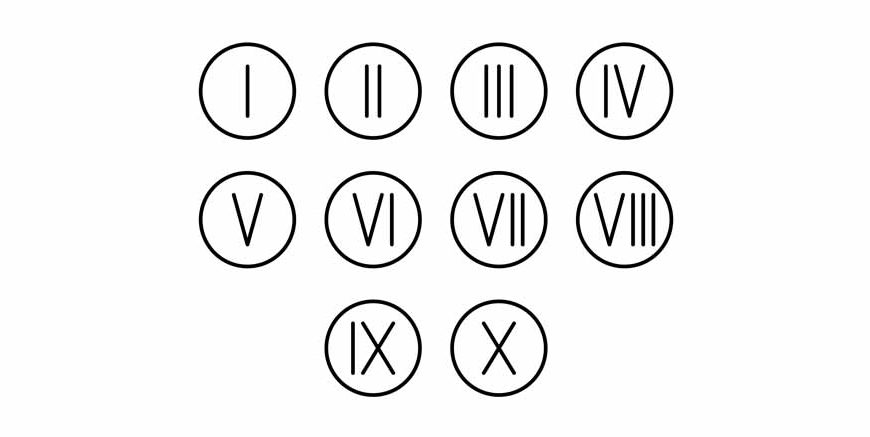
Have you ever looked closely at the face of a very old grandfather clock ticking away in a hallway, or perhaps peered at the shiny dial of a fancy wristwatch? If you have, you might have noticed something quite peculiar. Instead of the familiar, curved numbers we normally write in our school maths books, there are straight lines and crosses sitting elegantly around the dial. These fascinating marks are not random scratches; they are an ancient way of counting!
Today, we are going to explore one specific, highly important symbol you will frequently spot right at the very top of a traditional clock face. We are going to decode the XII symbol, learn exactly how it works, and discover why this ancient code is still so relevant to us today.
Why Did Ancient People Use Letters for Maths?
Before we figure out how to read this code, it is helpful to understand why it was invented in the first place. Thousands of years ago, the ancient Romans did not have cheap paper or smooth pens. Instead, they often had to carve their numbers into hard stone buildings or scratch them into soft wax tablets using sharp tools.
Because drawing round, curvy numbers like 2, 3, or 8 was incredibly difficult to carve smoothly, they decided to use straight alphabet letters instead. It was a brilliant, practical solution! This secret alphabet allowed them to count gold coins, measure large buildings, and keep track of the days, all by combining a few simple, straight lines.
Read More – The Importance of Math in Everyday Life
Decoding the XII Number
To understand how to read the XII number, we must first look at the basic building blocks of this ancient system. It is exactly like learning a fun puzzle or a secret spy code. For our special number today, we only need to memorise two specific letters:
- The letter ‘X’ stands for the number 10. A fantastic trick to remember this is to hold up both of your hands, spread your ten fingers wide, and cross your wrists to make a big ‘X’ shape!
- The letter ‘I’ stands for the number 1. It looks just like a single, straight wooden tally mark or one person holding up a pointing finger.
The XII Number Meaning and Mathematics
Now that we know our letters, how do we find the true XII number meaning? The Romans had a very clever, simple rule for reading their numerals: if a smaller letter is placed directly after a bigger letter, you simply add their values together.
Let us break down XII to solve the maths:
First, we look at our big letter ‘X’, which gives us a solid 10.
Next, we move to the right and find an ‘I’, which gives us 1.
Finally, we have another ‘I’, giving us another 1.
If we do a bit of simple addition (10 + 1 + 1), we easily arrive at the magical number twelve! Therefore, writing XII is exactly the same as writing the number 12 in our modern, everyday numbering system.
Spotting XII in the Real World
Why is twelve such a brilliant number for children to learn? Because it is secretly hiding everywhere around us!
When you look at a traditional analogue clock, XII always sits proudly right at the top centre. When the minute and hour hands point directly at the XII, it marks either the bright, sunny midday where we eat our lunch, or the dark, quiet midnight when we are fast asleep. Furthermore, there are exactly twelve months in our calendar year. So, when December finally arrives with its frosty mornings and festive cheer, it is technically the XII month! You might even spot this ancient number at the end of a famous king or queen’s name in a history book, showing that they were the twelfth ruler to share that specific royal name.
Read More – Teaching Kids About Roman Numerals
Conclusion
Learning to read ancient numerical codes is a wonderful reminder that mathematics is much more than just answering routine test papers. It is a shared, continuous language that beautifully connects us to people who lived hundreds and thousands of years ago. By understanding what XII means, you are reading the exact same symbols that ancient builders, mighty emperors, and busy market traders used in their daily lives.
It gently shows us that while the physical world completely changes, human curiosity and our deep need to count, measure, and understand our vast universe always remains the same. The next time you check the time or open a new chapter in a classic storybook, look closely; you are actually reading history! To discover more fascinating facts and nurture your child’s brilliant learning adventure, explore the EuroKids Blog and find all the details regarding EuroKids Preschool Admission today.
FAQs
What does XII mean in normal numbers?
In our modern Arabic numbering system, the Roman numeral XII translates exactly to the number 12.
How do you calculate the mathematical value of XII?
You calculate it by simply adding the individual values of the letters together from left to right: X (10) + I (1) + I (1) = 12.
Why is XII so common on clock faces?
Traditional analogue clocks are divided into twelve equal hours, so XII is traditionally used to mark the 12 o’clock position right at the top of the dial.