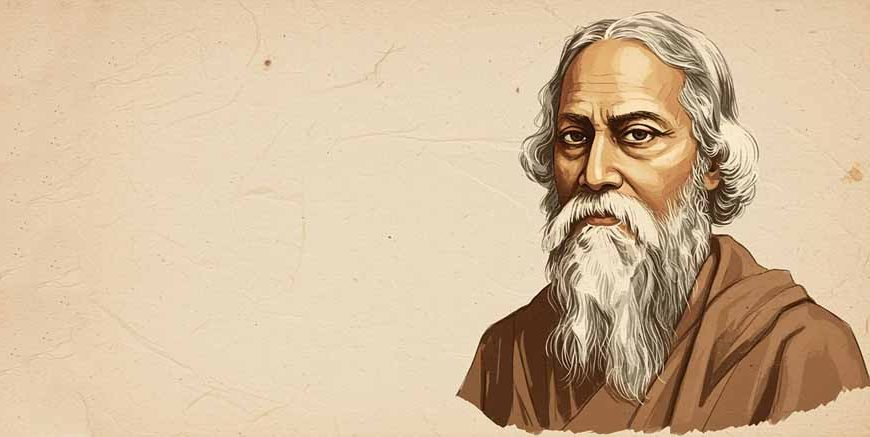
In today’s fast-paced world, you often find yourself looking for role models who can teach your children the value of creativity and deep thinking. You want your child to grow up with a sense of purpose, not just a set of grades. This is where the story of a visionary like Rabindranath Tagore becomes a vital lesson. When you share the life of the “Bard of Bengal” with your little one, you aren’t just teaching history; you are showing them how to see the world with wonder.
This blog provides a comprehensive Rabindranath Tagore essay, ranging from simple 10-line points for school assemblies to a deep dive into his life and philosophy. Whether you are a parent or a business professional seeking inspiration, this guide will help you understand the man who reshaped Indian culture.
Rabindranath Tagore History: A Legacy of the Renaissance
To understand the man, you must first look at the era that shaped him. The Rabindranath Tagore history begins in the heart of the Bengal Renaissance. Born on 7 May 1861 at the Jorasanko Thakur Bari in Kolkata, he was the youngest of thirteen surviving children. His family was at the forefront of a cultural awakening, hosting literary gatherings and musical recitals that filled their home with art.
His father, Debendranath Tagore, was a prominent philosopher and social reformer. Growing up in such an intellectual environment, young Rabindranath was exposed to the Upanishads, classical music, and literature from a very tender age. However, you might find it interesting that despite his brilliant mind, he loathed the rigid “factory-like” school system of his time. He often skipped classes to wander in nature, a habit that eventually defined his philosophy of learning without walls.
Rabindranath Tagore Biography: The Journey of a Global Icon
A detailed Rabindranath Tagore biography reveals a life of immense travel and intellectual curiosity. In 1878, he sailed to England to study law at University College London, but he soon realised his heart belonged to poetry rather than the courtroom. He returned to India and began publishing works that would eventually change the landscape of Bengali literature.
The turning point in his life came in 1913. You should know that he was the first non-European and the first Asian to receive the Nobel Prize in Literature. This honour was bestowed upon him for Gitanjali (Song Offerings), a collection of poems that mesmerised the West with its spiritual depth. Beyond his writing, he was a bold voice against colonial injustice. In 1919, he renounced his knighthood to protest the Jallianwala Bagh massacre, showing the world that his conscience was far more valuable than any royal title.
Read More – The Importance of Indian National Anthem in Our Culture
The Inner Voice: Autobiography of Rabindranath Tagore
If you wish to peek into his soul, you must explore the autobiography of Rabindranath Tagore, titled My Reminiscences (Jivansmriti). In these pages, he describes how he wrote his first poem at the age of eight. He vividly captures the loneliness of his childhood and the freedom he felt when he was allowed to learn through observation. This self-written account is essential for anyone who wants to understand how a “home-schooled” boy became a world teacher.
Essential Rabindranath Tagore Information for Every Student
When you look for Rabindranath Tagore information, few facts stand out as prominently as his contribution to national identities. He is the only person in the world to have composed the national anthems for two different countries: India’s Jana Gana Mana and Bangladesh’s Amar Shonar Bangla.
He was a man of many names. People affectionately called him “Gurudev,” a title given by Mahatma Gandhi. He was also known as “Kobiguru” (the Master of Poets) and “Biswakobi” (the World Poet). His vision led to the foundation of Shantiniketan in 1901, an experimental school where he sought to blend the best of Indian traditions with Western science. This school eventually grew into the world-renowned Visva-Bharati University.
Read More – Effective Essay Writing Tips for Kids
Masterpieces of a Polymath: Famous Works of Rabindranath Tagore
The works of Rabindranath Tagore are vast, spanning poetry, novels, short stories, and even paintings.
- Literary Giants: His novels like Gora and The Home and the World explore complex themes of nationalism and identity.
- Rabindra Sangeet: He composed over 2,000 songs that are still sung in every Bengali household today.
- Artistic Evolution: Remarkably, he began painting in his late 60s. His art was avant-garde and proved that your creative journey never really has an end date.
Essay on Rabindranath Tagore: 10 Lines, Short & Long Paragraphs
- Rabindranath Tagore was a famous Indian poet, writer, and philosopher born on 7 May 1861.
- He was the first Asian to win the Nobel Prize in Literature in 1913.
- He wrote the national anthems of India and Bangladesh.
- People gave him the title “Gurudev” because of his great wisdom.
- He started writing poems when he was only eight years old.
- He founded a unique school called Shantiniketan to teach children about nature.
- Tagore was a talented painter and composed more than 2,000 songs.
- He returned his knighthood to protest against British cruelty in 1919.
- His most famous book of poems is called Gitanjali.
- He passed away on 7 August 1941, leaving behind a legacy that inspires the world.
Read More – APJ Abdul Kalam Essay in English for Kids
Write a Short Note on Rabindranath Tagore (Paragraph)
A comprehensive Rabindranath Tagore paragraph must mention his role as a bridge between the East and the West. He was a polymath who believed that education should not be confined to a classroom. Through his writing, he introduced the beauty of Indian culture to the world while advocating for universal brotherhood. His vision of a world “where the mind is without fear” continues to be a guiding light for students and leaders alike.
Why Tagore’s Vision Lives on at EuroKids
At EuroKids, you will see a reflection of Tagore’s belief that learning should be a joyous, natural process. We understand that children are not vessels to be filled with facts but fires to be lit. That is why we follow the Heureka Curriculum, which focuses on “Visible Thinking” and nurturing the emotional and creative “EPICS” development of every child.
Just as Tagore wanted students to connect with their surroundings, our curriculum encourages your child to be a discoverer rather than a rote learner. By choosing EuroKids, you are ensuring your child gets a “Sahi Shuruaat” (Right Start) in an environment that values their individuality.
Conclusion: Start Your Child’s Journey Today
Understanding about Rabindranath Tagore in English is the first step toward appreciating the rich intellectual heritage of India. Whether you are teaching your child about his bravery or his books, his life offers endless lessons in curiosity and resilience.
We invite you to explore the EuroKids Blog section for more educational resources that help you navigate the beautiful journey of parenting. If you are looking for an environment that nurtures thinkers like Tagore, consider the EuroKids Admission process for the upcoming session. Visit your nearest centre to see how we are shaping the leaders of tomorrow.
Frequently Asked Questions (FAQs)
What is the most famous work of Rabindranath Tagore?
His most famous work is Gitanjali, for which he won the Nobel Prize.
What curriculum does EuroKids use?
EuroKids uses the Heureka Curriculum, which is inspired by Harvard’s Project Zero and focuses on visible thinking routines.
Is the EuroKids franchise profitable?
Yes, EuroKids offers a high-ROI business model with extensive operational and marketing support for partners.
Why did Tagore return his Knighthood?
He returned it in 1919 to protest against the Jallianwala Bagh massacre committed by British forces.