Children ask questions that adults often overlook. Where does rain come from? Why do clouds disappear? How does water reach plants again after flowing away? These questions may sound simple, but they point to one of the most important natural systems on Earth. When children do not receive clear answers early, science can start feeling confusing or disconnected from real life.
Learning about the water cycle helps children see science as a story that unfolds around them every day. It explains how the same water travels through the sky, land, rivers, and living beings without ever leaving the planet. Understanding what is water cycle gives children clarity, not just for exams, but for how nature stays balanced. This blog explains the water cycle in a way that makes sense to young minds, supports parents in guiding learning, and helps students build strong scientific foundations from the very beginning.
When children understand how water moves through nature, they begin to see connections between the sky, land, plants, and living beings. Learning what is water cycle helps them realise that water does not simply appear or vanish. It follows a continuous path that supports life on Earth. This blog explains the water cycle step by step, using simple language, clear examples, and meaningful explanations that children can relate to easily, while giving parents the confidence to support learning at home.
What Is Water Cycle: A Simple Explanation for Students
To understand science, children first need clarity. So, what is water cycle? The water cycle is the continuous movement of water from the Earth to the sky and back again. Water changes its form but never leaves the planet. It moves through air, land, rivers, oceans, plants, and living beings.
When the sun heats water in oceans, lakes, and rivers, the water rises into the air. Later, it comes back to the Earth as rain or snow. This movement repeats again and again. Children often find this idea fascinating once it is explained in simple terms. The water they drink today could have been part of a cloud or a river many years ago. This understanding builds curiosity and respect for natural resources.
Read More – Water Cycle for Kids
Water Cycle Definition in Everyday Language
A clear water cycle definition helps children remember the concept easily. The water cycle is the natural process through which water moves continuously between the Earth’s surface and the atmosphere.
This definition becomes meaningful when children connect it to daily life. The sun plays a major role in starting this cycle. Without sunlight, water would not move or change form. Teaching definitions in simple language allows children to recall them during exams while also understanding their meaning beyond textbooks.
What Is Water Cycle Short Answer for Quick Learning
Sometimes, children need a short and clear response for tests or oral exams. Here is a what is water cycle short answer that works well. The water cycle is the continuous process in which water moves from the Earth to the sky and back to the Earth through evaporation, condensation, and precipitation. Short answers help children build confidence and express ideas clearly without confusion.
Read More – How Rain Is Formed
Writing a Clear Water Cycle Paragraph
A water cycle paragraph helps children practise structured writing. It allows them to explain the concept in a few connected sentences while maintaining clarity. The water cycle is the movement of water between the Earth and the atmosphere. The sun heats water in rivers, lakes, and oceans, causing it to evaporate and rise into the air. This water vapour cools down and forms clouds through condensation. When clouds become heavy, water falls back to the Earth as rain or snow. This process repeats continuously and helps support life on Earth.
Water Cycle Explanation as a Natural System
A detailed water cycle explanation helps children understand that nature works as a system where everything stays connected. The cycle does not have a beginning or an end. It works continuously to supply fresh water to plants, animals, and humans. When children learn this, they also understand why rainfall patterns matter and why water conservation is important. They begin to see science as part of everyday life rather than as isolated facts to memorise.
Explain the Process of Water Cycle Step by Step
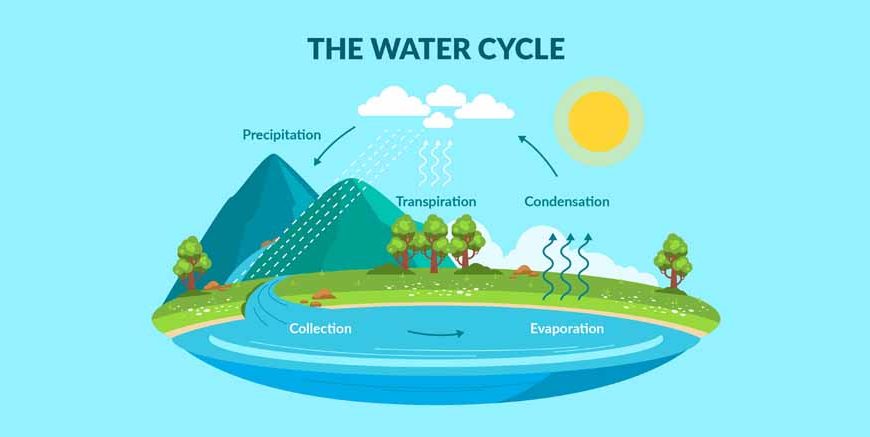
To truly understand science, children must be able to explain the process of water cycle clearly. The process happens in four main stages that work together. Evaporation occurs when the sun heats water in rivers, lakes, and oceans. The heat turns water into water vapour, which rises into the air. Next comes condensation. As water vapour rises, it cools down and forms tiny droplets that gather to create clouds. Precipitation happens when these droplets become heavy and fall back to the Earth as rain, snow, or hail. Finally, collection occurs when water gathers again in rivers, lakes, oceans, and underground sources. Each step connects smoothly to the next, forming a continuous cycle.
Read More – Essay on Save Water
Describe the Process of Water Cycle Using Real-Life Examples
When you describe the process of water cycle using familiar examples, children understand faster. Wet clothes drying under the sun show evaporation. Fog on a bathroom mirror shows condensation. Rain falling from dark clouds shows precipitation. Water flowing into rivers and lakes shows collection. These examples help children visualise the cycle instead of memorising it. Learning becomes natural and enjoyable when science connects with daily experiences.
Important Water Cycle Information Every Student Should Know
Some water cycle information helps children deepen understanding. Water on Earth remains the same amount. It only changes form. The sun drives the entire cycle. Plants also play a role by releasing water vapour into the air through a process called transpiration.
This knowledge helps children realise that water is precious and limited. When they understand this early, they develop responsible habits that last a lifetime.
Read More – Types Of Water Bodies
Interesting Facts About the Water Cycle
Facts often spark curiosity. The water you drink today may have existed millions of years ago. The same water keeps moving through the cycle again and again. Clouds do not store water forever. They release it back to Earth to keep the cycle balanced. Such facts make learning memorable and exciting for young minds.
Understanding the water cycle helps children respect nature. They learn that wasting water affects the balance of the environment. This awareness encourages mindful habits like turning off taps and using water carefully. Science education at an early age builds responsible citizens who understand their role in protecting natural resources.
Making Science Simple and Engaging at EuroKids
At EuroKids, children learn science through observation, discussion, and hands-on experiences. Complex concepts like the water cycle become easier when taught through stories, activities, and real-life connections. EuroKids follows the Heureka Curriculum, which focuses on experiential learning and helps children understand concepts deeply rather than memorising them.
Conclusion
Learning about the water cycle helps children understand how nature works and why water matters in everyday life. From short answers to detailed explanations, this topic strengthens scientific thinking, curiosity, and environmental awareness.
Choosing the right learning environment supports this growth. EuroKids Preschool Admission offers children a nurturing space where foundational concepts are taught with clarity and care. Parents can also explore the EuroKids Blog to find reliable learning resources and expert insights that support early education and holistic development.
Frequently Asked Questions
What is water cycle in simple words?
The water cycle is the movement of water from the Earth to the sky and back again.
Why is the water cycle important?
It helps provide fresh water and supports life on Earth.
How can parents explain the water cycle at home?
By using daily examples like rain, drying clothes, and clouds.
At what age should children learn about the water cycle?
Children can start learning basic ideas from preschool age.
How does the water cycle help the environment?
It keeps water moving and balanced in nature.