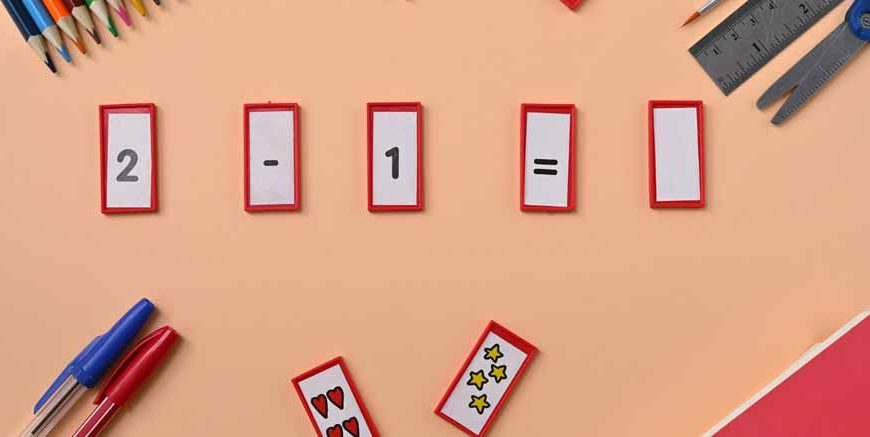
If you watch a child learn basic arithmetic, you will notice a distinct pattern. Addition usually clicks very quickly. Gathering toys, counting sweets, and stacking blocks are natural human behaviours. We like to accumulate things. However, the moment you ask a child to give some of those items back, the cognitive process shifts. Taking things away requires a completely different type of mental gymnastics.
Teaching math subtraction is the first time a young student has to think in reverse. It is a foundational skill that bridges simple counting to complex algebraic equations later in life. If you are a parent trying to help your child with their homework, or a student trying to grasp why fractions suddenly produce negative numbers, you need a clear, logical breakdown. We are going to strip away the confusion. We will explore the core vocabulary, visual strategies, and advanced examples to ensure this concept is never intimidating again.
The Core Subtract Definition
Let us start with the absolute basics. When people search for a substract definition (often misspelling the word “subtract”), they are looking for a simple way to explain a core concept. Subtraction is the mathematical operation of finding the difference between two numbers. It is the process of taking one quantity away from another.
Imagine you have ten apples in a basket. You take three apples out to bake a pie. The process of removing those three apples and counting what is left in the basket is subtraction. It tells you exactly how much smaller a quantity has become. Unlike addition, the order of your numbers is incredibly important. If you mix up the order, you completely change the answer.
Read More – Importance of Math in Everyday Life
Understanding the Vocabulary: Parts of Subtraction
Math is a language. If you do not know the vocabulary, you cannot read the sentence. A subtraction equation is built using very specific terminology. If you want to know how to subtract correctly, you must memorise the parts of subtraction.
Let us break down a simple equation: $10 – 4 = 6$.
- The Minuend: This is your starting point. It is the total amount you begin with before anything is removed. In mathematical terms, the number from which we subtract is called the minuend. In our example, the number 10 is the minuend.
- The Subtrahend: This is the portion you are taking away. The number which is subtracted is called the subtrahend. You will often hear teachers phrase it slightly differently, saying the number to be subtracted is called the subtrahend. Both mean the exact same thing. In our example, the number 4 is the subtrahend.
- The Difference: This is your final answer. It represents what is left over after the subtraction has taken place. In our example, 6 is the difference.
- The Symbol: The horizontal line that tells you to perform this operation is the subtraction sign, universally known as the minus symbol.
Visualising the Process: Subtraction on a Number Line
For visual learners, abstract numbers on a page mean very little. They need to see the movement. This is where the number line becomes your best educational tool. A number line is simply a straight horizontal line with numbers placed at equal intervals.
To solve an equation using this method, you always start by finding your minuend (the first number) on the line. Place your finger or pencil on that spot. Then, look at your subtrahend (the second number). This tells you exactly how many “jumps” you need to make. Because we are subtracting, we always jump backward, moving to the left.
If the equation is $8 – 3$, you place your pencil on the number 8. You then make 3 separate jumps to the left. One jump lands on 7, the second jump lands on 6, and the final jump lands on 5. Your stopping point is your answer. This method eliminates finger-counting and builds a strong mental map of numerical order.
Read More – Learning Math with Everyday Objects
Practice Exercises: Subtract the Following
Let us look at how these rules apply across different difficulty levels. When a test paper says subtract the following, you need to be ready for various formats.
Example 1: Basic Single Digits
Evaluate: $9 – 5$
- Identify the Minuend: $9$
- Identify the Subtrahend: $5$
- Action: Start at $9$, take away $5$.
- Difference: $4$.
Example 2: Double Digits with Borrowing
Evaluate: $42 – 17$
- Here, you cannot subtract $7$ from $2$ in the units column without getting a negative number. You must “borrow” a ten from the $4$ in the tens column.
- The $2$ becomes $12$, and the $4$ becomes $3$.
- Now, subtract $7$ from $12$, which gives you $5$.
- Subtract the remaining $1$ from the $3$ in the tens column, giving you $2$.
- Difference: $25$.
Advanced Math: Subtract 3/4 from 1/3
As students progress, they encounter fractions. The wording of fraction problems often tricks people. If a question asks you to subtract 3/4 from 1/3, you must arrange the equation correctly. The word “from” dictates the starting point. Therefore, $1/3$ is your minuend, and $3/4$ is your subtrahend.
The equation looks like this:
$$\frac{1}{3} – \frac{3}{4}$$
You cannot subtract fractions that have different bottom numbers (denominators). You must find a common language first, known as the Lowest Common Multiple (LCM). The LCM for 3 and 4 is 12.
First, convert the fractions so they both have 12 as the denominator.
$$\frac{1}{3} = \frac{4}{12}$$
$$\frac{3}{4} = \frac{9}{12}$$
Now, rewrite the equation:
$$\frac{4}{12} – \frac{9}{12}$$
Because you are taking away a larger number ($9$) from a smaller number ($4$), your answer will drop below zero. You subtract the top numbers (numerators) and keep the bottom number exactly the same.
$$4 – 9 = -5$$
Your final, mathematically correct answer is:
$$-\frac{5}{12}$$
This specific example shows why a deep understanding of the fundamental rules is so critical. If you do not know which number is the subtrahend, you will get the equation backward and fail the test.
Read More – What Is Sum for Kids?
The EuroKids Philosophy on Teaching Mathematics
At EuroKids, we firmly believe that mathematics should never be a source of anxiety. Traditional schooling often forces children to memorise formulas without understanding the logic behind them. We take a completely different approach.
We utilise the HEUREKA Curriculum, which is deeply inspired by Harvard University’s Project Zero. Our primary goal is to make a child’s thinking visible. When we introduce the concept of subtraction to early learners, we do not start with worksheets. We start with physical objects. We use blocks, sensory play, and active storytelling. A child might learn about the minuend by building a tower of ten blocks and physically taking three away to see what happens.
By making the mathematical process tangible and interactive, we remove the fear of making mistakes. We encourage our students to ask questions, explain their reasoning out loud, and understand the “why” behind the numbers. This builds incredibly confident problem solvers.
Your Next Step in Early Education
If you want your child to build a rock-solid foundation in logic, mathematics, and critical thinking, you need an environment that supports active discovery. The EuroKids Preschool Admission process is your gateway to a preschool network that prioritises deep comprehension over simple rote learning. We invite you to visit one of our centres and watch our educators bring these concepts to life.
For more resources on helping your child navigate their early academic milestones, we highly recommend exploring the EuroKids Blog. You will find a wealth of information designed to help you support their learning journey right from your living room.
Subtraction Summary
|
Term |
Definition |
Role in Equation |
|
Minuend |
The starting number. |
The total amount you have before taking anything away. |
|
Subtrahend |
The number to be subtracted. |
The exact amount you are removing from the total. |
|
Difference |
The final answer. |
What is left over after the math is done. |
|
Minus Sign |
The horizontal line ($-$). |
The symbol that tells you to perform a subtraction. |
|
Number Line |
A visual counting tool. |
Used by jumping backward to find the difference. |
Frequently Asked Questions (FAQs)
1. What is the difference between the minuend and the subtrahend?
The minuend is always the number you start with (the number you are subtracting from). The subtrahend is the number you are taking away. If you have $15 – 5 = 10$, $15$ is the minuend and $5$ is the subtrahend.
2. Why is subtraction on a number line helpful for kids?
It changes an abstract mental concept into a physical, visual game. Young brains process visual movement much faster than silent counting. Moving their finger backward on the line gives them a concrete way to find the answer without getting lost.
3. Does the order of numbers matter in subtraction?
Absolutely. This is called the commutative property, and subtraction does not have it. While $2 + 3$ is exactly the same as $3 + 2$, doing $5 – 2$ gives you $3$, but doing $2 – 5$ gives you $-3$. Order is everything.
4. How do you explain borrowing to a child?
Use the concept of money or base-ten blocks. Explain that if they need to pay $7$ coins but only have $2$ loose coins, they need to break open a ten-coin roll from the next column to get enough loose change to make the payment.
5. How does EuroKids introduce early math concepts?
Through our HEUREKA curriculum, we introduce math organically during play. Children group items, separate toys, and count physical objects daily. They learn the logic and vocabulary of math naturally through joyful engagement long before they are asked to solve equations on paper.