Did you ever notice a small puddle of rainwater completely disappear after the bright sun comes out? Or perhaps you poured yourself a glass of freezing cold apple juice, and suddenly, the outside of the glass got completely wet? Where does the puddle go, and where do those drops on your glass come from? It feels like a magic trick, but it is actually just amazing science happening right in front of your eyes!
Today, we are going to learn about two powerful forces of nature that move water all around our planet. We will explore how water completely changes its shape, how it travels up into the sky, and how it safely returns to the ground.
The Disappearing Act: Understanding Evaporation
Let us start with the first magic trick. When liquid water gets warm, it turns into an invisible gas called water vapor and floats right up into the air. This happens all around us every single day. If someone asks you for examples of evaporation in everyday life, you only need to look around your own house!
Here are 5 examples of evaporation that you probably see all the time:
- Drying clothes: Wet shirts and pants drying on a clothesline under the hot sun.
- Cooling tea: A hot cup of tea or soup cooling down as you watch the steam rise into the air.
- Cleaning the house: Mopping a wet kitchen floor and watching it dry up in just a few minutes.
- Sweating: When you run fast in the park, your body sweats. As the sweat dries up, it cools your skin down.
- Drying puddles: A small puddle on the street slowly vanishing after a heavy rainy morning.
Why is this useful to humans? If a science teacher asks you to give two applications of evaporation, you can tell them how it helps us make the food we eat. First, it is exactly how we get salt! Ocean water is trapped in shallow pools, the hot sun dries up all the water, and pure white salt is left behind for us to collect. Second, farmers use this exact method to dry and preserve fruits, like turning fresh grapes into sweet raisins so they last a long time without spoiling.
Read More – How Clouds Develop and Fascinate Kids
The Appearing Act: Understanding Condensation
Now, let us talk about the reverse trick: water appearing out of thin air. The basic condensation definition is when that invisible water vapor (gas) floating in the air cools down and turns back into actual liquid water drops.
The condensation process happens entirely because of a sudden drop in temperature. When the warm, invisible gas hits a freezing cold surface, it quickly loses all its heat, clumps together, and forms heavy water drops. This is exactly why your bathroom mirror fogs up when you take a hot shower, or why the windows of your car get completely foggy on a cold winter morning!
The Endless Loop: The Water Cycle
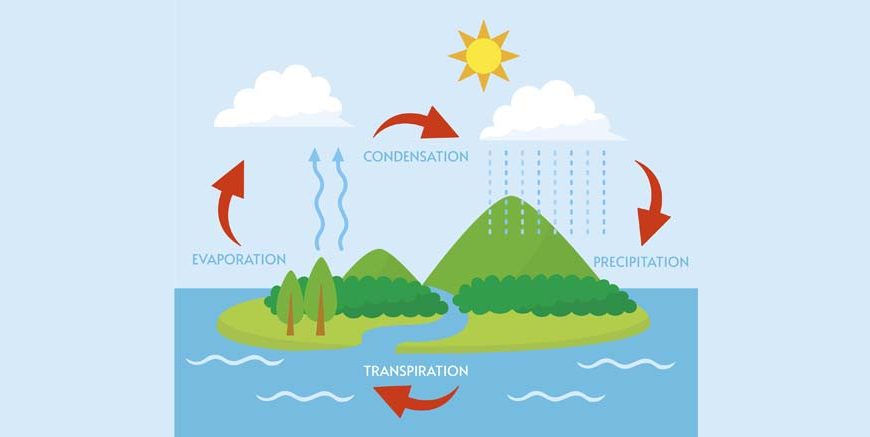
These two tricks work together as a perfect team to keep our entire planet alive and green. It is a giant, endless loop called the water cycle. This natural system relies perfectly on evaporation condensation and precipitation.
First, the hot sun heats up the oceans and rivers, making the water rise high into the sky as invisible gas (evaporation). High up in the sky, the air is freezing cold, so that invisible gas turns into fluffy white clouds (condensation). When those clouds get too heavy and full of water drops, the water finally falls back down to the ground as rain or snow (precipitation). It is a beautiful, never-ending circle!
Comparing the Two Opposites
To make it super easy to understand, let us put these two opposites side-by-side. Here is a simple table showing the main difference between evaporation and condensation.
|
Feature |
Evaporation |
Condensation |
|
What actually happens? |
Liquid water turns into an invisible gas. |
Invisible gas turns back into liquid water. |
|
Temperature needed |
It needs heat (the water gets warmer). |
It needs cooling (the gas gets colder). |
|
Where does it happen? |
Usually on the ground or the surface of the water. |
Usually high in the sky (clouds) or on cold surfaces. |
|
A quick example |
Wet hair drying after a bath. |
Morning dew drops on green grass. |
Read More – EVS Fun Facts For Kids
Learning Through Observation
At EuroKids, we love turning these big scientific ideas into fun, hands-on discoveries. Instead of just reading about how clouds form from a heavy textbook, we encourage children to carefully observe the world around them. Whether it is watching a boiling pot of water from a safe distance with their parents or drawing funny smiley faces on a foggy window, learning happens best when kids can actually see, touch, and question the science happening right inside their own homes.
Conclusion
Wrapping up, the journey of a single water drop is an incredible story of constant change. From turning into invisible gas to float up to the sky, to cooling down and falling back down as refreshing rain, water never stops moving. It is the ultimate recycling system of nature, keeping plants, animals, and humans completely healthy and hydrated.
The next time you drink a cool glass of water, just stop and think about it for a second. Because of this amazing endless cycle, that exact same water you are swallowing right now might have once been a cloud floating over a huge mountain, or even a muddy puddle a giant dinosaur stepped in millions of years ago! Nature simply keeps cleaning it and giving it back to us, over and over again.
To read more fun and educational articles, check out the EuroKids Blog, and visit our website for details on EuroKids Preschool Admission.
FAQs
What exactly is precipitation?
Precipitation is any water that falls from the clouds back to the ground. This includes normal rain, freezing snow, and hard hailstones.
Does evaporation only happen in the hot summer?
No, it happens all year long! Wet clothes will still dry in the winter, it just takes a little bit longer because the air is not as hot.
Why do my glasses fog up when I drink hot milk?
Your hot milk releases warm water vapor into the air. When that warm gas hits the cool glass of your spectacles, it cools down and forms tiny water drops.
Can we actually see water vapor?
No, true water vapor is a completely invisible gas. The white “steam” you see coming out of a hot kettle is actually tiny liquid water drops that have already started condensing in the cooler air!