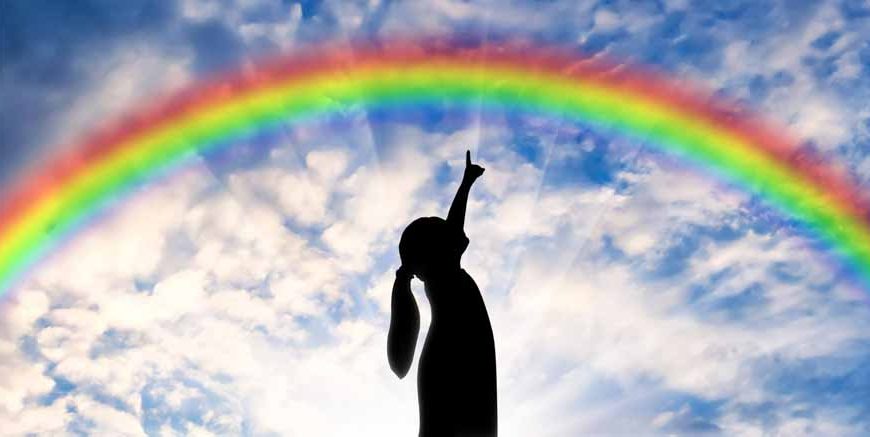
Imagine a dreary, wet Tuesday afternoon. The clouds have been weeping for hours, the air feels chilly, and the local playground is covered in massive, muddy puddles. Then, almost out of nowhere, the heavy clouds finally break apart. A brilliant, sharp beam of sunlight sneaks through the grey, and right there in the distance, a massive stripe of bright colours stretches across the horizon. It is one of those rare moments that makes toddlers drop their toys in the mud and adults pause their busy phone calls just to stare upward.
But what exactly are we looking at when we point up at the clouds? Is it a giant painted bridge? Is it some sort of solid object we could fly a helicopter through? Let us break down this beautiful puzzle, strip away the old fairy tales, and figure out the brilliant, everyday science behind those stunning colours.
The Magic Trick: what is a rainbow anyway?
At its absolute core, understanding this event starts with knowing that it isn’t a physical, solid object. You cannot touch it, you certainly cannot climb it, and you definitely will not find a pot of gold sitting in the mud at the end of it. When a curious child pulls your sleeve and asks what is a rainbow, the easiest way to explain it to them is as a giant, natural light show. It is an optical illusion created entirely by two very simple, everyday things: sunshine and falling water droplets.
We call this a rainbow natural phenomenon because it happens entirely on its own when the weather conditions are just right.
To our eyes, normal sunlight looks completely white or slightly yellow. But that white light is actually a tightly packed, hidden mixture of all the colours you can possibly imagine. When that beam of white light hits a tiny, round raindrop floating in the chilly air, the raindrop acts just like a tiny glass prism. It bends the sunlight, splits it apart into its separate colours, and bounces it straight back to our eyes. This bending and splitting of light is the fundamental rainbow concept that makes the whole spectacular show possible.
Read More – The Secret of The Rainbow Phoenix
The Perfect Setup: The sky and rainbow
You don’t just get these brilliant colours appearing randomly on any old sunny day. The relationship between the sky and rainbow is actually quite strict and demanding. For you to witness a stunning natural rainbow in the sky, you have to be standing in the exact right spot at the exact right time.
The sun absolutely must be shining directly behind your back, and the rain needs to be falling in the distance right in front of you. Think of it exactly like sitting in a dark cinema. The sun is the bright, glowing projector at the very back of the room, you are sitting in the audience watching, and the heavy rain is the massive screen at the front. If any of those three things are in the wrong place, if the sun is in your eyes, or if the rain is behind you, the movie simply won’t play, and the colours will not appear.
Looking Closely at the rainbow shape
Most children draw it as a bright, colourful half-circle or a painted bridge connecting two fluffy white clouds. But why does it actually look like that in real life? The rainbow shape is determined entirely by the clever mathematics of how light bounces inside millions of falling water droplets. Because all these tiny, floating water droplets are spherical, just like tiny glass marbles, they reflect the separated light back to your eyes at a very specific angle of exactly 42 degrees.
If a student asks their science teacher what is the shape of a rainbow called, the technical mathematical term is a circular arc. To a child, it looks exactly like a bent bow, the kind you use to shoot arrows in the woods, which is precisely where the old English name originally came from. It is essentially a curve of bent light stretching beautifully across the horizon.
Read More – Exciting Monsoon Activities for Kids
The Great Illusion: Spotting a full rainbow
Here is a brilliant secret that usually completely blows a child’s mind. That classic half-circle we all draw in our school notebooks with crayons is actually only half the story. The true, genuine shape of this weather event is a perfect, continuous circle! So why on earth do we only ever see an arch?
The answer is simple: the ground gets in the way. Because we are standing firmly on the earth, the horizon cuts off the bottom half of the circle from our vision. We only get to see the top half peeking bravely above the trees, hills, and houses. However, if you are incredibly lucky and happen to be flying high up in a commercial aeroplane, or if you are standing on the very edge of a massive, steep mountain when a rainstorm passes by below you, you might just spot a full rainbow. Seeing that complete, brilliant ring of floating colours suspended in the thin air is one of the most breathtaking, unforgettable sights on the planet.
Making Your Own at Home
You actually don’t have to wait for a heavy thunderstorm to see one. You can easily recreate the rainbow concept right in your own back garden on a warm weekend. On a bright, sunny afternoon, grab the garden hosepipe. Stand with your back to the sun, turn the tap on, and put your thumb tightly over the plastic nozzle to create a fine, misty spray of water.
Look closely into the mist hovering over the grass, and you will instantly see your very own miniature version of a natural rainbow in the sky. It works on the exact same scientific principles as the giant ones over the ocean, just on a much smaller, wetter scale. You will see the red band sitting proudly on the outside, going all the way down to the deep violet on the inside edge.
Read More – Science Quiz Questions and Answers for Kids
Conclusion
Every single time you stop to look at this beautiful burst of colour, you are experiencing something completely and utterly unique to you. Because the shape and the brightness of the colours depend entirely on the exact angle of your own two eyes, the person standing just a few steps next to you is actually seeing a slightly different version! It is a fleeting, deeply personal masterpiece painted by nothing more than light and water, reminding us to pause, look up, and appreciate the everyday magic hiding in our unpredictable weather. For more brilliant parenting ideas, engaging science facts, and to continuously nurture your child’s boundless curiosity, keep reading the EuroKids Blog and discover a world of joyful learning through EuroKids Preschool Admission.
FAQs
What makes the colours appear in the exact same order?
The colours always appear in the same order (Red, Orange, Yellow, Green, Blue, Indigo, Violet) because different colours of light bend at slightly different angles inside the raindrop. Red bends the least, so it sits on top, while violet bends the most and sits at the bottom.
Can you ever actually touch it?
No, you cannot. Because it is just an optical illusion made of reflected light, it has no physical substance. If you try to walk towards it, it will always seem to move further away from you.
What exactly is a double rainbow?
Sometimes, the sunlight bounces twice inside the falling raindrops before escaping. This double bounce creates a second, much fainter arc of light sitting just outside the main one, and the colours on the second arc are completely reversed!