You set a cut-glass tumbler down by the kitchen window on a clear morning, and a bright red, green, and blue patch suddenly appears across the breakfast counter. Your seven-year-old drops their spoon, stretches out their fingers, and tries to scoop the colours right off the laminate surface. When they ask you how the rainbow got trapped inside plain water, you might reach for a quick answer about shiny reflections or tell them to wait for eighth-grade science class. Most parents do that without thinking. Science in school textbooks often reads like a dry catalogue of ray paths and memorised definitions, which drains the fun right out of natural curiosity. You can change that narrative at home by using that morning ray of light to show your child how the physical world really works.
The Basic Idea of an Optical Prism
To answer your child without drowning them in textbook jargon, start with the core question: what is prism in physics? Put simply, an optical prism is a solid, clear piece of glass, plastic, or mineral cut with flat faces that lean toward one another at precise angles.
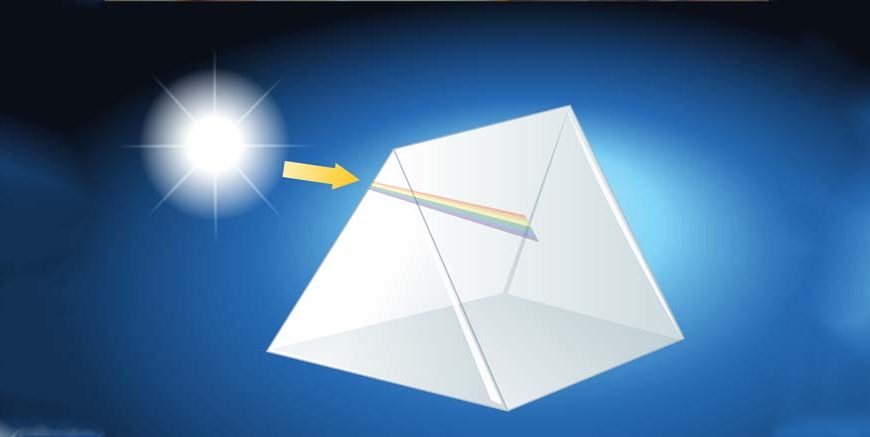
The front and back sheets of glass sit parallel to each other. When morning light hits a window, it slips through and carries on in virtually the same direction. An optical prism is shaped differently. Its polished sides slant toward each other, usually forming a triangle at the base. When a beam of daylight moves through open air, it travels fast, roughly three hundred thousand kilometres every single second. The moment that beam hits the thick glass of a slanted prism, it slows right down and changes direction.
Read More – Science Quiz Questions and Answers for Kids
Why White Sunlight Breaks into Rainbow Colours?
When a white sunbeam hits the slanted side of a glass block, the dense material slows each colour wave down by a slightly different amount. The tight violet waves get held up the most, so they take a sharp turn. The long red waves barely flinch, taking a much gentler turn. This separation is called dispersion. The angled glass unbundles the mixed beam, fanning it out across your wall into red, orange, yellow, green, blue, indigo, and violet.
Top 4 Uses of Prisms
1. Binoculars, Field Monoculars, and Periscopes
Optical prisms do a lot more than paint rainbow stripes across school science desks. Engineers put them inside sports optics to steer, fold, and flip light paths without adding extra bulk.
Submarines use the same internal bounce trick in periscopes so crews below sea level can view ships up on the water without sticking their heads out.
2. Traditional SLR Cameras and Viewfinders
The light bounces off the internal glass walls several times, correcting the reversed image before pushing it into the little rubber viewfinder. It gives you a clean, real-time look at what your lens sees without using any battery power. That is why wildlife trackers and sports photographers still stick with optical pentaprisms rather than relying solely on battery-hungry electronic screens that can lag when an animal darts through tall grass.
3. Medical Endoscopes and Modern Eye Exams
Doctors rely on tiny, micro-engineered prisms to examine sensitive internal organs without cutting patients wide open. When a physician checks a patient’s stomach lining or knee joint with an endoscope, miniature glass tips guide the path.
Optometrists use prisms in a completely different way during routine eye clinics. If a child suffers from strabismus, which families often call a squint, or complains of double vision, the eye specialist tests them using specialised plastic test prisms mounted in a frame.
4. Atmospheric Rainbows After Afternoon Rains
Sunlight enters the curved front wall of the drop, bends, bounces off the curved back wall, and bends a second time as it exits back into the humid air. Weather researchers also point specialised prism instruments at the open sky. By checking which subtle bands of colour get soaked up by passing air, scientists can measure regional smog, airborne dust, and humidity levels without having to send weather balloons up every afternoon.
Read More – Fascinating Science Facts for Kids
How EuroKids Sparks Early Scientific Thinking
EuroKids designs its early learning spaces around this kind of hands-on exploration. Instead of lecturing young toddlers on optical theory, teachers bring out child-safe acrylic shapes, tinted translucent paddles, and mirrors right onto the activity tables. Children shine small torches through transparent blocks, mix coloured panels to see blue and yellow make green, and watch rainbows trace across the nursery floor. By letting children handle physical materials and ask their own questions, EuroKids helps little learners develop real observation skills, patience, and the confidence to question how everyday objects work around them.
Conclusion
Looking closely at how prisms work reminds us that plain daylight holds plenty of surprises right in plain sight. An angled piece of glass does not manufacture red or green out of thin air; it simply exposes what was already packed inside the sunbeam from the start. Teaching your child how light bends and splits shows them that everyday things are rarely as simple as they first seem. When children learn to look past the surface and ask what makes things tick, they develop a sharp, curious mindset that stays with them long after their school years wrap up.
To read more practical guides on early childhood development and home activities, check out the EuroKids Blog, and get in touch with your local branch for friendly assistance with EuroKids Preschool Admission this season.
Frequently Asked Questions:
What does a basic glass prism do in school labs?
A glass prism demonstrates refraction by bending light at an angle and shows dispersion by splitting ordinary white daylight into separate colour bands.
Why do we only see rainbows when the sun is behind us?
You see a rainbow only when sunlight hits falling raindrops from behind you, reflecting the bent light rays back into your eyes at an angle of forty-two degrees.
Why does a flat glass window not show rainbow colours?
A flat window has parallel sides, so when light enters and exits, the bends cancel each other out, keeping the rays running in their original mixed path.
Which colour turns the sharpest corner inside an optical prism?
Violet light bends the most because it has the shortest wavelength and slows down more than any other visible colour when travelling through glass.