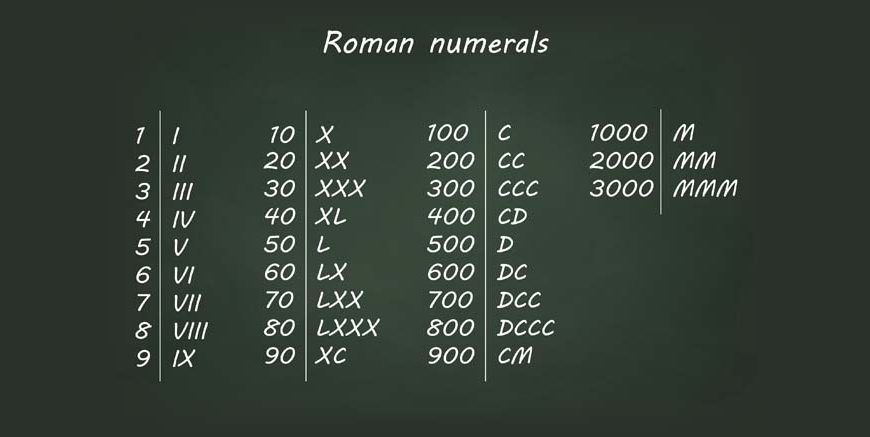
Roman numerals have been used for centuries to represent numbers symbolically. Even today, they are used in clocks, books, monuments, and official documents. Understanding Roman numbers 50 to 100 is crucial for students, educators, and anyone interested in learning about historical numbering systems.
In this article, we will cover how to write 50 in Roman numerals, the complete Roman number 50 to 100 chart, and practical examples in both Indian and international contexts. We will also answer common queries like what are the Roman numerals and how to write numbers like 51, 70, 90, and 100 in Roman numerals.
What Are the Roman Numerals?
Roman numerals are a numeral system originating in ancient Rome, using combinations of letters from the Latin alphabet to represent numbers. The basic symbols include:
|
Roman Numeral |
Value |
|
I |
1 |
|
V |
5 |
|
X |
10 |
|
L |
50 |
|
C |
100 |
|
D |
500 |
|
M |
1000 |
Example:
- 50 = L
- 100 = C
- 90 = XC
Read More – Teaching Kids About Roman Numerals
How to Write 50 in Roman Numerals
The number 50 in Roman numerals is written as L.
Quick Tips:
- L represents fifty.
- Numbers between 50 and 100 are created by combining L, X, and I.
Example:
- 51 = LI
- 55 = LV
- 60 = LX
Roman Number 50 to 100 Chart
Here is a complete Roman numbers 50 to 100 chart for easy reference:
|
Number |
Roman Numeral |
Number |
Roman Numeral |
|
50 |
L |
76 |
LXXVI |
|
51 |
LI |
77 |
LXXVII |
|
52 |
LII |
78 |
LXXVIII |
|
53 |
LIII |
79 |
LXXIX |
|
54 |
LIV |
80 |
LXXX |
|
55 |
LV |
81 |
LXXXI |
|
56 |
LVI |
82 |
LXXXII |
|
57 |
LVII |
83 |
LXXXIII |
|
58 |
LVIII |
84 |
LXXXIV |
|
59 |
LIX |
85 |
LXXXV |
|
60 |
LX |
86 |
LXXXVI |
|
61 |
LXI |
87 |
LXXXVII |
|
62 |
LXII |
88 |
LXXXVIII |
|
63 |
LXIII |
89 |
LXXXIX |
|
64 |
LXIV |
90 |
XC |
|
65 |
LXV |
91 |
XCI |
|
66 |
LXVI |
92 |
XCII |
|
67 |
LXVII |
93 |
XCIII |
|
68 |
LXVIII |
94 |
XCIV |
|
69 |
LXIX |
95 |
XCV |
|
70 |
LXX |
96 |
XCVI |
|
71 |
LXXI |
97 |
XCVII |
|
72 |
LXXII |
98 |
XCVIII |
|
73 |
LXXIII |
99 |
XCIX |
|
74 |
LXXIV |
100 |
C |
|
75 |
LXXV |
This chart is very helpful for students learning to convert numbers 50 to 100 into Roman numerals.
Read More – Roman Numerals 1 to 20 Chart for Kids
How to Write Numbers Between 50 and 100 in Roman Numerals
Numbers from 51 to 99 follow a combination of the basic Roman numerals L (50), X (10), and I (1):
- 51–59: L + I, II, III… IX
- 60–69: LX + I, II, III… IX
- 70–79: LXX + I, II, III… IX
- 80–89: LXXX + I, II, III… IX
- 90–99: XC + I, II, III… IX
Examples:
- 57 = LVII (50 + 5 + 2)
- 68 = LXVIII (50 + 10 + 8)
- 92 = XCII (100 – 10 + 2)
- 99 = XCIX (100 – 10 + 9)
Importance of Learning Roman Numerals
Educational Use
- Roman numerals are part of the school curriculum in India and globally.
- Helps students understand historical numbering systems.
Practical Applications
- Clocks and watches
- Book chapters
- Movie sequels (e.g., Star Wars IV)
- Monument inscriptions
- Legal documents
Example in Indian Context:
- A school’s annual report may label class sections as Class IX, Class X, and Class XI.
Fun Facts About Roman Numerals
- The largest numeral in Roman numbering is M = 1000.
- Roman numerals do not have a zero.
- They are still used in India for numbering rulers, kings, and centuries in history books.
- The abbreviation L for 50 comes from the Latin word “quinquaginta”, which means fifty.
Frequently Asked Questions
1. What is 100 in Roman numerals?
- 100 in Roman numerals = C
2. How to write 51 in Roman numerals?
- 51 = LI
3. What is the Roman number 70?
- 70 = LXX
4. How to write 90 in Roman numerals?
- 90 = XC
5. What is Roman fifty?
- 50 = L
Conversion Practice for Students
Try converting the following numbers to Roman numerals:
- 55 → LV
- 63 → LXIII
- 78 → LXXVIII
- 84 → LXXXIV
- 97 → XCVII
Why Roman Numerals Are Still Used
- They give titles, monuments, and clocks a classical or traditional look.
- Commonly used in India for legal documents, awards, and official government notifications.
- Helps students learn different numeral systems, which is useful for history, math, and general knowledge.
Example:
- The 75th Independence Day of India could be written as LXXV Independence Day.
Tips to Remember Roman Numbers 50 to 100
- L = 50
- C = 100
- X = 10
- Numbers 51–59: L + I to IX
- Numbers 60–69: LX + I to IX
- Numbers 70–79: LXX + I to IX
- Numbers 80–89: LXXX + I to IX
- Numbers 90–99: XC + I to IX
Memory Trick:
- Break the numbers into 50 + remaining digits for easier conversion.
How EuroKids Builds Strong Math Foundations
When mathematics is introduced through storytelling, real-life objects, and engaging hands-on activities, young learners understand concepts like addition and sums more naturally. This is why structured early education programs prioritise activity-based learning over rote methods.
At EuroKids, foundational math concepts are taught using playful learning materials, visual tools, and interactive number-based activities aligned with the HEUREKA curriculum. This approach ensures children experience math in a way that feels enjoyable and meaningful.
Ideas such as addition and understanding sums are reinforced through relatable, everyday situations so that children truly comprehend the concept rather than simply memorising it. With a child-focused, play-driven methodology refined over 20+ years and implemented across 1600+ preschools, EuroKids emphasises building confidence first, allowing speed and accuracy to develop gradually.
Practical Examples of Roman Numerals in India
- Clock faces: Many public clocks show hours in Roman numerals.
- Book chapters: School textbooks often label chapters using Roman numbers.
- Government Documents: Historical laws and notifications sometimes use Roman numerals for numbering acts.
- Sports Tournaments: Indian cricket tournaments or national competitions may use Roman numerals for editions.
Example:
- National Sports Championship LXXIII Edition (73rd Edition)
Conclusion
Learning Roman numbers 50 to 100 is simple once you understand the basics of L, X, and I. These numerals are not only important for academics but also have real-life applications in India and worldwide. Using the Roman number 50 to 100 chart provided above, students can easily convert, memorise, and use Roman numerals confidently.
Understanding Roman numerals enhances mathematical skills, historical knowledge, and general awareness, making it an essential skill for students and adults alike.
To explore more learning ideas, simple explanations, and early childhood resources, parents
can visit the EuroKids Blog. Those who wish to understand the preschool journey better or
explore enrolment options can find complete information on the EuroKids Preschool Admission
Page, where learning is designed to be joyful, engaging, and child-friendly.