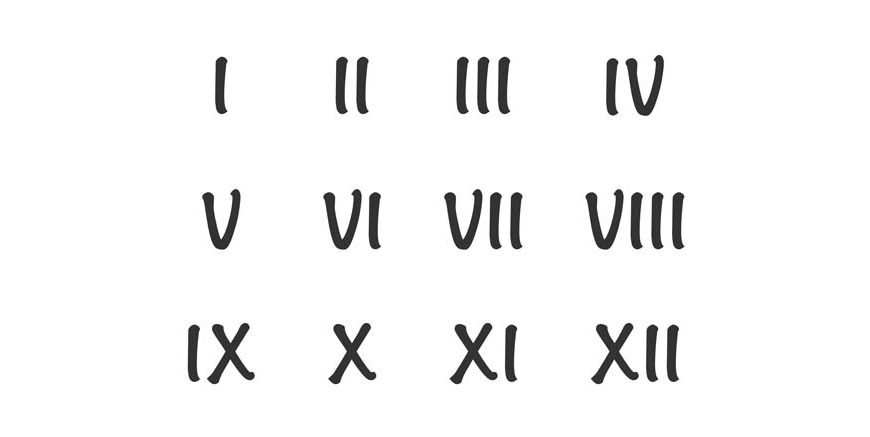
Next time you take a weekend stroll past a grand old library, a stone monument, or even a historic clock tower, take a very close look at the stonework. Instead of normal numbers marking the date it was built, you might spot a strange, straight row of capital letters. To anyone else, it just looks like a spelling mistake. But to a clever historian, it is a brilliant mathematical puzzle!
Thousands of years ago, the ancient Romans did not write their numbers the way we do today in our school maths books. They used their alphabet to create a counting system that is still hidden all over our modern world. Today, we are going to crack one of their more challenging codes. Grab your detective hat, because we are going to learn all about XCII, how it works, and how to write it in normal digits.
The Building Blocks of the Alphabet Code
Before we can solve a big puzzle, we need to understand the pieces. The Romans used a handful of specific letters to build their numbers, much like snapping together colourful plastic bricks. For our specific code today, we only need to memorise three important letters:
- C stands for 100. A fantastic trick to remember this is to think of the word ‘Century’, which means a hundred years. The Romans called it ‘Centum’.
- X stands for 10. Think of crossing your two hands together to make a big ten!
- I stands for 1. It looks exactly like a single, straight tally mark.
Now that we know our basic alphabet blocks, we can start to piece together the secret of XCII roman numerals.
Read More – Teaching Kids About Roman Numerals
The Clever Subtraction Trick: Decoding XC
The Romans liked to keep their writing as neat and short as possible. Because of this, they invented a very clever subtraction rule. If a smaller letter is placed directly before a bigger letter, it means you have to take it away.
When we look at the first half of our code: XC, we see the letter X (10) sitting right in front of the letter C (100). Because 10 is much smaller than 100, our secret rule tells us to subtract. If we take 10 away from 100, we are left with a solid 90.
Just like that, we have solved the hardest part of the puzzle!
Putting It All Together: XCII in Roman Numerals
Now we move on to the second half of our code, which is much easier. After the XC, we have two straight lines: II.
Because the letter ‘I’ stands for 1, putting two of them together simply means 1 plus 1. That gives us the number 2.
To find the final answer for XCII in roman numerals, we just add our two decoded parts together. We take our 90 (XC) and add our 2 (II). The grand total is 92! So, if you ever find an old, dusty treasure map that tells you to walk XCII paces towards a giant oak tree, you know you need to take exactly ninety-two steps.
Why Learn Ancient Numbers Today?
You might be wondering why we still learn about these old-fashioned letters when we have perfectly good numbers today. Writing the number 92 is incredibly fast, while writing XCII takes a bit more thought.
However, learning this ancient code is fantastic for a child’s developing brain. It teaches young learners to look for hidden patterns, practise mental maths, and follow logical rules. Plus, it is incredibly exciting! Understanding these numerals turns a boring history trip into an interactive treasure hunt. You can challenge your child to spot these letters on the back pages of their favourite storybooks, on the credits of old films, or on the faces of fancy watches.
Read More – Roman Numbers 50 to 100 Chart
Conclusion
Learning to read an ancient numerical system is a beautiful reminder that human history is completely connected. The exact same alphabet letters that ancient builders carved into colossal stone amphitheatres are the ones your child is decoding on their paper today. By understanding that XCII is just another brilliant, creative way to write the number ninety-two, young learners realise that mathematics is not just a rigid set of rules; it is a flexible, fascinating language that has travelled through thousands of years of history just to reach them. Keep encouraging this wonderful curiosity, and you will quickly find that numbers are hiding magnificent stories.
To uncover more joyful ways to learn and to actively support your child’s brilliant educational journey, explore the EuroKids Blog and find all the details you need about EuroKids Preschool Admission today.
FAQs
What number is XCII in normal digits?
It translates exactly to the number 92 in our modern Arabic numbering system.
Why is the letter X placed before the letter C?
The Romans used a subtraction rule to keep numbers short. Placing the smaller X (10) before the larger C (100) means you subtract 10 from 100, making 90.
What does the letter C stand for in this code?
The letter C stands for 100. It comes from the ancient Latin word ‘Centum’.