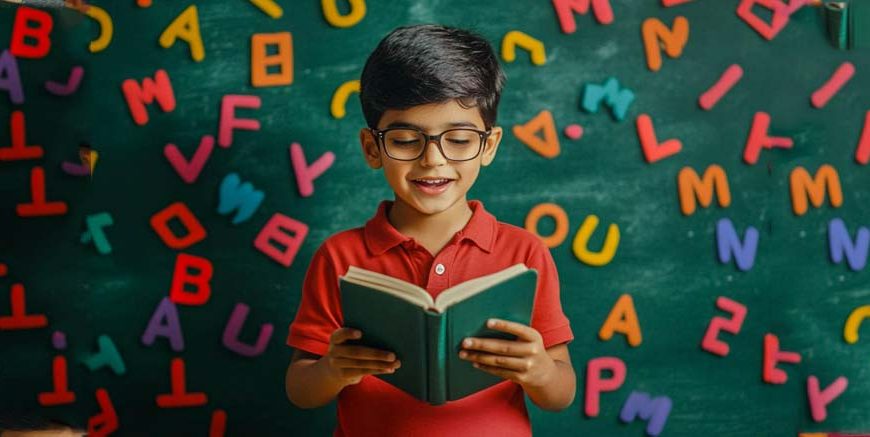
You might have noticed a familiar scene during story time. Your child looks at a page, points to a word, and looks up at you with a mix of hope and hesitation. They might guess “dog” because they see a picture of a puppy, even though the word on the page is “pet”. This guessing game is a common stage in early childhood, but it can also be a source of hidden anxiety for little ones. They realise there is a code they cannot quite crack yet. They want to read, but they don’t have the key.
That key is phonics.
It is not just about memorising the alphabet song. It is about understanding the mechanics of how language works. When a child learns phonics for kids, they stop guessing and start decoding. This shift from “I hope I am right” to “I know how to work this out” is where true confidence begins. This blog will walk you through why phonics is the secret weapon for early literacy, how you can support this journey at home with basic phonics for kids, and the simple games that turn learning into play.
The Secret Code: What Actually is Phonics?
Imagine trying to read a language where you have to memorise the shape of every single word. It would be exhausting. That is what reading feels like for a child who doesn’t know phonics. Phonics is the method of teaching reading by correlating sounds with symbols. It breaks the English language down into 44 sounds (phonemes) and the letters (graphemes) that represent them.
When we talk about phonics sounds for kids, we are teaching them that the letter ‘c’ is not just the name ‘see’ but the sound ‘k’ (as in cat) or ‘s’ (as in city). It transforms written text from a series of mysterious pictures into a logical puzzle. Once your child understands that words are made up of small sounds glued together, the intimidation factor of big books disappears. They realise that even a long word like “fantastic” is just a string of simple sounds: f-a-n-t-a-s-t-i-c.
Read More – Fun Phonics Sounds for Kids
From Anxiety to Authority: The Confidence Connection
Confidence in children comes from competence. When a child relies on memorising whole words (sight reading), their memory eventually gets full. They might know “cat” and “bat”, but get stuck on “mat”. This creates a fragile confidence that breaks as soon as they see a new word.
Phonics words for kids work differently. If your child knows the sounds for ‘m’, ‘a’, and ‘t’, they don’t need to have seen the word “mat” before to read it. They can build it themselves. This ability to attack new words independently is empowering. It gives them the authority to pick up phonics books for kids and navigate through them without constantly asking for help. They become the drivers of their own reading journey, rather than passengers waiting for you to read the signs.
How to Teach Phonics to Kids: A Parent’s Guide
You do not need to be a teacher to help your child master basic phonics for kids. The process is logical and moves through distinct stages.
1. Listening comes first
Before they even look at letters, children need to hear sounds. This is called phonological awareness. Can they hear that ‘sun’ and ‘sock’ start with the same sound? You can practice this anytime.
2. Matching sounds to letters
This is where you introduce the symbols. Show them the letter ‘s’ and make the snake sound “ssss”. Avoid adding an ‘uh’ sound to the end of letters (like saying “buh” for ‘b’). Keep the sounds short and crisp.
3. Blending and Segmenting
Blending is for reading; segmenting is for spelling. Blending means pushing sounds together (c-a-t becomes cat). Segmenting is pulling them apart (cat becomes c-a-t).
4. Tricky Words
Some words do not play by the rules (like ‘the’, ‘was’, or ‘said’). These just need to be learned by sight, but only after the foundation of decoding is laid.
Making it Fun: Phonics Games for Kids
Drills can be boring, but play is powerful. You can integrate phonics games for kids into your daily routine without it feeling like a lesson.
The Robot Talk Game
Pretend you are a robot who can only speak in broken sounds. Ask your child to pass you the “c-u-p” or “b-a-g”. They have to blend the sounds in their head to understand what you want. This is excellent practice for oral blending.
I-Spy with Sounds
Instead of saying “I spy something beginning with the letter B,” say “I spy something starting with the sound ‘buh'”. This helps them focus on the phonics sounds for kids rather than the letter names.
Sound Scavenger Hunt
Give your child a bucket and ask them to find three things in the house that start with the sound ‘t’. This connects the abstract concept of sounds to physical objects they can touch and hold.
Word Building with Magnets
Use magnetic letters on the fridge. Move the vowels (a, e, i, o, u) around to change “hat” to “hot” to “hit”. This visual representation helps them see how changing one symbol changes the whole sound.
Read More – Phonics Activities for Kids
Tools of the Trade: Worksheets and Books
While games are great, structured practice has its place. Phonics worksheets for kids can be very helpful for reinforcing letter shapes and sound matching. Look for worksheets that require the child to say the sound out loud as they write the letter. This multi-sensory approach (seeing, saying, doing) locks the learning in deeper.
When choosing phonics books for kids, look for “decodable readers”. These are books written specifically using only the sounds the child has learnt so far. They don’t contain surprise words that force the child to guess. Reading a whole book from start to finish without help is a massive confidence booster for a four-year-old.
The EuroKids Edge: The Heureka Curriculum
At EuroKids, we understand that learning to read is not a race; it is a developmental milestone that needs the right environment. We follow the Heureka curriculum, which emphasises “Mindful Learning”. This approach ensures that children absorb how to teach phonics to kids concepts at their own pace, moving from simple sounds to complex blending only when they are ready. We focus on deep understanding rather than rote memorisation, ensuring that your child develops a genuine love for language.
Conclusion
Building a confident reader does not happen overnight. It happens one sound at a time. By focusing on phonics for kids, you are giving your child a reliable toolset that will serve them for the rest of their academic lives. They won’t just be reading words; they will be understanding the structure of language itself.
Start small. Play sound games in the car. Read phonics books for kids together. Celebrate every time they decode a new word on a street sign or a cereal box. The goal is to make the code of English feel like a fun puzzle they are capable of solving.
If you are looking for a partner in this educational journey, EuroKids is here to help. Our experts understand the delicate balance between structure and play. We invite you to visit our website to learn more about EuroKids Preschool Admission and find a centre near you. For more tips on early childhood development, explore the EuroKids Blog section.
Frequently Asked Questions (FAQs)
1. What is the right age to start phonics for kids?
Most children are ready to start listening to sounds (phonemic awareness) around age 3 or 4. Formal phonics instruction usually begins around age 4 or 5, depending on the child’s readiness.
2. How is phonics different from the “whole language” approach?
Phonics teaches children to decode words by sound, while the whole language approach encourages children to recognise words as whole pictures or guess them based on context. Research generally supports phonics as the more effective method for early reading accuracy.
3. Where can I find good phonics worksheets for kids?
Many educational websites offer free resources. Look for worksheets that focus on CVC words (consonant-vowel-consonant) like ‘cat’, ‘dog’, or ‘sit’, as these are the building blocks of basic phonics for kids.
4. My child knows their alphabet but cannot read. Why?
Knowing letter names (Ay, Bee, See) is different from knowing letter sounds (ah, buh, k). To read, a child needs to know the phonics sounds for kids and how to blend them. Focus on teaching the sounds, not just the names.
5. What are “tricky words” in phonics?
Tricky words (also called sight words) are words that cannot be easily sounded out using standard phonics rules, such as “the”, “one”, or “was”. These phonics words for kids need to be memorised by sight.