Step outside and pick up a fallen green leaf from the dirt. Hold it gently by the stem and lift it up to the bright sunlight. At first glance, it just looks like a simple, flat piece of greenery. But if you look very closely at the tiny lines running across its surface, you will realize it is actually one of the most complex miniature factories on our entire planet.
While the deep roots pull water from the dark soil and the thick wooden trunk stands tall to provide heavy support, the leaf is the exact place where the real magic of nature happens. Today, we are going to take a magnifying glass to this tiny green machine. We will explore its hidden design, learn its specific vocabulary, and understand exactly how it manages to keep the entire world breathing safely.
A Closer Look: What Are The Parts Of A Leaf?
When a science teacher asks the class, what are the parts of a leaf, most young students simply point to the flat green surface and say, “That is the leaf!” However, a complete botanical leaf is actually made of several distinct sections working perfectly together as a team.
Breaking down the parts of a leaf for kids is much easier if we compare it to things we already know, like the plumbing pipes in our houses or the bones in our own bodies. Let us look at the main parts of a leaf so you can easily label them on your next biology drawing.
Read More – Exploring the Intricate World of Leaves
The Architecture: Parts of Leaf Structure
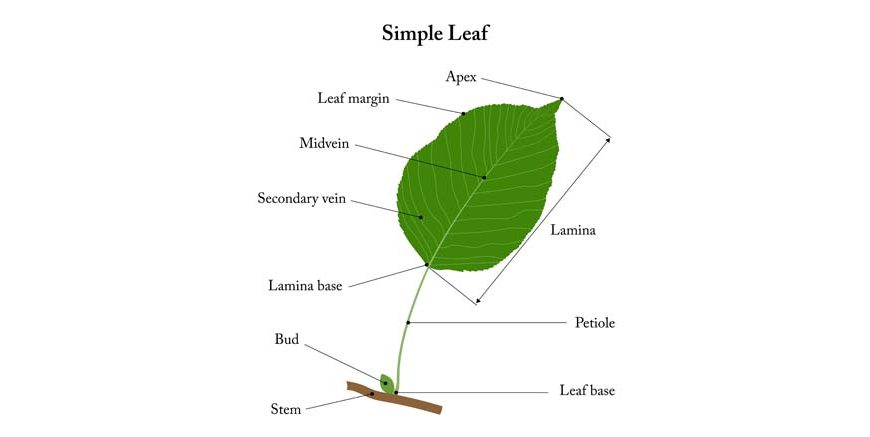
To fully understand the parts of a leaf and their functions, we need to examine the physical design from the bottom to the top. Every single curve and line has a very specific job to do.
1. The Petiole (The Connector)
This is the short, sturdy little stalk at the very base. It firmly attaches the leaf to the main wooden branch of the plant. Think of it as a strong arm holding a solar panel up to the sky. It twists and turns slightly to make sure the leaf is facing the direct sunlight.
2. The Lamina or Leaf Blade (The Solar Panel)
This is the broad, flat, green surface that everyone easily recognizes. It is wide and flat on purpose so it can catch as much sunlight as possible. The lamina is packed with a special green chemical called chlorophyll, which is exactly what gives plants their bright green color.
3. The Midrib (The Main Highway)
If you look at the center of the lamina, you will see a thick, straight line running from the bottom stalk all the way to the top tip. This is the midrib. It acts exactly like a human spine, keeping the leaf flat, strong, and supported so it does not flop over in the wind.
4. The Veins (The Plumbing System)
Branching out from the thick midrib are dozens of smaller, thinner lines called veins. These tiny tubes act like drinking straws. They carry fresh water and important minerals from the roots all the way to the edges of the leaf, and they carry the newly made sweet food back down to the rest of the plant.
5. The Margin and The Apex (The Edges)
The margin is the outside boundary or edge. Some margins are completely smooth, while others look like the sharp teeth of a saw. The apex is the very pointy tip at the top, which helps heavy raindrops slide off easily so the leaf does not rot.
6. The Stomata (The Tiny Doors)
You cannot see these with your naked eyes. If you use a microscope to look at the bottom surface of the leaf, you will find thousands of microscopic holes called stomata. They act like tiny windows that open and close to let air in and out.
Read More – How Water Travels Through Leaves
The Engine Room: Function of Leaves in Plants
Now that we understand the parts of leaf structure, we need to figure out what this factory actually builds. The function of leaves in plants is incredibly important. Without them, the plant would starve to death in just a few days.
Here are the three main jobs happening inside that flat green blade:
Making Food (Photosynthesis)
Plants do not have mouths, so they cannot eat sandwiches or drink milk. They have to cook their own food. They use their flat green lamina to catch sunlight. They use their tiny stomata to breathe in a gas called carbon dioxide from the air. Finally, they use their veins to pull water up from the roots. They mix the sunlight, the gas, and the water together to cook a sweet sugar called glucose. This amazing cooking process is called photosynthesis.
Breathing for the World (Gas Exchange)
When the plant cooks its sweet sugar, it creates a leftover waste product. That waste product is fresh oxygen! The plant opens its microscopic stomata doors and releases this pure oxygen back into the air. Every single time you take a deep breath, you are breathing the fresh oxygen that a green leaf just pushed out.
Sweating (Transpiration)
Just like humans sweat when we get too hot, plants also release extra water to stay cool. The extra water turns into invisible vapor and floats out through the tiny stomata. This constant upward pull of water helps the roots suck even more fresh water out of the dirt.
Read More – Types of Plants for Kids
Summary Guide
To make studying for your science test super simple, here is a quick table matching the physical structures to their daily jobs.
|
Part Name |
What It Looks Like |
Its Main Function |
|
Petiole |
The short, thick bottom stalk. |
Connects the leaf to the tree branch. |
|
Lamina |
The wide, flat, green part. |
Acts as a solar panel to catch bright sunlight. |
|
Midrib & Veins |
The thick middle line and small side lines. |
Acts as a plumbing system to carry water and food. |
|
Stomata |
Invisible, microscopic holes on the bottom. |
Acts as tiny doors to let air and water vapor pass through. |
Conclusion
To wrap up our botanical journey, a leaf is much more than just a piece of green decoration on a tree branch. It is a highly organized, hard-working structure. The sturdy petiole holds it up, the flat lamina catches the solar energy, the veins pump the water, and the tiny stomata breathe the air. Together, they perform the magical function of cooking food for the plant and providing fresh, clean oxygen for the rest of the planet.
As you walk to school tomorrow and see dry, crunchy leaves scattered across the sidewalk, it leaves you with a deeply thought-provoking realization. We often step on them without a second thought. But before that small leaf turned brown and fell to the ground, it spent its entire life quietly catching the sun, feeding a massive tree, and creating the exact invisible air keeping your lungs alive right now. It shows us that even the smallest, quietest things in nature carry the heaviest responsibilities in the world.
To read more fun and educational articles, check out the EuroKids Blog, and visit our website for details on EuroKids Preschool Admission.
FAQs
Why do leaves change color and turn yellow or red in the autumn?
When the weather gets very cold, the plant stops cooking food. The bright green chlorophyll naturally fades away, allowing the hidden yellow, orange, and red colors inside the leaf to finally show through!
Do all plants have a midrib and veins?
Yes, almost all of them do, but the patterns look different. A wide mango leaf has a net-like pattern of veins, while a long blade of green grass has straight veins running parallel to each other.
Can a plant survive if all its leaves are eaten by bugs?
If a hungry caterpillar eats a few of them, the plant will easily survive and grow new ones. But if all of them are destroyed at the exact same time, the plant will completely lose its ability to make food and will slowly die.
Why are the stomata holes mostly on the bottom instead of the top?
If the tiny holes were on the top, the hot, direct sun would quickly dry out all the water inside the plant. Keeping them safely hidden on the shaded bottom stops the plant from losing too much water.