Watch a toddler playing completely unsupervised in a muddy garden. Within ten minutes, they will inevitably pick up a massive, heavy tree branch and try to forcefully shove it into a tiny, plastic yellow bucket. They will push, twist, and show visible frustration when the wood simply refuses to fit inside the plastic rim. To an adult watching from the kitchen window, the physical problem is completely obvious. But to that child, it is a brand-new scientific puzzle.
They are actively testing the physical boundaries of their universe. Teaching the long and short rule isn’t just about passing a primary school test; it is about giving your child the exact vocabulary they need to understand why the branch won’t fit in the bucket. Let us skip the boring, rigid flashcards and dive into how early spatial awareness actually develops in a young brain.
The Long Short Concept
If you try to sit a three-year-old down at a desk and explain horizontal dimensions, they will stop listening to you in roughly four seconds. Young children do not understand abstract mathematical theory. They only understand what they can physically touch, drop, or bite.
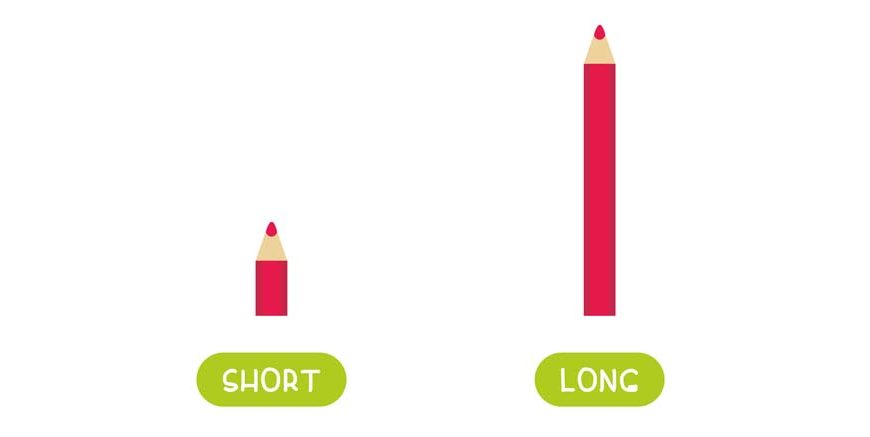
The core long short concept is fundamentally about comparing the horizontal distance between two points. However, kids frequently get this completely mixed up with ‘tall and short’. If you stand a ruler up vertically on a desk, a child might say it is tall. If you lay that exact same ruler flat on the floor, they need to understand that it is now long.
It requires a massive cognitive leap for a toddler to realise that the physical orientation of an object changes the specific descriptive word we use, even though the object itself hasn’t actually grown or shrunk. To teach this properly, you have to constantly demonstrate the difference using items laid flat on the floor or a table.
Read More – Measurement for Kids
Why Long Short For Kids Matters
You might wonder why we should spend an entire afternoon discussing the length of wooden building blocks or pieces of string. Introducing the idea of long short for kids is the absolute bedrock of early mathematical thinking.
Long before a child learns how to read the tiny, confusing millimetre markings on a plastic ruler, they need to master the art of visual estimation. They need to look at a gap between two sofa cushions and instantly judge if their toy car is too long to bridge the gap or short enough to fall straight through. This is the foundation of standard measurement, critical thinking, and logical categorisation.
The brilliant thing about the Heureka Curriculum is that it actively recognises this tactile learning process. Instead of forcing children to passively look at a flat picture of two caterpillars in a workbook, it encourages them to get their hands dirty, physically stretching out varying lengths of clay to see the mechanical difference for themselves.
Tactile Ways to Teach the Topic
Children are messy, physical learners. If you want them to genuinely understand the mechanics of length, you have to turn the lesson into a physical game. Start with something as simple as a family shoe lineup. Empty the hallway shoe rack and ask your child to place Dad’s massive winter boot directly next to their own tiny toddler trainer.
The stark visual contrast instantly makes the vocabulary click. You can also raid the kitchen cupboards. Pull out a piece of dry spaghetti and place it next to a single piece of macaroni. Let them physically run their small fingers down the smooth length of the spaghetti, and then tap the tiny macaroni. Another fantastic approach is the classic playdough snake. Hand them a lump of dough and ask them to roll the longest snake they possibly can.
Then, ask them to pinch off a tiny piece and roll the shortest snake they can manage. By physically forcing their hands to create the difference, the vocabulary permanently hardens in their memory.
Read More – What Are Some Fun and Educational Activities for Preschoolers?
Facts and Examples to Make Understanding Easy
Kids love odd trivia and clear, visual comparisons. Learning becomes significantly easier when they have funny, real-world anchors to attach the vocabulary to. Here is a list of brilliant facts and everyday examples designed specifically to help children grasp the idea of length:
Fascinating Facts About Length:
- It is completely relative: A pencil might look incredibly long when you put it next to a tiny paperclip, but that exact same pencil suddenly looks very short when you lay it next to a massive broom handle. Length always depends on what you are comparing it to!
- Animals use length to survive: The chameleon has a tongue that is often twice as long as its entire body, allowing it to snatch flies out of the air from far away. Meanwhile, a rabbit has a very short, fluffy tail that stays safely out of the way when it needs to sprint away from danger.
- We use the words for time too: We don’t just use these words for physical objects. We often talk about a “long” car journey to a holiday destination, or a “short” afternoon nap. This shows kids that distance can apply to minutes and hours just as much as it applies to ropes and roads.
Real-World Examples to Spot:
- The Shoelace Test: Look at a pair of adult boots with wildly long, looping laces that take ages to tie, compared to the short, quick velcro straps on a pair of toddler shoes.
- The Train Journey: A heavy freight train pulling fifty cargo carriages is incredibly long and takes minutes to completely pass by a railway crossing. A tiny, two-door smart car is very short and zips past in less than a second.
- The Haircut: Think about the physical difference between a lion’s massive, long, flowing mane and the very short, prickly hair on a hedgehog’s back.
- The Garden Hose: The green hosepipe curled up in the garden needs to be extremely long so it can reach all the way from the kitchen tap to the flowers at the very back fence. A toothbrush, however, is short so it can easily fit right inside your mouth.
- The Musical Instruments: A grand piano is a long, heavy instrument that requires a massive room, while a tiny harmonica is short enough to slip right into your front pocket.
Read More – Simple Preschool Activities For Learning At Home
Conclusion
Teaching basic spatial awareness completely shifts how a child interacts with their daily environment. When they finally grasp the physical rules of their surroundings, the world stops being a frustrating place where branches magically refuse to fit into buckets. Instead, it becomes a logical, highly predictable space that they can measure, sort, and conquer.
It is deeply thought-provoking to realise that we often rush to force young children to recite numbers and count to one hundred, long before we actually teach them the physical space and physical dimensions those numbers are meant to represent. Are we prioritising rote memorisation over actual, physical understanding?
Fostering that natural, messy, hands-on discovery is exactly how we build confident problem solvers who aren’t afraid to test the boundaries of their world. To uncover more fantastic ways to fuel your child’s daily development, dive into the EuroKids Blog and secure their exciting educational adventure today through EuroKids Preschool Admission.
FAQs
How do I know if my child understands the concept?
You will know they truly understand it when they start using the vocabulary naturally without you prompting them, such as complaining that their piece of chocolate is too short compared to their sibling’s piece!
At what age should children grasp this mathematical idea?
Most children begin to actively understand and use comparative words for length around the age of three or four, especially if they are frequently engaging in physical, sorting play.
What happens if my child keeps confusing length with height?
This is totally normal and happens all the time. Simply correct them gently by placing the objects flat on the floor to demonstrate length, and standing them upright to demonstrate height until the visual difference clicks.