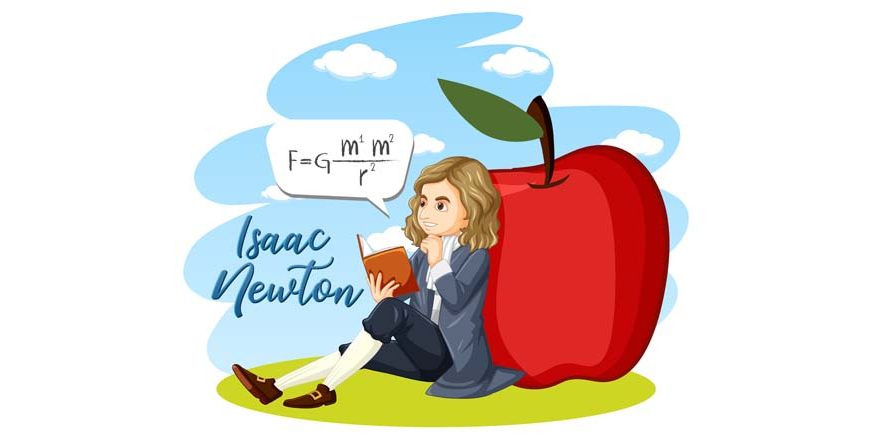
The small red apple slips from the tree branch and drops straight to the grass below with a quiet thud. Your young child watches it fall, picks it up, and takes a giant bite without thinking twice. To a seven-year-old child, things falling down is simply how the world works. Rain drops down from the clouds, toys fall to the living room carpet when dropped, and loose pencils roll off the edge of the study table. Yet, this everyday occurrence hides a massive scientific secret that completely puzzled the greatest minds in history for centuries. When a primary school teacher asks your child to write a short report or answer science questions about forces, children often struggle to connect these everyday household movements to the grand laws of nature.
Breaking down a massive national scientific legacy into a relatable story transforms a boring homework session into a thrilling exploration of the universe. This detailed guide offers parents the perfect tools, clear timelines, and basic concepts to help their youngster understand the life of the man who decoded the universe.
Who is Newton?
Sir Isaac Newton stands out in world history as one of the most influential mathematicians, physicists, and astronomers to have ever lived on our planet. He spent his entire life looking closely at ordinary objects to figure out exactly how the universe operates. Before his major discoveries, people believed that objects moved because of magical properties or hidden spirits. He completely changed human thinking by proving that everything in nature follows a strict, predictable set of mathematical rules. In standard primary school classes across India, students learn these basic principles to understand how trains move on tracks, why cricket balls soar into the sky, and how heavy ships float safely on ocean waters.
Read More – Famous Scientists and Their Inventions Explained
The Master of Motion: Essential Isaac Newton Information
He did not limit his curiosity to falling apples alone; he studied light, built advanced machinery, and created entirely new mathematical systems to solve complex problems.
One of his most famous experiments involved using a simple triangular glass prism in a dark room. He let a thin beam of white sunlight pass through the glass block and watched in amazement as it split into a vibrant rainbow of seven distinct colours. This single experiment proved to the world that white light is actually a beautiful mixture of red, orange, yellow, green, blue, indigo, and violet rays. Aside from his work with light, he also invented a brand-new type of magnifying telescope that utilised smooth, curved mirrors to look deep into space, allowing astronomers to see distant planets with spectacular clarity.
Exploring the Inspiring Details About Isaac Newton
He grew up as a very quiet, lonely, and observant boy on a small farm in England. He did not perform well in his initial school classes, and his teachers often scolded him for being completely absent-minded during lectures.
His life took a major turn when a deadly disease called the Great Plague broke out in London, forcing his university to close its doors for safety. He had to return home to his countryside farm for a long period of two years. Instead of wasting his time or feeling bored, the young scholar sat in his garden, observed nature, and did some of his most legendary thinking.
Read More – GK Questions On Famous Inventions
When Was Isaac Newton Born?
He officially came into the world at Woolsthorpe Manor, a small stone farmhouse in the county of Lincolnshire, England. According to the older Julian calendar used in England at the time, he was born on Christmas Day, 25 December 1642. However, the rest of Europe used a different, more accurate calendar system called the Gregorian calendar. When England finally switched to the modern calendar system years later, his official birth record was retroactively adjusted by 10 days.
Turning Science into Active Playtime Games
You should completely avoid forcing your young child to memorise physics formulas through dry repetition or endless textbook reading. Mechanical drills quickly drain the joy out of learning and cause young minds to lose interest in science altogether. Instead, you can smuggle his laws of motion into your regular evening playtime using simple, active challenges.
- Try a quick game of Marble Clash on your smooth living room floor. Let your child roll marbles of different sizes against each other to see how weight changes speed, directly demonstrating his second law of motion.
- You can also build a simple cardboard ramp and slide toy cars down the tracks, using different surfaces like rough towels or smooth paper to show how friction acts as an outside force.
These playful interactions remove all the academic pressure, helping your youngster absorb core scientific truths naturally through family bonding and laughter.
Read More – How do you make science interesting for kids?
How EuroKids Fosters Scientific Curiosity
Before young students ever enter a primary school classroom to write essays about historical figures, their basic observational pathways are already developing during their preschool years. EuroKids structures early childhood spaces to ensure that toddlers explore the natural world through sensory games, active outdoor play, and fun science experiments. By providing a beautifully balanced curriculum that encourages children to ask questions about light, shadow, gravity, and movement, the preschool setup builds high cognitive confidence. This early hands-on exposure ensures that your child’s brain can handle advanced abstract concepts and historical biographies with ease as they move into higher classes.
Conclusion
The journey of the boy from the Lincolnshire farm teaches us that great discoveries do not require magical powers; they require patience, steady observation, and a genuinely curious mind. From tracking the path of a falling apple to splitting sunbeams with a glass prism, his life shows children that the entire universe operates like a beautiful, logical puzzle waiting to be solved. True personal growth happens when you take these historical lessons from the notebook page and apply them by closely observing the movements, forces, and changes in your daily environment. Keeping your mind awake to the secrets of nature ensures that you grow into a sharp thinker and a capable problem solver.
For more down-to-earth advice on early childhood milestones and cognitive growth strategies, feel free to read through the EuroKids Blog and discover how to start your child’s educational journey on the right path today with EuroKids Preschool Admission.
Frequently Asked Questions
1. Did an apple really fall directly on Isaac Newton’s head?
No, the apple did not actually hit him on the head. He simply sat in his orchard garden and watched an apple fall straight to the ground, which made him wonder why objects always fall downward rather than float sideways or fly upward into the sky.
2. What is the name of the famous book that he wrote?
He wrote a legendary scientific book in Latin called Philosophiae Naturalis Principia Mathematica, which people usually call the Principia for short. This book contains his detailed mathematical formulas for gravity and motion.
3. Why did the King of England turn him into a Knight?
Queen Anne officially knighted him in 1705 for his significant contributions to science and mathematics and his valuable public service as Master of the Royal Mint, where he oversaw the nation’s currency.
4. How can I explain the concept of gravity to a Class 2 student?
Tell your child that gravity acts like a giant, invisible magnet hidden deep inside the Earth. This invisible force gently pulls every single object, person, and vehicle down toward the ground, keeping our feet planted safely on the floor instead of floating off into space.