Have you ever accidentally dropped a heavy toy on your toe and wondered why it fell straight down to the floor instead of magically floating up to the bedroom ceiling? Or have you ever stared out of the window at the bright, glowing moon and seriously questioned why it stays perfectly up there in the dark night sky? Hundreds of years ago, a very quiet, deeply curious boy asked these exact same questions about his surroundings. He grew up to become the legendary Newton scientist who completely changed how human beings understand the entire physical universe. Today, we are going to travel back in time to uncover his deeply fascinating story, exploring how his brilliant mind worked and how his ancient ideas still heavily shape our highly modern world.
Early Life and Education of Issac Newton
To truly understand the genius of the man, we need to look closely at a brief biography of Newton. Born in a tiny, quiet English village on a freezing Christmas Day way back in 1642, Isaac was actually a very small, frail baby. Growing up on a muddy, working farm, he was incredibly different from the other local boys. While they were busy playing rough games in the fields, he preferred spending his afternoons building tiny, complex wooden windmills, clever water clocks, and intricate sundials.
When we examine the early history of Isaac Newton’s education, we surprisingly see that he was not always the top student in his classroom. He frequently day-dreamed. However, he possessed a fierce, burning curiosity that eventually earned him a place at the world-famous University of Cambridge. His biggest influences were not actually his classroom teachers, but rather the great, heavy books written by earlier pioneering astronomers like Galileo. He loved quietly reading about how the planets moved through space, which sparked a massive, unstoppable fire in his young, developing imagination.
Read More Famous Scientists and Their Inventions Explained
The Famous Apple and Gravity
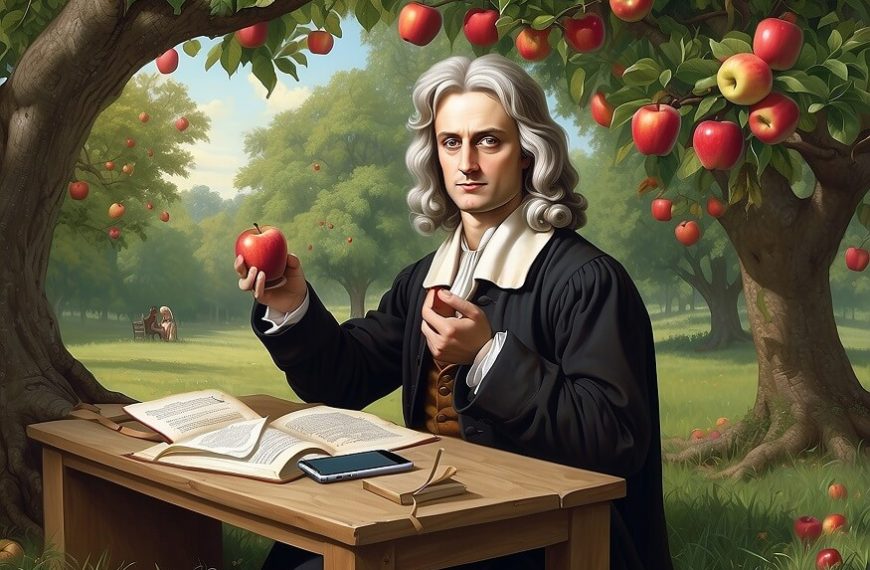
The most popular historical story says that during a terrible plague, he had to leave his university and return to his quiet family farm. One sunny afternoon, he was sitting peacefully under a leafy apple tree in his garden when a ripe apple suddenly fell down and hit the ground.
While the cartoon version of the apple hitting him directly on the head might be a slight myth, watching those falling apples truly made his brain work overtime. He suddenly realised that the exact same invisible, pulling force that dragged the heavy apple down to the grass was also reaching far, far out into dark space, holding the massive, heavy moon securely in its circular orbit around the Earth. This massive, world-changing contribution by Isaac Newton is exactly what we now call the universal law of gravity. You can easily explain this to a young child: gravity is the Earth’s invisible superpower that physically pulls everything towards its centre, which beautifully explains why we do not randomly float off our kitchen chairs into the sky.
Brilliant Inventions and Light
Beyond his legendary work with invisible gravity, he was also a brilliant, highly practical builder. When we look closely at Sir Isaac Newton’s inventions, his groundbreaking work with light is truly magical for young kids to understand. Before he came along, most smart people truly believed that white sunlight was just plain, boring, and completely colourless.
He decided to test this theory. He set up a completely dark room, let a tiny, thin beam of sunlight shine through a small hole in the thick curtains, and passed that light through a triangular piece of clear glass called a prism. Suddenly, a bright, beautiful rainbow splashed loudly across his bedroom wall! He definitely proved that white light is a tightly packed mixture of all the colours of the rainbow. Because he understood exactly how light bends, he also invented a brand-new type of telescope. Instead of using thick, heavy glass lenses that made distant stars look blurry, he cleverly used curved mirrors. This reflecting telescope was much smaller but far more powerful, changing astronomy forever.
Read More How do you make science interesting for kids?
A List of Remarkable Achievements
Writing the Principia:
He wrote a massive, highly complex book titled Principia Mathematica. Inside this huge book, he laid down the three basic laws of motion. For example, his laws explain that a rolling football on a pitch will keep rolling happily until the thick grass slows it down, and that pushing a heavy playground swing makes it swing back with the exact same force.
Inventing Calculus:
He literally had to invent a completely new, incredibly difficult branch of complex mathematics just to prove his own theories about how the planets smoothly move through space.
Receiving Historical Awards:
While they did not have the modern Nobel Prize back in the seventeenth century, when we look for Isaac Newton awards, we see he received the absolute highest honours possible. Queen Anne officially made him a royal knight, giving him the prestigious title ‘Sir’. He was also proudly made the President of the Royal Society, a very famous, exclusive club for the absolute smartest scientific minds in the entire country.
Read More GK Questions On Famous Inventions
Conclusion
Looking back at history, the deeply inspiring story of this quiet farm boy is a powerful reminder that asking incredibly simple questions can naturally lead to massive, world-changing answers. When children are guided through hands-on frameworks like the Heureka Curriculum, they are actively encouraged to question their physical environment, just as he did under that apple tree. They learn that science is absolutely not just about memorising old facts from a dusty classroom textbook; it is a thrilling, active, and messy adventure of figuring out exactly why things happen.
The next time your child drops a heavy pencil on the floor or watches a colourful, bright rainbow form after a heavy summer rainstorm, you can warmly remember the brilliant, curious man who finally explained the secret rules of nature to the world. Cultivating this deep, natural curiosity is the ultimate, true goal of all early learning.
To discover more fantastic, practical ways to fuel your child’s daily development and scientific wonder, read the latest expert articles on the EuroKids Blog and start their exciting educational journey today through EuroKids Preschool Admission.
FAQs
1. Did an apple really hit him directly on the head?
Probably not directly on his head! However, he did spend a lot of time watching heavy apples falling in his garden, which genuinely inspired his groundbreaking, historical theories about the invisible pull of gravity.
2. Why are his three laws of motion important for young kids to learn?
They physically explain everyday, normal movements. From safely riding a two-wheeled bicycle to kicking a football across a muddy park, his brilliant laws perfectly describe exactly how and why objects move, speed up, or completely stop in the physical world.
3. What did he successfully prove about rainbows?
He brilliantly and scientifically proved that plain white sunlight is not actually colourless; it is really a tightly packed, invisible bundle containing every single beautiful colour of the rainbow, waiting to be split apart.