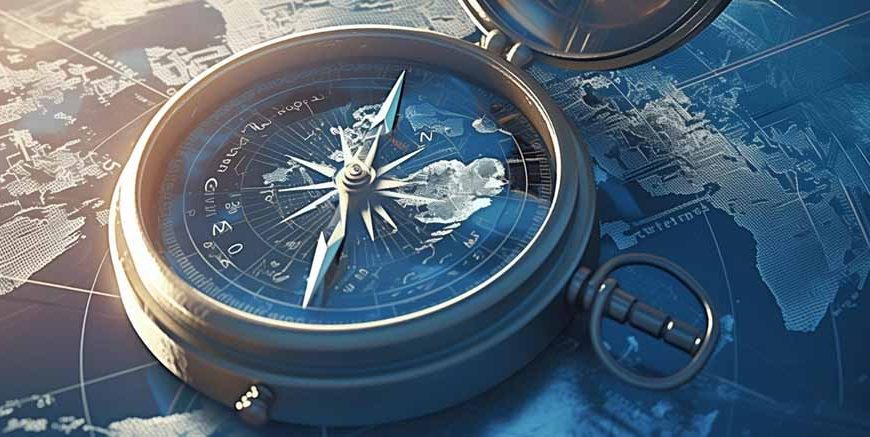
Have you ever wandered into a massive, bustling supermarket, spun around twice to look at the shiny toys on a shelf, and suddenly realised you have absolutely no idea which way the exit is? It is a very strange, slightly panicky feeling. Now, imagine feeling exactly like that, but instead of being in a brightly lit shop, you are sailing a fragile wooden ship in the middle of a dark, rolling ocean with no land in sight. For thousands of years, early explorers faced this terrifying problem every single time they left the safety of the harbour. They desperately needed to figure out a reliable way to navigate the globe without getting hopelessly lost at sea. This pressing need led to the creation of some of the most fascinating tools in human history.
The Basics of Navigation
Before we look at any clever gadgets, we need to understand how to find direction in the first place. You cannot just tell a ship captain to steer “a bit to the left” or “straight past that big grey cloud”. Clouds move, and “left” depends entirely on which way you happen to be facing. We need a fixed, unchanging system.
This is why we use the four cardinal points: North, South, East, and West. If you know exactly where North is, you can easily figure out the rest of the map. South is directly behind you, East is to your right, and West is to your left. It sounds incredibly simple, but you cannot just guess where North is by staring really hard at the ground. You need a bit of scientific help to point you on the right path.
Read More – Teaching Directions for Kids
Meet the Ultimate Explorer’s Tool
This brings us to a brilliant, pocket-sized invention. If someone asks you to name the primary device used to find directions, the answer is, without a doubt, the magnetic compass. It might look a bit like a simple glass pocket watch, but you won’t find any ticking clock hands inside.
Instead, it features a tiny, incredibly lightweight metal needle balancing delicately on a sharp pin. Usually, this needle sits inside a small capsule filled with clear liquid, which stops it from bouncing around too much when you are walking. This specific tool completely changed the course of human history. Before it was invented, sailors were absolutely terrified to leave the sight of the coastline. With it safely in their pockets, they could confidently sail across entirely empty, terrifyingly deep oceans.
The Invisible Magic of the Needle
So, how is compass used to find direction in the real world? It often feels a bit like magic to a young child, but it is actually just brilliant, invisible science at work. Our planet Earth is essentially a gigantic, spinning magnet. It has a huge magnetic North Pole and a matching magnetic South Pole.
The little needle sitting inside the casing is also a magnet. Because magnetic forces constantly interact with each other, the painted red tip of the needle is constantly being pulled by the Earth’s massive magnetic field. It is incredibly stubborn. No matter how much you turn, twist, or spin the plastic dial in your hands, that tiny red needle will always pull itself back to point towards the magnetic North. Once you line up your map with that needle, you suddenly know exactly where you are standing.
Read More – Fun Science Games for Kids At Home
Practical Applications in the Real World
We know it points North, but what do we actually do with that information on a rainy Tuesday? Here are 5 uses of compass that show just how versatile this little instrument can be:
- Guiding huge ships: Even with modern, highly complicated satellite computers on board, large cargo ships and submarines keep a traditional magnetic one on the bridge. If the ship’s power fails completely during a storm, this tool needs no electricity to guide them home safely.
- Exploring the wild: Hikers and mountaineers use them alongside traditional paper maps to avoid getting lost in thick, confusing forests. When every single pine tree looks identical, the needle stops you from walking in massive, tiring circles.
- Building houses: Architects and builders use them before they even pour the concrete. They need to figure out exactly which way a new house should face to get the most warm morning sunlight through the living room windows.
- Flying aeroplanes: Pilots rely heavily on these dials to keep passenger jets flying on a straight, safe path through thick, blinding clouds and heavy winter fog where they cannot see the ground at all.
- Military operations: Soldiers use highly accurate, heavy-duty versions to safely navigate across unfamiliar deserts and dense jungles during pitch-black nights, ensuring they reach their exact targets without making a wrong turn.
Trusting the Great Outdoors
But what happens if you trip and drop your tool in a fast-flowing river, or you simply forget to pack it in your rucksack? Is it still possible to figure out where you are? Absolutely! Learning how to identify the direction using only the natural world around you is a fantastic survival skill.
So, how to know direction without compass? You just need to look up. The sun always rises in the East and sets in the West. If you stand outside early in the morning and point your right arm directly at the rising sun, you are facing North.
If you are trying to navigate at night, things get even more fascinating. If you live in the northern half of the world, you can look up into the dark sky for the North Star. Unlike all the other stars that seem to slowly move across the night sky as the earth spins, this bright star stays practically still, sitting directly over the North Pole. Even the trees in your local park can help! In damp, chilly forests, green moss often grows thickest on the north-facing side of rough tree trunks because that specific side stays cool and shady for most of the day.
Read More – Science Quiz Questions and Answers for Kids
Conclusion
Knowing exactly where we are going gives us the incredible confidence to step out of our front doors and explore the unknown. Whether you are using a highly complicated digital GPS on a modern smartphone, holding a classic brass dial in the palm of your hand, or simply watching the bright sun rise over the garden fence, the fundamental idea remains exactly the same. We are always trying to find our place in this massive, beautiful world. It really makes you pause and wonder: if ancient explorers could map entire, terrifying oceans using just a tiny magnetic needle and the bright stars above them, what incredible, groundbreaking things will our children discover next? To find more wonderful ways to spark your child’s curiosity about the great outdoors and everyday science, do read the EuroKids Blog, and begin a joyful educational adventure through EuroKids Preschool Admission.
FAQs
Who invented the very first compass?
Historians believe the ancient Chinese invented the first versions over two thousand years ago, originally using a naturally magnetic rock called lodestone carved into the shape of a spoon.
Does the needle point to the exact top of the Earth?
Not exactly! It points to the magnetic North Pole, which is actually a little bit different from the true geographic North Pole found on a spinning globe.
Can a magnet ruin a compass?
Yes, absolutely. If you place a strong magnet right next to the dial, it will confuse the delicate needle and pull it in the wrong direction entirely.
Can I use the sun to navigate at midday?
It is much harder at midday because the sun is directly overhead. The sun is most useful for navigation early in the morning when it rises in the East, or late in the evening when it sets in the West.