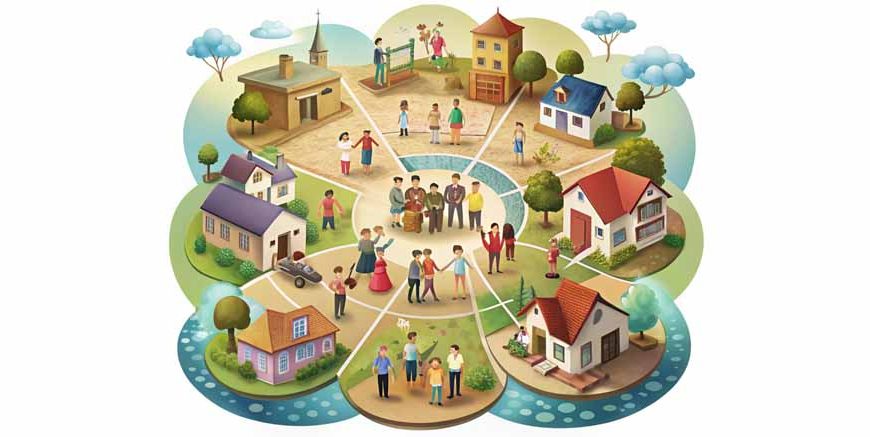
Look out of your living room window right now. What do you see? A busy, noisy street lined with tall blocks of flats? A quiet, winding village lane with a few scattered cottages? Or perhaps just endless green fields stretching out towards the horizon? Wherever you happen to be sitting to read this, you are part of something much bigger than just your own house. You are part of a human settlement. It is an incredible concept that shapes absolutely everything about how we interact, work, and survive on this planet. Let us take a wonderful journey through time and geography to understand exactly how we ended up living the way we do today.
Grasping the Basics
If your inquisitive child suddenly asks you, what is human settlement, the absolute simplest answer is that it is any place where people have decided to build homes and live together. It sounds terribly basic, doesn’t it? But it covers an astonishing variety of places. It ranges from a tiny, lonely farmhouse shivering in the cold Scottish Highlands to the sprawling, vibrant, and crowded streets of modern London or Mumbai.
Crucially, it isn’t just about the physical bricks, mortar, and concrete. It is about the connecting roads, the local corner shops, the schools, the places of worship, and the local parks where kids play football on a Sunday. It is the physical environment we purposefully create to share our lives with other people. A single tent pitched in the desert by a nomadic family is a temporary one, while a sprawling metropolis that has stood for a thousand years is a permanent one.
Read More – Understanding Human Evolution
Finding the Perfect Spot
Have you ever wondered why massive cities are built exactly where they are? People didn’t just close their eyes and throw a dart at a map. When trying to figure out which area is the most useful for human habitation, our early ancestors were incredibly picky. And quite rightly so! Their lives literally depended on choosing the right piece of land.
They desperately needed flat ground to build their shelters easily and to plant crops. They needed a relatively mild climate so they wouldn’t freeze in the winter or bake in the summer. But above absolutely everything else, they needed fresh water. This is precisely why almost every major ancient city on Earth grew right next to a massive river. Flat plains with rich, fertile soil and a steady, reliable supply of drinking water were absolute gold mines for early families. Even today, if you look at a map, the most crowded parts of the world are usually situated in flat, fertile river valleys or near safe, sheltered coastal harbours.
A Journey Through Time
To truly appreciate the comfortable homes we live in today, we have to explain how human settlements have evolved over thousands and thousands of years. It certainly didn’t happen overnight.
Long ago, early humans were nomads. They travelled constantly, hunting wild animals and foraging for wild berries and nuts. They lived in temporary caves or easily movable tents made of heavy animal skins. Why spend months building a permanent stone house if you know you have to move again next week to follow the reindeer herds?
But then, roughly ten thousand years ago, someone discovered farming. This single discovery changed absolutely everything. Suddenly, families had to stay in one place to water their crops, tend to their animals, and harvest their wheat. They started building small, permanent mud and timber huts near their fields. These little clusters of huts slowly grew into bustling farming villages.
As farmers became better at their jobs, they grew more food than they could actually eat. This meant not everyone had to be a farmer anymore. People suddenly had the free time to become blacksmiths, weavers, potters, and builders. Trading began. Villages eventually swelled into busy market towns, and during the Industrial Revolution, those towns exploded into massive, towering cities filled with factories and millions of workers. It is a brilliant story of human imagination and survival.
Read More – History of Ancient Indian Civilization
Different Ways We Live Together
Not all places look the same. Depending on where you travel across the country, you will notice very different types of human settlement. Geographers usually group them into a few simple categories to make them easier to study. Here is a quick list of how they are usually sorted out:
- Rural Settlements: These are the quiet, traditional villages and farming areas. The houses are usually spread out, and life moves at a slightly slower pace. Most of the people living here are directly involved in agriculture, fishing, or forestry.
- Urban Settlements: Think of giant towns and mega-cities. These areas are densely packed with high-rise apartments, massive office buildings, large hospitals, and heavy traffic. People here work mostly in manufacturing, trading, or professional services.
- Compact Settlements: This happens when houses are built right on top of each other, standing shoulder to shoulder. You usually see this in flat river valleys where the land is highly valuable, and everyone wants to live as close to the fertile soil and the water as possible.
- Scattered Settlements: Imagine a steep, rocky mountainside or a thick, dense forest. Here, you might see one farmhouse, and then you have to walk two miles down a muddy track to find the next one. They are heavily isolated simply because the rough, uneven land makes it incredibly hard to build houses close together.
Read More – Types Of Houses For Preschoolers
Conclusion
Think about it for a moment. The way we build our homes actually dictates how we live our daily lives. A tight-knit, compact village forces you to talk to your neighbours over the garden fence every morning, while a massive, sprawling city block allows you to blend into the background anonymously if you want to. From the earliest mud huts sitting near a flowing river to the giant concrete skyscrapers touching the clouds today, our homes tell the fascinating story of our survival. The environments we build end up shaping our habits, our communities, and our children’s futures right back. How will the cities of tomorrow look when our kids are grown up? To discover more wonderful insights into how children learn and engage with the world, read the EuroKids Blog, and take a brilliant step towards early learning through EuroKids Preschool Admission.
FAQs
What is the main difference between rural and urban areas?
Rural areas are usually countryside villages where people focus on farming and agriculture, while urban areas are large towns and cities where people work in offices, factories, and services.
Why did ancient civilisations always settle near rivers?
Rivers provided a constant supply of fresh drinking water, fertile soil for growing crops, and an easy way to transport goods by boat for trading with other villages.
What is a scattered settlement?
It is a place where houses are built very far apart from one another. You usually find these in difficult environments like high mountains, dense forests, or extreme deserts.
How did farming change the way humans lived?
Before farming, humans constantly travelled to find food. Farming forced them to stay in one permanent location to tend to their crops, which directly led to the creation of the very first houses and villages.