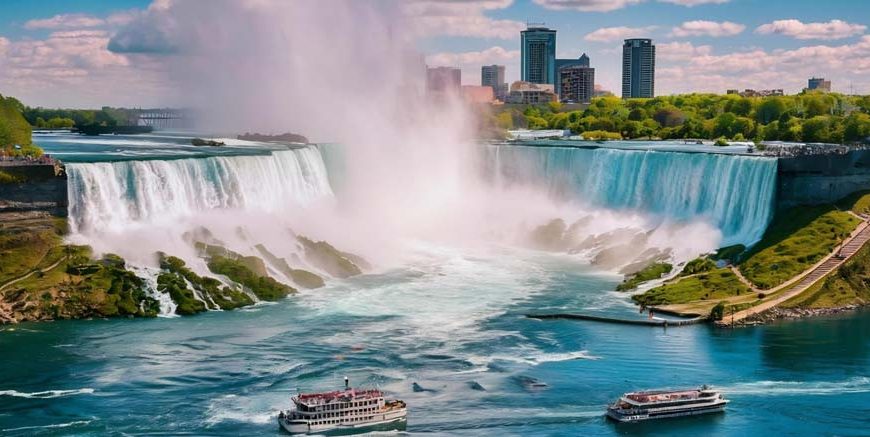
Water is one of the heaviest and most powerful natural substances on Earth. When millions of gallons of it drop off a steep, rocky cliff all at the exact same time, the loud, thundering roar can be heard from miles away. Long before modern highways and tall cities were built, early explorers traveling through thick forests were guided entirely by this massive, shaking sound. They had stumbled upon one of the most famous and breathtaking natural wonders of the world.
Today, we are going to explore the roaring, misty world of the niagara waterfall. We will pull out our geography maps to find its exact home, learn about the three distinct sections that make it up, and understand how this rushing water actively creates electricity for millions of nearby houses.
Drawing the Map: Where Does it Live?
The most common question young students ask in geography class is: niagara falls located in which country? The answer is actually a very fun geographical trick. It is not located inside just one single country. Instead, it proudly sits right on the invisible international border line between two massive countries in North America.
If you trace your finger on a world map to answer where is the niagara falls situated, you will find it flowing on the fast-moving Niagara River. This specific river connects two giant bodies of water called Lake Erie and Lake Ontario. The exact border line between the United States of America (specifically the state of New York) and Canada (the province of Ontario) runs right down the middle of the rushing river!
So, if a curious friend ever tries to trick you with a trivia question by asking, “niagara falls in which country?”, you can confidently smile and tell them that it officially belongs to both the USA and Canada. The two countries share it perfectly.
Read More – Best Waterfalls in India to Watch
A Family of Three: The Niagara Waterfalls
When people talk about this famous landmark, they usually picture one giant, unbroken wall of water. However, the term niagara waterfalls actually refers to a family of three completely separate waterfalls sitting right next to each other.
To make studying these three sections super easy for a school project, here is a simple table showing their names, where they sit, and what makes them unique.
|
Name of the Waterfall |
Which Side is it On? |
Special Features and Shape |
|
The Horseshoe Falls |
Mostly on the Canadian side. |
It is the absolute biggest of the three. It is shaped exactly like a giant, curved horseshoe, which drops a massive, heavy curtain of green water. |
|
The American Falls |
Entirely on the USA side. |
It is very wide and straight. At the bottom of this drop, there is a huge pile of giant, broken rocks that fell from the cliff many years ago. |
|
The Bridal Veil Falls |
Entirely on the USA side. |
It is the smallest of the three. It is named this because the falling white water looks exactly like the delicate, flowing lace veil a bride wears at a wedding. |
The Secret Power: Making Electricity
While watching the water crash down is a beautiful sight, the river is also doing a massive amount of hidden, heavy work. The water moves incredibly fast, dropping over 3,000 tons of water every single second!
Engineers realized that this fast-moving water held a massive amount of mechanical energy. They built special underground tunnels and giant spinning wheels called turbines. When the heavy river water rushes past these giant wheels, it spins them incredibly fast. This spinning motion creates pure electricity, which is then sent through long wires to power the lights, televisions, and refrigerators in millions of homes in both America and Canada. Creating power using moving water is a brilliant, clean science called hydroelectricity.
Moving Backwards: The Science of Erosion
Here is a highly surprising scientific fact: the cliff is actually moving! Every single day, the heavy, pounding water crashes into the rocks at the bottom of the falls. Over many years, this constant smashing breaks tiny pieces of the rock away.
This natural breaking and washing away of the earth is called erosion. Because the water constantly chips away the edge of the cliff, the entire waterfall is slowly inching backward up the river! Scientists estimate that since the river first started flowing thousands of years ago, the edge of the cliff has moved back over seven whole miles.
Read More – Places to Travel with Kids Worldwide
Exploring the Mist
For over a hundred years, tourists have traveled from all over the globe to get as close to the crashing water as safely possible. One of the most famous ways to see it is by riding a special, sturdy boat called the Maid of the Mist.
These boats drive passengers right up to the very bottom of the massive Horseshoe Falls. Because the water crashes down with so much force, it creates a thick, swirling cloud of white mist and rain. Everyone on the boat has to wear a bright, waterproof raincoat, or they will get completely soaked in just a few seconds! When the bright afternoon sun shines directly through this thick cloud of floating mist, it creates beautiful, permanent rainbows that stretch entirely across the river.
Conclusion
To summarize our geographical journey, Niagara Falls is a powerful, historic natural wonder made up of three distinct sections: the Horseshoe, the American, and the Bridal Veil falls. It sits perfectly on the border between the United States and Canada, providing incredible beauty to tourists and clean, rushing hydroelectric power to millions of local residents.
As we close our maps today, studying this moving river leaves us with a truly thought-provoking realization. We usually think of solid rocks and huge cliffs as permanent things that will never, ever change. But the slow, backward march of the falls proves that nothing in nature is truly permanent. The soft, flowing water is actually much stronger than the hard, solid rock, quietly reshaping the map of the world drop by drop, year after year. To read more fun and educational articles, check out the EuroKids Blog, and visit our website for details on EuroKids Preschool Admission.
FAQs
Is it the tallest waterfall in the entire world?
No, it is actually not very tall compared to others! Angel Falls in South America is much taller. However, Niagara is famous for being incredibly wide and having a massive volume of water flowing over it.
Does the rushing water ever freeze solid in the winter?
The water flows too fast to freeze completely solid. However, the mist blowing up into the freezing winter air freezes onto the trees, rocks, and railings, creating a beautiful, sparkling winter wonderland, and a massive “ice bridge” often forms at the bottom of the river.
Can fish survive going over the steep drop?
Surprisingly, yes! Fish are built to handle water pressure. The thick, bubbly white water at the bottom acts exactly like a giant, soft cushion, and experts say that almost all the small fish that accidentally go over the edge survive the drop perfectly fine.
Why does the water look so bright green?
The bright emerald green color comes from the dissolved minerals and finely ground rock powder (called rock flour) that the fast river picks up as it scrapes against the bottom of the lake and the riverbed.