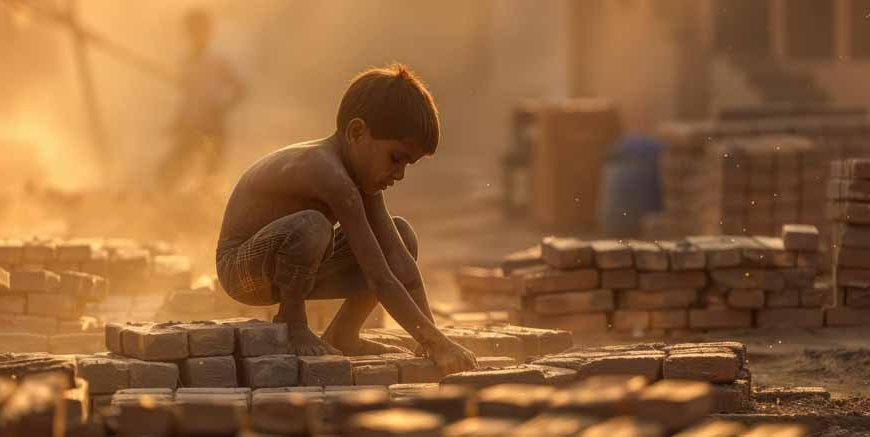
Every morning, alarm clocks ring in millions of homes. Children wake up, pack their school bags, eat a warm breakfast, and rush out the door to catch the school bus. It is a familiar, comforting routine. But sadly, this is not the reality for everyone. While many young ones are busy learning their multiplication tables or playing tag with their friends in the playground, others are waking up to do heavy, exhausting jobs. This unfair reality takes away the absolute magic of growing up.
Childhood is meant for learning, not earning. Today, we are going deep into this vital topic to help students understand it better. Whether you are preparing for a school debate, looking to write a child labour essay, or just trying to understand the world around you, this guide will give you all the right words.
A Short Paragraph on Child Labour
Let us start with a clear, short paragraph on child labour. Put simply, it means forcing young children to do difficult, adult jobs. Instead of holding a pencil, a paintbrush, or a favourite toy, these little hands are forced to hold heavy tools in noisy factories, dusty farms, or roadside tea stalls. It is a deeply harmful practice that steals away a child’s fundamental right to play, learn, and grow up in a safe environment. When young children spend their days doing tough physical work, they completely lose out on their education and their innocence.
Read More – History & Significance of Labour Day
10 Lines on Child Labour
Do you need quick, hard-hitting facts for a school assignment or a test? Here are 10 lines on child labour that explain the core of the issue clearly and simply:
- Child labour is the illegal practice of making young children do difficult, exhausting adult jobs.
- It completely takes away a child’s right to a safe, healthy, and happy childhood.
- Extreme poverty is the biggest single reason why many families feel forced to send their little ones to work.
- A lack of accessible, good-quality schools in rural areas also pushes kids into daily wage labour.
- These young workers are often paid incredibly little money for long, back-breaking hours.
- Working in hazardous places like firecracker factories and dark mines is incredibly dangerous for a child’s physical health.
- Without going to school, these children remain trapped in poverty and cannot build a bright future for themselves.
- The government has made strict laws to completely ban the employment of children under fourteen years of age.
- Every responsible citizen should step up and report to the authorities if they see a young child working at a shop or construction site.
- Providing free and compulsory education is the strongest weapon we have to finally eradicate this social evil.
Preparing a Speech on Child Labour
If you have been chosen to deliver a speech on child labour in your morning school assembly, the secret is to speak directly from the heart. You want to make your classmates and teachers stop and really think.
Start your speech by asking your audience to look at their own privileged lives. Ask them to imagine what it would feel like if their parents told them they could never go back to school, and instead had to work ten hours a day washing dirty dishes. Tell them about the children working in carpet weaving units who have never even seen the inside of a classroom. Use a strong, clear voice to remind everyone that children are the future of our nation, and a nation simply cannot progress if its future is covered in factory dust.
Drafting Your Thoughts: Write an Article on Child Labour
Sometimes, your English teacher might ask you to write an article on child labour for the school magazine. Depending on the marks allocated, you might need to adjust the length.
If your task is to write an article on child labour in 150 words, you need to keep it very direct. Focus strictly on the definition, the main cause (which is almost always poverty), and the ultimate solution (education). You can write a powerful closing sentence about how every single child deserves to carry a school bag full of books, not a heavy sack of bricks on their shoulders.
However, if you are asked for an article on child labour in 200 words, you have the space to add a little more descriptive, emotional detail. You could include a brief example. Picture a young boy working at a roadside dhaba (eatery), scrubbing pots while watching other children his exact age walk by in neat, clean school uniforms. Explain how society as a whole needs to financially support poor families so they do not ever have to rely on their children’s tiny incomes just to survive.
Read More – My Aim in Life Essay in English for Kids
Conclusion
Childhood is a delicate, beautiful, and fleeting time. It is a period meant for chasing butterflies, making silly mistakes, reading adventurous storybooks, and dreaming about the future. When we look away and allow this unfair practice to continue, we are not just breaking a legal rule; we are breaking our moral promises to the next generation.
Eradicating this harsh reality is not just the government’s job; it is a shared social responsibility. The next time you sit in your comfortable classroom, remember the immense, life-changing value of your education. Let us all actively work towards and hope for a bright future where every single child is holding a book, ready to learn.
To explore more insightful educational topics and to nurture a deep, lifelong love for learning in your child, wander through the EuroKids Blog and discover the wonderful pathways waiting for you through EuroKids Preschool Admission today.
FAQs
Why does child labour still happen today?
The main root causes are extreme poverty and a lack of awareness. When poor families cannot afford basic food, they unfortunately pull their children out of school to help earn money for survival.
At what age is working considered child labour?
While laws vary slightly globally, in most countries, including India, employing any child under the age of 14 in any form of physical labour or hazardous work is strictly illegal.
How can ordinary people help stop this practice?
You can make a huge difference by reporting any instances of underage working to local child protection authorities or NGOs, and by supporting charities that focus on providing free education to underprivileged kids.