Learning to read is a lot like cracking a highly complex, secret code. Children start by making simple phonetic sounds, pointing at single letters, and slowly blending consonants and vowels. Then, suddenly, they encounter a tricky new rule: sometimes, two letters team up to make one entirely different noise.
When two ‘e’s stand right next to each other in a word, they stop making their short, quick sound (like in the word ‘bed’) and instead stretch out into a long, smiling “eeee” noise. Unlocking these specific sounds marks a massive leap forward in early literacy, giving young readers the confidence they need to tackle bigger, bolder books. Let us dive into the wonderful world of vowel teams, discover why they matter, and explore a brilliant vocabulary list you can use at home.
EE Words Phonics
Phonics is the clever educational system we use to teach children how to translate written letters into spoken sounds. When we look at ee words phonics, we are exploring what teachers call a ‘vowel team’ or a digraph.
In the English language, there is a very famous, slightly silly rule: when two vowels go walking, the first one usually does the talking. Therefore, in words with double e, the letters work as a perfect team to create a long ‘E’ sound, which sounds exactly like you are just saying the name of the letter itself out loud. Teaching this simple rhyming rule helps children confidently decode unfamiliar vocabulary rather than just guessing from the pictures on the page.
Read More – Words That Start With E
Building Fluency with EE Sound Words
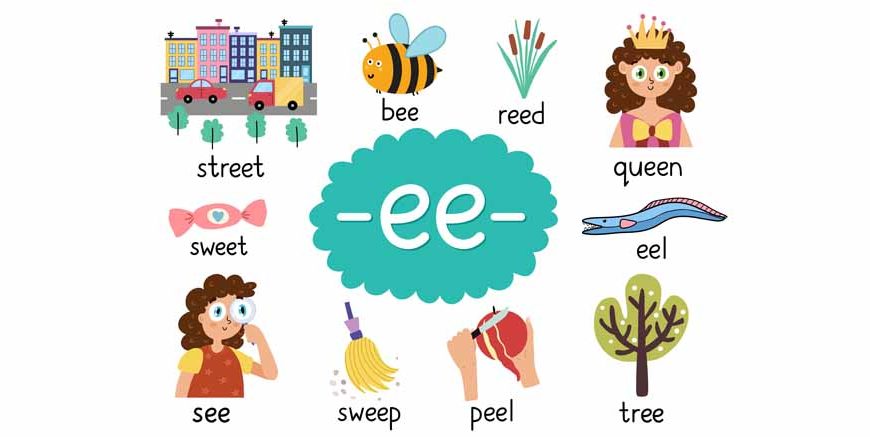
Once a child understands how this double vowel functions, their reading speed naturally accelerates. EE sound words are incredibly common in children’s literature and everyday conversations. From buzzing bees in the garden to big green trees in the park, these phonetic sounds pop up on almost every single page of a primary school picture book. By actively practising ee words for kids, we remove the frustrating stumbling blocks that interrupt their reading flow. It helps them move from slowly sounding out individual letters to smoothly reading whole sentences with lovely expression.
Fun Ways to Practise Words With Double E
You certainly do not need boring, repetitive worksheets to master ee words in english. The best learning always happens through active play.
Try playing a ‘Double E Detective’ game at home. Give your child a magnifying glass and their favourite storybook, and ask them to spot as many ee words as they can find hidden in the text. Another brilliant activity is using physical actions; ask them to touch their ‘feet’, point to their ‘teeth’, or run to the nearest ‘tree’ outside. When they physically connect the spelling to a real-world object, the vocabulary locks permanently into their memory.
Read More – List of Sight Words in English for Kids
EE Sound Words List
To help you build your little one’s vocabulary, here is a comprehensive ee sound words list featuring exactly 40 fantastic words and their simple meanings, perfect for spelling practice!
- Bee: A small, buzzing flying insect that makes sweet honey.
- Tree: A tall outdoor plant with a wooden trunk and green leaves.
- See: To look at something using your eyes.
- Free: Costing absolutely no money at all.
- Three: The cardinal number that comes right after two.
- Feet: The body parts at the bottom of your legs used for walking.
- Meet: To see and talk to someone face-to-face.
- Deep: Going very far down into the ground or water.
- Keep: To hold onto something and not give it away.
- Sleep: Resting your body and mind quietly at night.
- Sheep: A fluffy farm animal that gives us warm wool.
- Sweep: To clean the floor using a brush or broom.
- Jeep: A strong, sturdy car made for driving over rough ground.
- Peep: To take a very quick, secret look at something.
- Weep: To cry tears when you are feeling sad.
- Need: Something you must have to survive, like food or water.
- Seed: A tiny object planted in the dirt that grows into a big plant.
- Feed: To give food to a hungry person or an animal.
- Weed: A wild plant growing in the garden where it is not wanted.
- Deed: A helpful or brave action that someone does.
- Feel: To physically touch something or to experience an emotion.
- Heel: The rounded back part of your foot.
- Peel: To pull the outer skin off a fruit or vegetable.
- Reel: A round object used to wind up a fishing line or thread.
- Wheel: A round, spinning part that helps cars and bicycles roll.
- Green: The bright colour of summer grass and leaves.
- Queen: A royal lady who wears a crown and rules a country.
- Screen: The flat, glowing glass part of a television or tablet.
- Teen: A young person aged between thirteen and nineteen.
- Keen: Feeling very eager, willing, or excited to do something.
- Beef: The meat that comes from a cow.
- Reef: A beautiful, colourful ridge of coral under the sea.
- Seek: To look very carefully to find a hidden object.
- Week: A period of time made up of exactly seven days.
- Cheek: The soft, fleshy side of your face below your eyes.
- Speech: Talking out loud to a large group of people.
- Bleed: To lose a little bit of blood from a cut or scrape.
- Greed: Wanting much more food, toys, or money than you actually need.
- Speed: How fast or slow a person or a car is moving.
- Sweet: Tasting lovely and sugary, just like honey or chocolate.
Read More – Simple Words for Kids
Conclusion
When we sit down and patiently help a child sound out a brand-new word, we are doing far more than simply ticking off a phonics checklist. Language is the ultimate tool for human connection. By giving a child the phonetic keys to unlock words like ‘feel’, ‘seek’, and ‘speech’, we are giving them the power to articulate their deepest thoughts and brilliantly describe the world around them.
Every single new sound they master is a tiny, sturdy brick building their future independence. Read with them, laugh at the silly rhyming sounds, and celebrate the magnificent moment those puzzling letters finally click into place.
To discover more educational insights and to explore joyful ways to support your child’s continuous growth, visit the EuroKids Blog and find out everything you need to know about joining our vibrant learning community through EuroKids Preschool Admission.
FAQs
Are ‘ea’ and ‘ee’ words pronounced the same way?
Yes, they often make the exact same long ‘E’ sound! However, they are spelled differently depending on the word (for example, you sail on the sea, but you see with your eyes).
When should I introduce these double vowels to my child?
Usually, vowel teams are introduced in Year 1 or Year 2, right after a child has confidently mastered all of their single, short letter sounds.
Why do some words sound like ‘ee’ but end in a ‘y’?
The English language loves to break its own rules! A ‘y’ at the very end of a longer word (like ‘happy’ or ‘puppy’) acts like a vowel and borrows the long ‘E’ sound.