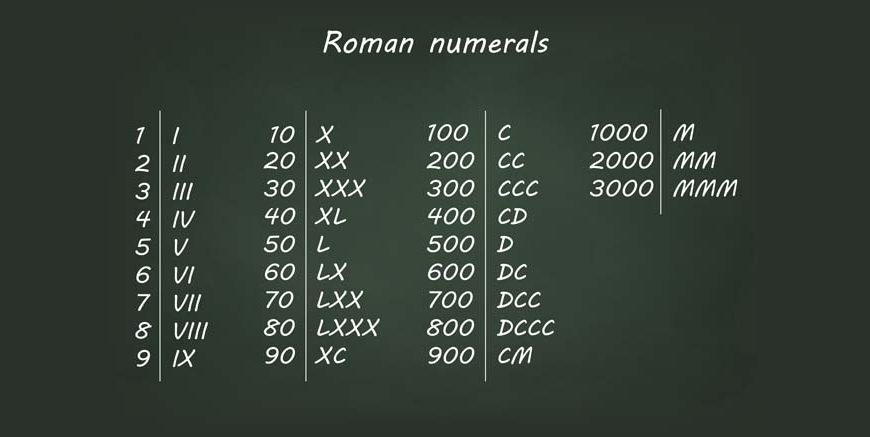
Imagine exploring a grand, dusty museum or staring up at the giant face of an old clock tower in the middle of a bustling city. Instead of the familiar, curly digits we see every day, you notice a strange jumble of straight alphabet letters carved into the stone or painted on the glass.
To a passerby, it looks like a secret, unbreakable code. In a way, it truly is! Thousands of years ago, the ancient Romans used their alphabet to count everything around them, from the sweet apples sold in the lively markets to the heavy gold coins kept in treasure chests.
Today, we are going to put on our historical detective hats and crack the code for a very specific two-digit number. We are going to learn exactly how to write 80 in Roman numerals. It is a brilliant mathematical puzzle waiting to be solved!
The Basic Building Blocks of the Ancient Code
Before we can build our target number, we need to understand the special tools in our ancient toolkit. The Romans did not have the digit zero, and they certainly did not use the numbers 0 to 9 like we do in our modern school workbooks. Instead, they cleverly used just seven capital letters to build every single number imaginable.
For our counting mission today, we only need to memorise two of these special alphabet blocks:
- The letter X stands for the number 10. A fun trick to help you memorise this is to hold up both of your hands and cross your wrists together to make a big ‘X’ shape!
- The letter L stands for the number 50.
Once you know what these two letters mean, you hold the absolute key to solving our puzzle.
Read More – The Importance of Math in Everyday Life
Decoding the Roman Number 80
Now, how do we actually create the roman number 80? The rule in this ancient game is incredibly simple: when you place a smaller letter directly after a bigger letter, you simply add their values together. Think of it like stacking colourful wooden blocks on top of one another to build a taller tower.
Let us start with our largest chunk. We lay down the letter L, which immediately gives us 50. But 50 is not quite 80. We need to keep adding more!
We can add tens by using our letter X. If we place one X right next to the L (making LX), we have 50 + 10, which gives us 60.
If we add another X (LXX), we are doing the maths for 50 + 10 + 10, which equals 70.
Finally, if we add a third X (LXXX), we get 50 + 10 + 10 + 10.
If you add all those pieces together, you reach exactly 80. Just like that, you have successfully built the number!
Why Do We Write 80 in Roman Like This?
If you are a very clever thinker, you might be wondering, “Why can we not just write eight Xs in a row? Or why don’t we use a C (which means 100) and take 20 away?”
The Romans were incredibly organised people, and they had very strict golden rules to keep their writing neat and tidy. One of their most important rules was that you can never put more than three of the exact same letters next to each other in a row. Because of this strict rule, writing eight Xs is completely forbidden.
Additionally, their subtraction rules state that you can only ever subtract one smaller letter from a bigger one. Taking two tens away from a hundred (writing XXC) goes against the rules of their game. Therefore, the only correct, perfect way to write 80 in roman is LXXX.
Read More – Teaching Kids About Roman Numerals
Conclusion
Solving these historical number puzzles is exactly like learning how to read a brand-new, magical language. When you understand that writing LXXX is the exact same thing as writing eighty, you are sharing a mathematical secret with the very people who built mighty empires thousands of years ago. It gently shows young learners that maths is not just about answering sums correctly on a classroom whiteboard; it is a fascinating, time-travelling adventure that connects us to the distant past.
The next time you spot strange letters carved into a magnificent stone building or the face of a grandfather clock, remember the clever addition rules you learned today. To discover more wonderful educational facts and to actively support your child’s brilliant learning journey, explore the EuroKids Blog and find out everything you need to know about EuroKids Preschool Admission today.
FAQs
What is the Roman numeral for 80?
The correct way to write it is LXXX.
Why can I not write XXC to make 80?
The ancient rules state that you are only allowed to subtract one smaller numeral from a larger numeral at a time. Therefore, subtracting two tens (XX) from a hundred (C) is not allowed.
What does the letter L stand for in this code?
In this counting system, the letter L always represents the number 50.