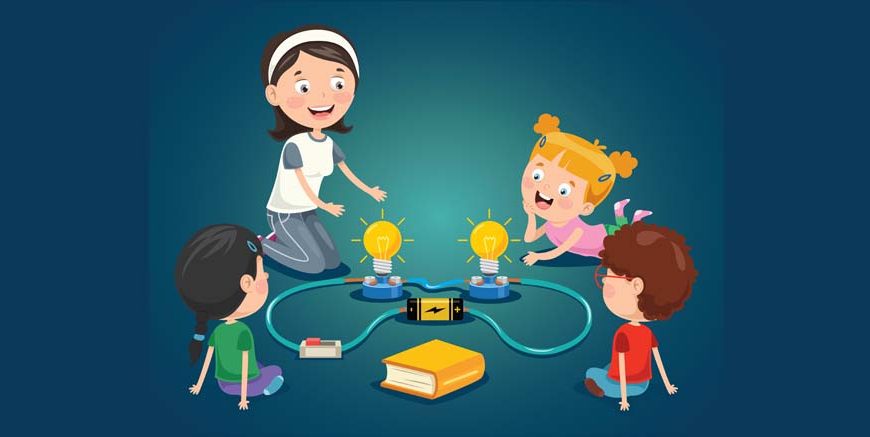
Flipping a plastic wall switch to turn on a bedroom light happens so fast that we rarely pause to understand the science behind it. A dark room instantly fills with bright light, or a quiet toy suddenly starts playing a loud song. This immediate power does not come from magic. It relies entirely on a carefully built, invisible path hidden behind our walls and inside our plastic toys.
Today, we break down exactly how these invisible paths work. We explore the simple meanings behind the big vocabulary words, look at the required parts, and understand how energy travels from a battery to a glowing bulb.
The Basics: Controlling the Invisible
Before we build a path, we must understand the energy traveling on it. If a younger student asks, what is electronics in simple words, you can tell them it is the science of controlling tiny, invisible particles called electrons.
The true electronic meaning involves directing these highly energetic particles to do specific jobs, like lighting up a television screen, spinning a fan motor, or making a phone ring. A formal electronics definition states that it is the branch of science dealing with the flow and control of electricity through various materials. When we master this control, we build modern computers and smartphones. We essentially tell the energy exactly where to go and what to do when it gets there.
Read More – Electricity and Magnetism Explained for Kids
The Perfect Circle: The Invisible Path
Now, how do we actually control these fast particles? We build them a road. If someone asks, what is a circuit, the easiest answer is a “circle.” In fact, the word itself comes directly from the old Latin word for circle.
An electric circuit meaning is simply a continuous, unbroken loop that allows electricity to flow freely. To provide a clear electric circuit definition, it is a complete, closed path through which electric current travels. Therefore, if a teacher asks what is the definition of electric circuit, you can confidently say it is the fully connected track that electrons use to move from a power source, through a device, and back to the source again.
Think of it like a race track for cars. The cars (electrons) leave the starting line, drive all the way around the track, and return to the start. If a bridge breaks on the track, the cars stop completely.
The Four Main Parts of the Road
Every successful path requires four basic parts to function correctly. If you remove even one of these items, the whole system stops working completely. Here is a simple table showing the necessary parts and exactly what they do:
|
Part Name |
What It Is |
Its Specific Job |
|
Power Source |
A battery or a wall socket. |
It pushes the invisible electrons forward. It acts exactly like the beating heart of the system, providing the necessary pressure. |
|
Conductor |
Metal wires (usually copper). |
It provides the actual physical road. Electrons easily slide through these metal wires without getting stuck. |
|
Load |
A light bulb, a buzzer, or a toy motor. |
It uses the traveling energy to do real work, changing the electrical energy into bright light, loud sound, or fast movement. |
|
Switch |
A button or a wall flip-switch. |
It acts as a movable bridge. It can open or close the road to stop or start the power whenever we want. |
Read More – Electrical Safety Tips for Kids
The Bridge: Open vs. Closed Paths
Understanding how the switch works is very important. When you turn on your remote-control car, you push the switch to the “closed” position. This lowers the bridge inside the toy, completely connecting the metal wire. The electrons easily run around the full circle, and the toy car moves forward. Scientists call this a closed circuit.
When you finish playing, you turn the toy off. Pushing the switch to the “open” position lifts the bridge up. The metal wire is now broken in half. Because electrons cannot jump across empty air, the flow stops immediately, and the toy car rests quietly. Scientists call this an open circuit. The power stays safely resting inside the battery until you decide to lower the bridge again.
Sometimes, electricity finds a shortcut and travels down the wrong path where there is no load to slow it down. This is called a short circuit. It makes the wires extremely hot and causes the battery to fail quickly. This is exactly why engineers carefully wrap all copper wires in thick rubber, keeping the energy safely trapped on the correct road.
Conclusion
To summarize the lesson, electricity absolutely needs a complete, unbroken circle to do any work. An electric circuit provides that perfect, closed road. By connecting a strong battery, conductive copper wires, a working load, and a controlling switch, we successfully direct energetic electrons to light up bulbs and spin motors. To read more fun and educational articles, check out the EuroKids Blog, and visit our website for details on EuroKids Preschool Admission.
FAQs
Can electricity flow through plastic or rubber?
No, it cannot. Materials like plastic, wood, and rubber are called insulators. They completely block the electrons from moving, which is exactly why we wrap our dangerous copper wires in safe rubber coatings.
Why does a flashlight stop working when the battery dies?
The battery holds the chemical pressure that pushes the electrons forward. When the battery runs out of active chemicals, the pushing force drops to zero, and the electrons simply stop moving.
What happens if the metal wire snaps in the middle?
If the wire snaps, the circle breaks. The path instantly becomes an “open” path, and the electricity stops flowing immediately.
Is a simple setup the same as the one inside a computer?
The basic rules of physics are exactly the same! However, a computer uses millions of microscopic paths stacked closely together on a green board instead of using just one single wire loop.