Everything around us is made of matter. Matter is anything that has mass and takes up space. The chair you sit on, the water you drink, and the air you breathe are all forms of matter. Matter exists mainly in three common states: solids, liquids, and gases. Understanding these states helps students learn basic science concepts more easily.
Children observe solid, liquid, and gas forms every day, even if they don’t realize it. Ice, water, and steam are classic examples of how the same substance can exist in different states. Learning how to identify and compare them builds strong foundational knowledge. In this blog, we will explore what solids, liquids, and gases are, their characteristics, examples, and the differences between solids, liquids, and gases.
What Is Solid, Liquid, Gas?
Matter exists in three main states:
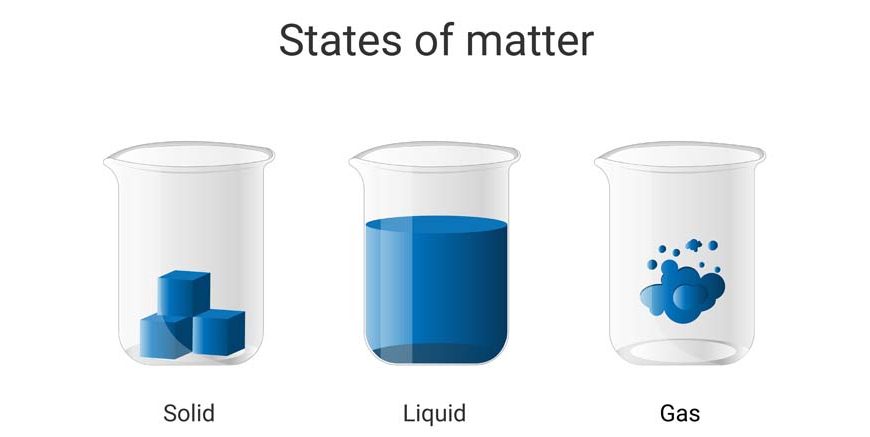
- A solid is a state of matter that has a fixed shape and fixed volume. The particles are tightly packed. Examples: stone, book, pencil, ice, table.
- A liquid is a state of matter that has a fixed volume but takes the shape of its container. Examples: water, milk, oil, juice, honey.
- A gas is a state of matter that spreads out to fill any space. It has no fixed shape or volume. Examples: air, oxygen, carbon dioxide, steam.
These three forms together are called solids, liquids, and gases.
Read More – Science of Sound For Kids
Properties of Solid, Liquid, and Gas
|
Properties |
Solid |
Liquid |
Gas |
|
Shape |
Fixed |
Takes container shape |
No fixed shape |
|
Volume |
Fixed |
Fixed |
Not fixed |
|
Particle spacing |
Very close |
Close |
Far apart |
|
Movement |
Very little |
Moderate |
Fast |
|
Compressibility |
Very low |
Low |
High |
Characteristics of Solid, Liquid, and Gas
Solids
Solids are strong and rigid in structure, which means they cannot be easily moulded into different shapes.
Properties of solids:
- They occupy a definite space.
- They have a fixed shape and fixed volume.
- They have high intermolecular attraction.
- There is very little space between molecules, which makes them rigid.
- They do not flow like liquids and cannot be compressed easily.
Examples: wood, ice, brick, stone.
Liquids
Liquids have a fixed volume but no fixed shape. They take the shape of the container in which they are kept.
Properties of liquids:
- They occupy space.
- They have a fixed volume but change shape according to the container.
- They have more intermolecular space than solids.
- Their particles can flow freely.
- They can be compressed slightly.
Examples: water, milk, blood, coffee.
Gases
Gases do not have a fixed shape or volume. They spread out to fill the entire space available.
Properties of gases:
- They have neither a fixed shape nor a fixed volume.
- Particles are far apart with very weak intermolecular forces.
- They can be easily compressed.
- They fill the container.
- Gas particles move randomly and freely.
Examples: oxygen, carbon dioxide, neon.
Examples of Solids, Liquids, and Gases
Real-world examples help children remember better.
- Solids- Book, chair, ice cube, apple, and toy.
- Liquids- Water, milk, juice, oil, and ink.
- Gases- Air, steam, oxygen, cooking gas, and carbon dioxide.
Read More – Oil and Water Science Fun for Kids
Differentiate Between Solid, Liquid, and Gas
|
Properties |
Solids |
Liquids |
Gases |
|
Mass |
Definite |
Definite |
Definite |
|
Shape |
Definite |
Acquires the shape of the container |
Acquires the shape of the container |
|
Volume |
Definite |
Definite |
Indefinite |
|
Compressibility |
Not possible |
Almost negligible |
Highly negligible |
|
Fluidity |
Not possible |
Can flow |
Can flow |
|
Rigidity |
Highly rigid |
Less rigid |
Not rigid |
|
Diffusion |
Slow |
Fast |
Very fast |
|
Space between particles |
Most closely packed |
Less closely packed |
Least closely packed |
|
Interparticle forces |
Definite |
Slightly more than the solid |
Negligible |
Change of State
Matter can change from one state to another. Same substance, but different states. Changes Include:
- Solid to Liquid = Melting
- Liquid to Solid = Freezing
- Liquid to Gas = Evaporation/Boiling
- Gas to Liquid = Condensation
Example: Ice to Water to Steam
Fun Facts About Solids, Liquids, and Gases
- Ice floats on water because solid water is less dense
- Liquids can form drops due to surface tension
- Gases spread quickly in the air
- Heat increases particle movement
- Cooling slows particles
- Some materials can exist in all three states
Read More – Pepper and Soap Science Experiment for Kids
The Role EuroKids Plays in Teaching Solid, Liquid, and Gas Concepts
EuroKids introduces solids, liquids, and gases through activity-based learning and real-life observation. Children explore solid, liquid, and gas examples using classroom objects like blocks, water, and air-filled balloons. Teachers explain solid definition, liquid definition, and gas characteristics through experiments, storytelling, and play-based demonstrations. Instead of memorising the difference between solid, liquid, and gas, students see and experience it through guided activities. This approach helps young learners understand properties, characteristics, and state changes clearly while building curiosity and scientific thinking skills.
Conclusion
Understanding solids, liquids, and gases is one of the most important basics in science learning. When students know the definitions, along with their properties and characteristics, they can easily identify matter around them. From ice and water to air and steam, everyday examples make these concepts simple and relatable. Learning the difference through tables, activities, and real-life observation builds strong foundational knowledge. With practice and hands-on learning, children can confidently explain and apply solid, liquid, and gas concepts in school and daily life.
To explore more learning ideas, simple explanations, and early childhood resources, parents can visit the EuroKids Blog. Those who wish to understand the preschool journey better or explore enrolment options can find complete information on the EuroKids Preschool Admissions Page, where learning is designed to be joyful, engaging, and child-friendly.
FAQs:
1. What are solids, liquids, and gases?
Solids, liquids, and gases are the three main states of matter. Everything around us belongs to one of these forms based on how its particles are arranged and move.
2. How can you identify a solid easily?
A solid keeps its own shape and does not change when placed in a container. It is usually firm and cannot be poured.
3. Why do liquids take the shape of a container?
Liquids take the shape of a container because their particles can move and slide past each other while still staying close together.
4. Why do gases spread everywhere?
Gases spread out because their particles are far apart and move freely in all directions.
5. Can a substance change from solid to liquid to gas?
Yes. With temperature change, many substances can change state, like ice melts into water and water turns into steam.