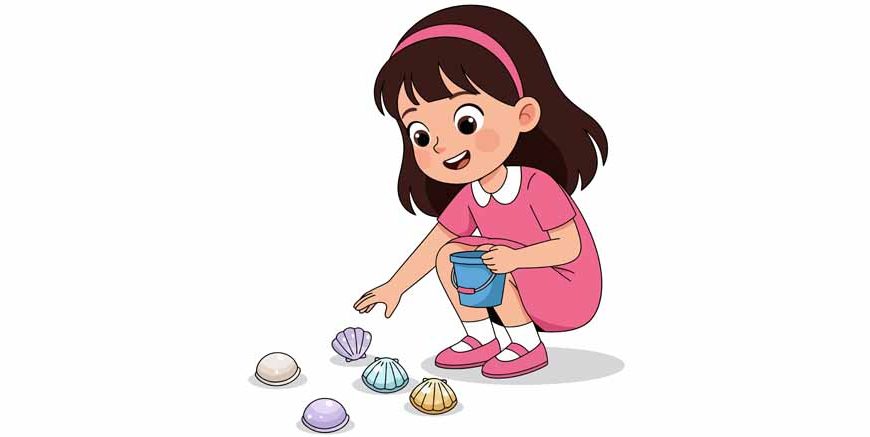
Nursery rhymes and tongue twisters are wonderful tools for helping children develop language skills in a fun and engaging way. They improve pronunciation, listening, memory, and confidence while encouraging children to enjoy the sounds of words. One of the most famous English rhymes is She Sells Seashells by the Seashore. Although many people know it as a nursery rhyme, it is also recognised as a classic seashell tongue twister because of its repeated “s” and “sh” sounds.
For Indian parents and teachers preparing children for a global future, rhymes like She Sells Seashells by the Seashore help build clear speech, vocabulary, and communication skills. Children enjoy the challenge of saying the rhyme quickly while practising correct pronunciation. In this article, we will read the lyrics, understand the meaning, explore its educational benefits, and discover fun learning activities that make this classic rhyme even more enjoyable.
She Sells Seashells by the Seashore Lyrics
Here is the traditional version of the rhyme.
She sells seashells by the seashore.
The shells she sells are surely seashells.
So if she sells shells on the seashore,
I’m sure she sells seashore shells.
These well-known lines are loved by children and adults alike because they are rhythmic, playful, and fun to repeat.
Read More – Nursery Rhymes For Kids with Lyrics
What Is “What Is She Sells Seashells by the Seashore” About?
The rhyme tells the simple story of a girl who sells beautiful seashells by the seashore. While the story is short, the rhyme’s real purpose is to challenge the speaker’s pronunciation. The repeated sounds encourage children to listen carefully and pronounce similar words correctly.
Many teachers use this rhyme to improve speech clarity and make language learning more enjoyable.
Why Is It Called a Seashell Tongue Twister?
A seashell tongue twister contains words that sound very similar when spoken quickly. In this rhyme, the repeated use of “she,” “sells,” “shells,” “seashells,” and “seashore” makes pronunciation challenging.
Tongue twisters are designed to:
- Improve pronunciation.
- Strengthen speaking confidence.
- Develop listening skills.
- Help children distinguish similar sounds.
The more children practise, the easier the rhyme becomes.
Meaning of the Rhyme
The rhyme describes a girl selling shells collected from the beach. It paints a cheerful picture of the seaside while encouraging children to enjoy wordplay.
Parents can explain that seashells are the hard outer coverings of certain sea animals. After the animals leave the shells, they may wash onto beaches, where people enjoy collecting them.
Although the rhyme is simple, it introduces children to nature, language, and rhythm all at once.
Vocabulary Children Learn
The rhyme introduces useful words.
|
Word |
Meaning |
|
Seashell |
The hard outer covering of certain sea animals |
|
Seashore |
The land beside the sea |
|
Sell |
To exchange something for money |
|
Shore |
The edge of a sea or lake |
|
Beach |
A sandy or pebbly area beside the sea |
Parents can reinforce these words using books, pictures, or family trips to the beach.
Read More – Easy School Related Words and Vocabulary Activities
What Did the Child Do With the Shell?
Teachers sometimes ask questions such as “What did the child do with the shell?” to encourage thinking and storytelling.
Although the rhyme does not mention a child collecting a shell, children can imagine different endings.
For example, the child could:
- Collect the shell as a souvenir.
- Decorate a craft project.
- Show it to family and friends.
- Learn about sea animals.
- Keep it in a nature collection.
Questions like “What did the child do with the shell?” help develop imagination and comprehension.
Fun Classroom Activities
Teachers can extend learning through enjoyable activities.
Tongue Twister Challenge
Ask children to repeat the rhyme slowly and then gradually increase the speed.
Seashell Counting
Use toy shells or pictures to practise counting.
Beach Drawing
Invite children to draw a beach with shells and waves.
Storytelling
Ask children to imagine where the shells came from.
These activities combine language learning with creativity.
Learning About Seashells
The rhyme also introduces simple science concepts.
Children can learn that:
- Seashells come from sea animals such as molluscs.
- Shells protect the animals that live inside them.
- Empty shells sometimes wash onto beaches.
- Shells come in many shapes, sizes, and colours.
- Collecting shells should always be done responsibly without disturbing living creatures.
These discussions connect language learning with nature.
Why Tongue Twisters Are Good for Children
Tongue twisters offer many educational benefits.
Clearer Speech
Children practise difficult sounds.
Better Concentration
Repeating similar words requires careful attention.
Improved Fluency
Frequent practice makes speaking smoother.
Stronger Memory
Children remember rhythmic phrases more easily.
These advantages explain why tongue twisters remain popular in schools worldwide.
Read More – Ding Dong Bell Nursery Rhyme
Interesting Facts About the Rhyme
Fact 1
It is one of the world’s best-known English tongue twisters.
Fact 2
Many speech teachers use it to improve pronunciation.
Fact 3
The rhyme focuses more on word sounds than on storytelling.
Fact 4
Children enjoy trying to say it faster without making mistakes.
Fact 5
It is popular in schools, speech competitions, and language classes.
Questions to Ask Children
After reading the rhyme, ask:
- Where does the girl sell seashells?
- What is a seashell?
- Can you name another beach object?
- Which words sound similar?
- Can you create your own tongue twister?
These questions strengthen comprehension and creativity.
How EuroKids Builds Strong English Language Foundations
Learning English at a young age becomes natural when children engage with stories, songs, real-life objects, and interactive activities. Instead of rote memorisation, EuroKids focuses on developing language skills through meaningful experiences that make reading, writing, speaking, and listening enjoyable.
At EuroKids, foundational English concepts are taught through storytelling, picture books, phonics-based exercises, and interactive vocabulary games, all aligned with the HEUREKA – Visible Thinking Curriculum.
Tips for Indian Parents
Parents can make the rhyme even more enjoyable.
Read Slowly First
Help children pronounce each word clearly.
Practise Every Day
A few minutes of practice improve fluency.
Use Pictures
Show children photographs of real seashells and beaches.
Play Sound Games
Encourage children to identify words beginning with the “s” sound.
Visit a Beach
If possible, let children observe real seashells by the seashore and learn about marine life.
These activities create meaningful learning experiences.
Quick Revision
Let’s review the important points.
- She Sells Seashells by the Seashore is a famous English rhyme.
- It is also a well-known seashell tongue twister.
- The rhyme improves pronunciation, vocabulary, listening, and confidence.
- Children learn about beaches, shells, and nature.
- Parents and teachers can extend learning through crafts, storytelling, and pronunciation games.
Conclusion
She Sells Seashells by the Seashore is much more than a fun rhyme. It is a playful language exercise that helps children improve pronunciation, listening skills, vocabulary, and speaking confidence. The repeated sounds challenge young learners while making English enjoyable and memorable.
To explore more learning ideas, simple explanations, and early childhood resources, parents can visit the EuroKids Blog. Those who wish to understand the preschool journey better or explore enrolment options can find complete information on the EuroKids Preschool Admission
Page, where learning is joyful, engaging, and child-friendly.