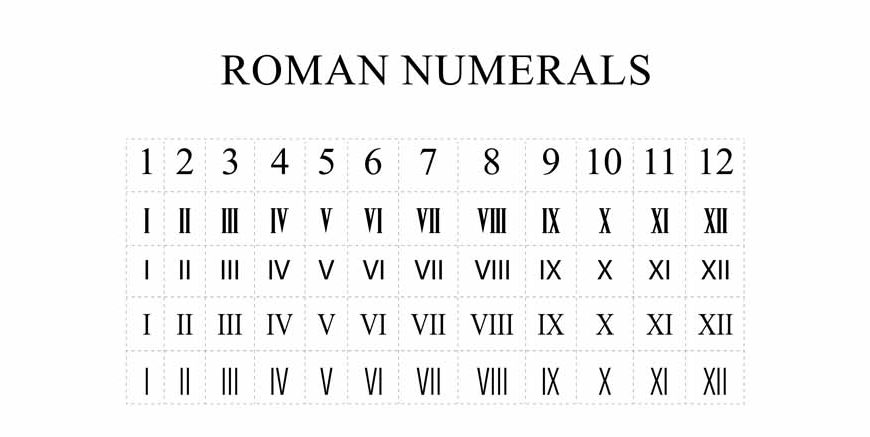
Different number systems have been used throughout history, and Roman numerals remain one of the most interesting and widely recognised forms even today. Children often notice Roman numerals on clocks, monuments, chapter headings, and special occasions, which naturally creates curiosity about their meaning. Learning Roman numerals helps children improve number recognition, logical thinking, and mathematical understanding. Once children understand the symbols and rules, reading and writing Roman numerals become simple and enjoyable. In this blog, we will explore Roman numerals from 1 to 200, understand the symbols, and learn how to read and write them correctly.
What Are Roman Numerals?
Roman numerals are numbers represented using letters from the Latin alphabet.
The main Roman numeral symbols are:
|
Roman numeral |
Value |
|
I |
1 |
|
V |
5 |
|
X |
10 |
|
L |
50 |
|
C |
100 |
Read More – The Importance of Math in Everyday Life
Basic Rules of Roman Numerals
1. When a smaller numeral comes after a bigger numeral, we add.
Example:
- VI = 5 + 1 = 6
2. When a smaller numeral comes before a bigger numeral, we subtract.
Example:
- IV = 5 − 1 = 4
3. A numeral can be repeated up to three times.
Example:
- III = 3
- XXX = 30
4. Symbols V, L, and D are never repeated.
Roman Numbers 1 to 200 Chart
|
Number |
Roman numeral |
Number |
Roman numeral |
|
10 |
X |
110 |
CX |
|
20 |
XX |
120 |
CXX |
|
30 |
XXX |
130 |
CXXX |
|
40 |
XL |
140 |
CXL |
|
50 |
L |
150 |
CL |
|
60 |
LX |
160 |
CLX |
|
70 |
LXX |
170 |
CLXX |
|
80 |
LXXX |
180 |
CLXXX |
|
90 |
XC |
190 |
CXC |
|
100 |
C |
200 |
CC |
Read More – How to Write CCXCIX in Numbers?
How to Write Roman Numerals?
Example 1: Write 24 in Roman numerals
24 = 20 + 4
- 20 = XX
- 4 = IV
So:
24 = XXIV
Example 2: Write 75 in Roman numerals
75 = 50 + 20 + 5
- 50 = L
- 20 = XX
- 5 = V
So:
75 = LXXV
Example 3: Write 145 in Roman numerals
145 = 100 + 40 + 5
- 100 = C
- 40 = XL
- 5 = V
So:
145 = CXL
Where Are Roman Numerals Used?
Roman numerals are still used in many places:
- clocks and watches
- book chapters
- movie sequels
- sports events
- monarch names
- historical monuments
Examples:
- Super Bowl LVIII
- King Charles III
- Clock showing XII
Roman Numerals 100 to 200
|
Number |
Roman numeral |
|
101 |
CI |
|
110 |
CX |
|
125 |
CXXV |
|
140 |
CXL |
|
150 |
CL |
|
175 |
CLXXV |
|
190 |
CXC |
|
199 |
CXCIX |
|
200 |
CC |
Common Mistakes Children Make
Incorrect:
- IIII for 4
- VV for 10
- XXXX for 40
Correct:
- IV for 4
- X for 10
- XL for 40
Easy Trick to Learn Roman Numerals
Children can remember the symbols using this sentence:
“I Value Xylophones Like Candy”
- I = 1
- V = 5
- X = 10
- L = 50
- C = 100
Difference Between Roman Numerals and Numbers
|
Standard numbers |
Roman numerals |
|
1 |
I |
|
10 |
X |
|
50 |
L |
|
100 |
C |
|
200 |
CC |
Read More – How to Write 250 in Roman Numerals?
Worksheet Activity
Fill in the blanks:
- 50 in Roman numerals = ________
- C = ________
- XX = ________
- 200 in Roman numerals = ________
Answers:
- L
- 100
- 20
- CC
Importance of Learning Roman Numerals Early
- improve number recognition
- develop logical thinking
- strengthen maths basics
- understand historical number systems
Making Number Systems Fun to Explore
At EuroKids, children are introduced to interesting maths concepts in playful and engaging ways. While learning Roman numerals from 1 to 200, children begin to recognise symbols like I, V, X, L, and C through simple activities and pattern-based learning. Instead of seeing Roman numerals as difficult, they gradually learn to identify and compare symbols. Visual charts, matching exercises, and number games help children build familiarity with mathematics, making mathematical learning enjoyable and easier to understand from an early age.
HEUREKA Brings Maths Concepts to Life
The HEUREKA curriculum at EuroKids helps children understand concepts through observation, inquiry, and discovery. When exploring Roman number charts for 1 to 200, children are encouraged to notice patterns, compare number formations, and express their observations. These visible thinking routines strengthen memory and logical reasoning instead of encouraging rote memorisation. By making learning interactive and meaningful, HEUREKA helps children build confidence in maths while nurturing curiosity and critical thinking.
Conclusion
Roman numerals are an interesting and important part of mathematics that help children understand different number systems used throughout history. From clocks and books to events and monuments, Roman numerals are still commonly seen in everyday life. Understanding the rules and patterns of Roman numerals 1 to 200 makes reading and writing them much easier for children. With regular practice, charts, and simple activities, children can quickly recognise Roman numerals and improve their number skills in a fun and engaging way.
Parents looking to give their child a strong foundation in early learning can explore EuroKids Preschool Admission to begin this enriching journey.
For more insightful articles that support early learning, awareness, and child development, parents and educators can explore the wide range of resources available on EuroKids Blogs.
For those interested in being part of this impactful learning ecosystem and contributing to quality early education across communities, EuroKids Preschool Franchise opportunities offer a meaningful path forward.
FAQs
1. What are Roman numerals?
Roman numerals are numbers represented using letters.
2. What is 100 in Roman numerals?
100 in Roman numerals is C.
3. What is 200 in Roman numerals?
200 in Roman numerals is CC.
4. Why are Roman numerals important?
They improve understanding of numbers and historical knowledge.
5. Where are Roman numerals used?
On clocks, books, movies, and events.