Hand a child a blank piece of paper and a silver crayon, and you are not just giving them an activity; you are handing them a ticket to a brand new galaxy. A blank page represents endless possibilities. For young learners, the universe is a place of massive mystery, filled with floating rocks, glowing gas giants, and brave explorers.
But what if that silver crayon could do more than just fill in a drawing? What if it could act as a bridge to learning a brand new language? When children are deeply focused on a creative task, their brains are incredibly relaxed and open to absorbing new information. By combining the vast, exciting theme of the cosmos with simple language lessons, parents and teachers can turn a standard afternoon activity into a brilliant English vocabulary lesson.
The Visual Map: Space Coloring Pages
When we introduce English to early learners, handing them a heavy textbook is rarely the best approach. Children need to touch, see, and interact with the concepts they are learning. This is exactly where space coloring pages come in.
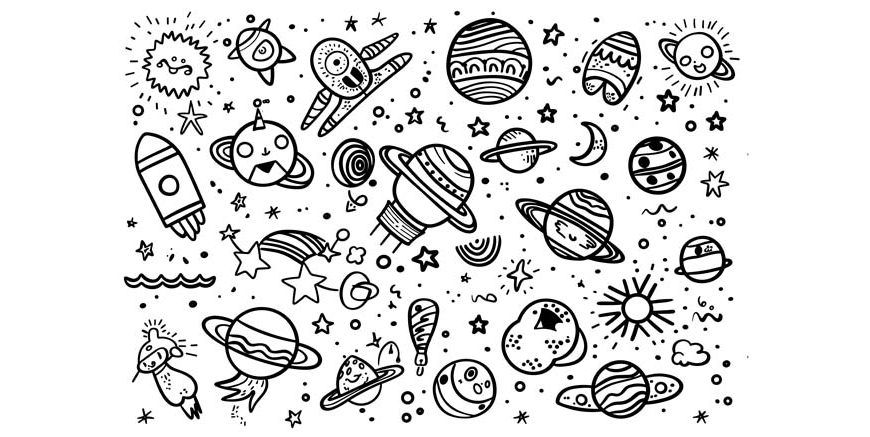
These pages act as visual maps for new vocabulary. Imagine a simple outline of our solar system. As your child picks up a yellow crayon to shade in the giant circle in the center, you can casually introduce the word “Sun.” When they move to the ringed planet, you introduce “Saturn.”
Because the child is physically coloring the object while hearing the English word, their brain builds a strong, permanent bridge between the visual image and the new vocabulary. They are not just memorizing a random word; they are actively bringing that word to life with their own hands.
Read More – Understanding Vocabulary Types
Expanding the Vocabulary: Space Coloring Sheets
To keep the learning process fresh and exciting, it is highly recommended to use a wide variety of space coloring sheets. Different sheets introduce entirely different sets of words. You do not want to just focus on the names of the planets; you want to introduce action words (verbs) and descriptive words (adjectives) as well.
Here are a few ways to use different thematic sheets to expand a child’s English vocabulary:
- The Astronaut Sheet: While coloring a brave explorer in a bulky suit, you can teach words like Helmet, Gloves, Boots, and Float.
- The Alien Planet Sheet: When coloring a strange, bumpy landscape, you can introduce fun adjectives like Bumpy, Crater, Rocky, Dark, and Mysterious.
- The Night Sky Sheet: A sheet filled with tiny celestial bodies is perfect for teaching counting in English, alongside words like Star, Comet, Meteor, and Shine.
By rotating the themes, you ensure that the English vocabulary stays diverse, covering everything from simple nouns to complex descriptive words.
Zooming In: The Spaceship Colouring Page
One of the absolute favorites for any young artist is the vehicle that takes us to the stars. A dedicated spaceship colouring page is a fantastic tool for focused learning.
When a child is coloring a massive rocket, they are usually highly engaged with the exciting idea of speed and exploration. You can use this specific page to teach them the parts of a whole object. Instead of just saying “Rocket,” you can point to different sections as they color:
- The Nose Cone: The pointy top of the ship.
- The Window/Porthole: Where the astronaut looks out.
- The Fins: The wings at the bottom that keep it flying straight.
- The Engine/Flames: The fire pushing it up into the sky.
You can also use this page to practice action phrases. Ask them, “Is the spaceship flying up or down?” or “Can you make the flames look very hot?” This encourages them to respond in English, turning a quiet coloring session into an active, bilingual conversation.
Read More – Small Sentences in English for Kids to Learn Easily
A Parent’s Guide: Color to English Mapping
To help you guide these creative sessions at home, here is a simple table showing how to easily connect basic crayon colors to broader English space vocabulary during your next coloring afternoon.
|
Crayon Color |
English Vocabulary Word |
Concept to Discuss |
|
Yellow |
Sun, Star, Light, Hot |
The sun gives us bright light and keeps the planets warm. |
|
Blue |
Earth, Ocean, Water, Planet |
Earth is called the blue planet because it is covered in oceans. |
|
Red |
Mars, Fire, Engine, Fast |
Mars is a dusty, rocky red planet right next to ours. |
|
Black |
Sky, Space, Dark, Night |
Space is mostly dark and empty, like a giant black blanket. |
|
Silver/Grey |
Spaceship, Moon, Crater, Rock |
The moon is covered in grey dust and giant, bumpy craters. |
Read More – Describing Words for Kids
H2 Conclusion
To summarize our creative language journey, blending art with education is one of the most effective ways to teach young minds. By using outer space coloring pages, sheets, and spaceship designs, we take the massive, intimidating task of learning a new language and shrink it down to the size of a simple crayon. Children naturally learn English vocabulary like stars, planets, flying, and astronauts without ever feeling like they are sitting in a strict classroom.
Watching a child proudly hold up a brightly colored picture of a rocket ship leaves us with a truly thought-provoking realization. The universe is endlessly vast and constantly expanding, and so is a child’s capacity to learn. When we give them the right tools, a bit of paper, some vibrant colors, and a few new words, we are not just teaching them how to speak; we are giving them the exact vocabulary they need to explain their biggest, most astronomical dreams to the rest of the world.
To read more fun and educational articles, check out the EuroKids Blog, and visit our website for details on EuroKids Preschool Admission.
FAQs
How do I keep my child talking if they just want to color quietly?
Do not force the conversation. Instead of asking them direct test questions, simply narrate what they are doing. Say, “I see you are coloring the star yellow,” and let them naturally agree or repeat the word back to you.
Is it better to use markers, crayons, or colored pencils?
For preschoolers, thick crayons are the absolute best choice. They help develop the fine motor skills and grip strength required for proper handwriting later on.
Should I correct my child if they color a planet the “wrong” color?
No, let their imagination run completely wild! If they color the sun purple, just use it as an opportunity to teach the English word “Purple.” Art is about creativity, not strict scientific accuracy.
Where can I find these types of educational coloring sheets?
There are thousands of free, printable options available on educational websites and library resources perfectly tailored to early learners.