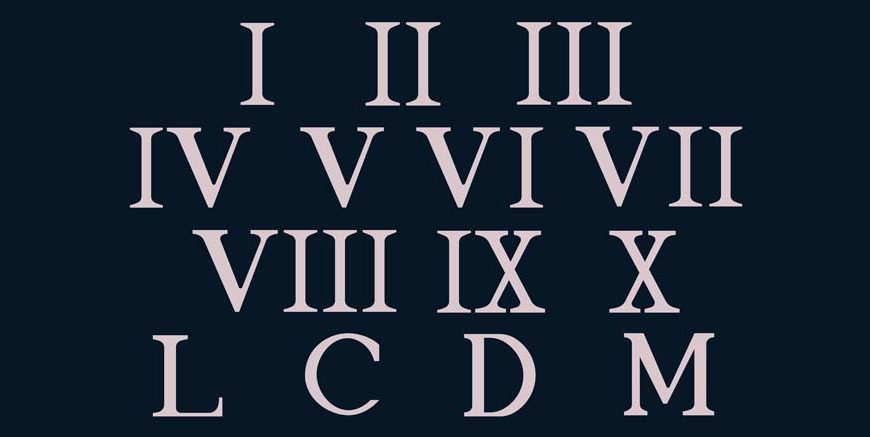
Let us step away from the usual maths textbooks for a moment. Think about a dusty, ancient treasure map or the towering stone pillars of a forgotten palace. If you were searching for hidden clues left behind by the ancient Romans, you would quickly realise something is missing. You would not find our standard, everyday digits like 7, 8, or 9 carved into the grand walls. Instead, you would find a secret code made entirely out of capital alphabet letters!
Today, we are going to act as historical codebreakers and solve a highly specific numerical puzzle. We will explore the number 104 and learn the step-by-step process of translating it into this fascinating ancient language.
The Building Blocks of the Ancient Alphabet Code
Before we can solve a massive puzzle, we must first gather our essential puzzle pieces. The Romans did not have the digits zero through nine. They used seven primary letters to build every single number they needed, much like snapping together colourful plastic bricks. For our special code today, we only need to memorise three important characters:
- C stands for 100. A fantastic trick to help children memorise this is to think of the word ‘Century’, which simply means a hundred years. The ancient Latin word for a hundred was ‘Centum’.
- V stands for 5. If you hold your hand up and stretch your thumb far away from your pointing finger, you make a perfect ‘V’ shape!
- I stands for 1. It looks exactly like a single, straight tally mark drawn on a chalkboard.
Read More – Teaching Kids About Roman Numerals
Decoding the Number 104
When we want to translate a modern digit into this old-fashioned system, the smartest trick is to break the whole amount apart into smaller, friendlier chunks. We must split our target number into hundreds, tens, and units.
First, we pull out the 100. As we just learned from our building blocks, 100 is beautifully represented by the letter C.
Next, we look at the remaining digit, which is 4. Because there are zero tens in this number, we can skip straight to the units! However, building a four requires learning a brilliant historical rule.
The Subtraction Rule
You might assume that to write a four, you simply draw four straight lines, like IIII. However, the Romans were very neat writers and had a strict golden rule: you can never place more than three of the exact same letters next to each other in a row.
To get past this obstacle, they invented a clever subtraction trick. If you place a smaller letter right in front of a bigger letter, you take the smaller amount away. To make a four, we take our letter V (5) and place an I (1) right in front of it. One less than five gives us IV, which is exactly four!
Putting It All Together: 104 in Roman Numeral
Now we simply push our decoded pieces closely together to reveal the final, magnificent answer. We take our hundreds piece (C) and combine it with our units piece (IV).
When we join them on the page, we get CIV! So, if you ever need to write down 104 in Roman Numeral format on a secret playground map, you will boldly write CIV. It is a wonderfully satisfying puzzle to solve, showing us that large values are just small pieces cleverly fitted together.
Read More – The Importance of Math in Everyday Life
Conclusion
Learning to read an ancient numerical system is so much more than just a standard school lesson. It is a brilliant, invisible bridge connecting our modern classrooms directly to the distant past. When a child understands that writing CIV is exactly the same as writing the number 104, they share a secret language with the emperors, builders, and citizens who lived thousands of years ago.
It gently teaches young learners that mathematics is a wonderfully flexible tool, full of hidden patterns and creative rules. The next time you spot a giant grandfather clock or read the publication date in the front of an old storybook, look very closely. You might just spot these familiar letters staring back at you. To uncover more joyful ways to learn and to actively support your child’s brilliant educational journey, explore the EuroKids Blog and find all the details you need about EuroKids Preschool Admission today.
FAQs
What is 104 in Roman numerals?
It is correctly written as CIV.
Why do we use the letters IV to write the number 4?
The system’s rules state you cannot use four identical letters in a row. Placing an I (1) before a V (5) simply subtracts one from five, giving you four.
What does the letter C stand for in this ancient code?
The letter C stands for 100, originating from the ancient Latin word ‘Centum’.