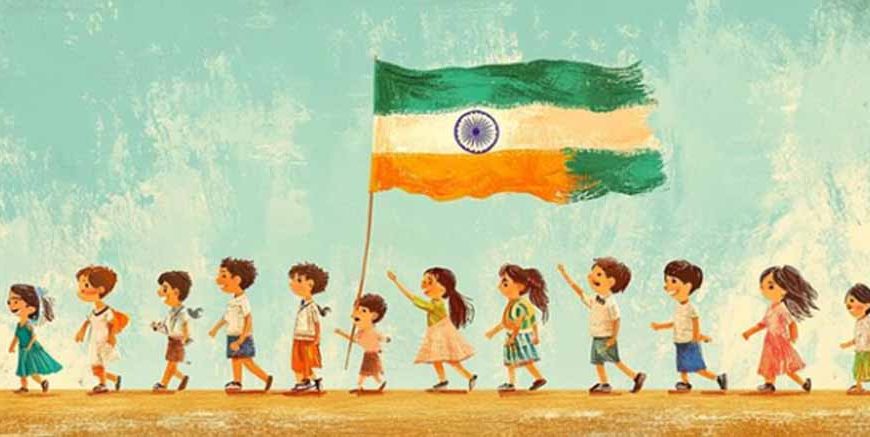
Do you remember standing in your school courtyard on an August morning, looking up as the tricolor flag unfurled against the wind? There is a very specific kind of goosebumps that comes with hearing the national anthem sung by hundreds of tiny voices. It is a shared memory that ties all of us together.
But for young children just starting their educational journey, these feelings of patriotism begin with simple curiosity. They see the tiger at the zoo or draw a peacock in their sketchbooks, not fully realizing the heavy significance these icons carry for our country. Teaching the national symbols of India for kids is less about memorizing a textbook and more about telling them the story of their home.
Whether you are a parent trying to keep your child engaged on a Sunday afternoon or a teacher preparing for a lively classroom quiz, having a solid list of national questions of India is incredibly helpful. Let’s look at why these symbols matter, break down the ideas behind them, and then jump into a mega-list of questions that range from super easy to a few difficult GK questions with answers to really test their growing minds.
Why Do We Have National Symbols?
Think of a school badge or your favorite superhero’s logo. When you see a bat signal, you immediately know it stands for Batman. Countries work in a very similar way. India is a massive, incredibly diverse land with hundreds of languages, different climates, and unique cultures. To bring everyone together under one shared identity, we use symbols.
When we teach these concepts to kids, we explain that the Banyan tree isn’t just a plant; its massive, spreading branches represent the way our country shelters and protects its people. The Bengal Tiger isn’t just a wild cat; it shows our nation’s strength and grace. The Lotus flower grows in muddy water but remains completely untouched and beautiful, teaching us to stay pure and focused no matter what is happening around us.
Understanding these ideas helps children feel connected to their roots. It builds a sense of pride and belonging that goes far beyond the classroom walls.
Read More – States and Capitals of India
The Ultimate Quiz: 50 GK Questions on India’s Symbols
Here is a comprehensive list tailored for students in classes 1, 2, and 3. You can use these to host a fun family trivia night or a quick rapid-fire round before bedtime!
The Tricolor Flag
- What is the National Flag of India called? Answer: Tiranga (The Tricolor).
- How many colors are there in our National Flag? Answer: Three main colors (plus the blue chakra).
- Which color is at the top of the flag? Answer: Saffron.
- Which color is at the bottom of the flag? Answer: Green.
- What does the Saffron color stand for? Answer: Courage and sacrifice.
- What does the White color in the middle represent? Answer: Peace and truth.
- What does the Green color symbolize? Answer: Growth and fertility of the land.
- What is the wheel in the center of the flag called? Answer: The Ashoka Chakra.
- What color is the Ashoka Chakra? Answer: Navy Blue.
- How many spokes does the Ashoka Chakra have? Answer: 24 spokes.
National Emblems and Anthems
- What is the National Anthem of India? Answer: Jana Gana Mana.
- Who wrote our National Anthem? Answer: Rabindranath Tagore.
- How long does it take to sing the National Anthem properly? Answer: 52 seconds.
- What is the National Song of India? Answer: Vande Mataram.
- Who wrote the National Song? Answer: Bankim Chandra Chatterjee.
- What is the National Emblem of India? Answer: The Lion Capital of Ashoka.
- How many lions are a part of the National Emblem? Answer: Four (but only three are visible from the front).
- What are the words written below the National Emblem? Answer: Satyameva Jayate.
- What does ‘Satyameva Jayate’ mean? Answer: Truth Alone Triumphs.
- From which ancient text are the words ‘Satyameva Jayate’ taken? Answer: Mundaka Upanishad.
Flora and Fauna (Plants and Animals)
- Which animal is the National Animal of India? Answer: The Royal Bengal Tiger.
- Which beautiful bird is the National Bird of India? Answer: The Indian Peacock.
- What is the National Flower of India? Answer: The Lotus.
- What is the National Tree of India? Answer: The Banyan Tree.
- Which sweet summer fruit is the National Fruit of India? Answer: Mango.
- What is the National Aquatic Animal of India? Answer: The Ganges River Dolphin.
- What is the National Heritage Animal of India? Answer: The Elephant.
- Which snake is recognized as the National Reptile? Answer: The King Cobra.
General National Identity
- What is the official currency of India? Answer: The Indian Rupee.
- What is the National River of India? Answer: The Ganga (Ganges).
- What is the National Calendar of India called? Answer: The Saka Calendar.
- What is the unofficial National Game of India? Answer: Field Hockey.
- On what date do we celebrate our Independence Day? Answer: 15th August.
- On what date do we celebrate Republic Day? Answer: 26th January.
- Whose birthday is celebrated as Gandhi Jayanti? Answer: Mahatma Gandhi.
- Who is known as the Father of the Nation? Answer: Mahatma Gandhi.
- Who was the very first Prime Minister of independent India? Answer: Jawaharlal Nehru (Chacha Nehru).
- Who was the first President of India? Answer: Dr. Rajendra Prasad.
The Challenge Round (Difficult GK Questions)
If your child breezed through the first 38, try throwing these slightly harder curveballs at them!
- Who originally designed the Indian National Flag? Answer: Pingali Venkayya.
- In which museum is the original Lion Capital of Ashoka kept today? Answer: The Sarnath Museum.
- Look closely at the National Emblem. Which animal is carved on the right side of the wheel? Answer: A Bull.
- Which animal is carved on the left side of the wheel on the Emblem? Answer: A Horse.
- What is the exact length-to-width ratio of the National Flag? Answer: 3:2.
- Before the tiger, which wild cat was the National Animal of India? Answer: The Lion.
- In what year was the National Flag officially adopted? Answer: 1947 (July 22).
- From which famous book was the song Vande Mataram taken? Answer: Anandamath.
- Which language was the National Anthem originally written in? Answer: Bengali.
- What do the 24 spokes in the Ashoka Chakra represent? Answer: The 24 hours of the day, showing constant motion and progress.
- What is the official name of India in the Hindi language? Answer: Bharat.
- Why was the Bengal Tiger chosen as the National Animal over the Lion? Answer: Because tigers are found in almost all states of India, representing the whole country better.
Read More – GK Questions and Answers for Kids
Wrapping Up
When a young child learns that the green in their flag stands for the dirt, the farms, and the trees in their own backyard, it changes how they look at the world. General knowledge isn’t just about winning a spelling bee or a weekend trivia contest. It is about helping kids realize that they are a small but very important piece of a massive, beautiful puzzle. By teaching them about the silent strength of the banyan tree or the bravery represented by the color saffron, you are slowly shaping the values they will carry with them for the rest of their lives.
To read more fun, engaging, and educational articles to share with your little ones, check out the EuroKids Blog, and visit our website for details on EuroKids Preschool Admission.
FAQs
At what age should kids start learning about national symbols?
You can start introducing simple visual symbols like the flag, the peacock, and the tiger as early as 4 or 5 years old through coloring books and stories.
How can I make learning GK fun for my child?
Turn it into a game! Use flashcards, host a family quiz with small prizes, or ask them to draw their favorite national symbol and explain what it means to you.
Why is general knowledge important for primary students?
It builds their confidence, makes them more aware of their surroundings, helps them participate actively in school discussions, and lays the groundwork for understanding history and geography later on.