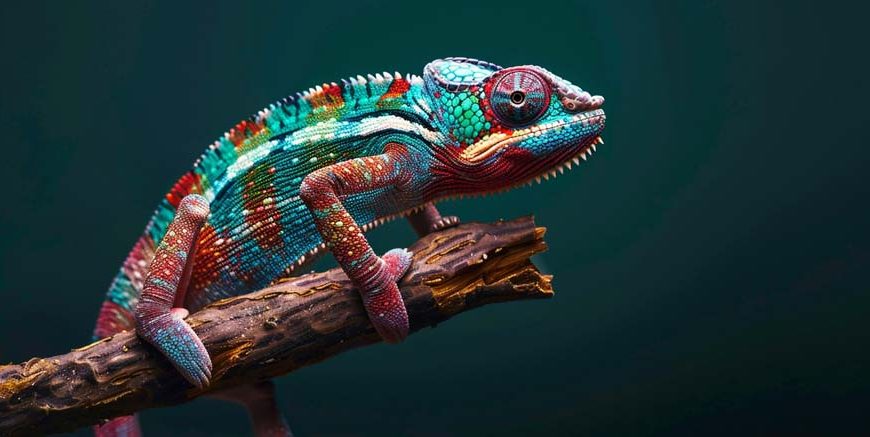
Nature often feels like a puzzle waiting to be solved, and few pieces are as intriguing as the chameleon animal. When a child spots this reptile, their immediate reaction is often a mix of confusion and delight. It looks ancient, almost like a miniature dinosaur that has forgotten to go extinct. As parents and educators, we have a unique opportunity to turn this fascination into a deep learning moment. Rather than dismissing it as just another lizard, we can use the chameleon to teach fundamental concepts about adaptation, biology, and the environment. Understanding this creature requires us to look beyond the cartoons and myths. We must explore the real science behind its colour-changing skin and its robotic movements. By diving into the facts, you help your child build a foundation of scientific inquiry that will serve them well in their academic journey.
What is a Chameleon?
To answer the question what is a chameleon, we must look at its specific place in the animal kingdom. A chameleon is a highly specialised reptile that belongs to the family Chamaeleonidae. Unlike their ground-dwelling cousins who scurry under rocks, these creatures have evolved to rule the treetops. They are the masters of the canopy. The chameleon meaning actually gives us a clue about how ancient cultures viewed them. The name is derived from the Greek words chamai, meaning “on the ground,” and leon, meaning “lion.” The term “earth lion” might seem strange for a shy, tree-loving animal, but it refers to the ornate crests on their heads which look somewhat like a lion’s mane. When you explain this to a student, you are teaching them that names often carry history and hidden descriptions within them.
Read More – Reptile Facts for Kids
The Scientific Name and Classification
When we discuss the chameleon scientific name, we introduce children to the concept of taxonomy. These animals belong to the order Squamata, which they share with snakes and other lizards. However, their specific family name is Chamaeleonidae. This distinction is important because it tells us that the chameleon animal is not just a generic lizard; it is a distinct evolutionary branch. Learning these scientific terms helps students understand that nature is organised. It is not a random collection of animals but a structured system where every creature has a specific family and role. This knowledge helps young minds move from simple observation to structured scientific thinking.
Distinctive Chameleon Characteristics
The physical build of this reptile is an engineering marvel. One of the most defining chameleon characteristics is the structure of their feet. Unlike humans or other lizards who have five separate toes, chameleons have zygodactylous feet. This means their toes are fused into bundles of two and three, creating a pincer-like shape. This allows them to grip branches firmly, ensuring they do not fall even during strong winds. It is essentially like having hands for feet. Additionally, they possess a prehensile tail. This tail functions as a fifth limb. They use it to wrap around stems for stability or to hang on while reaching for the next branch. These features show students that every part of an animal’s body is designed to help it survive in its specific home.
Read More – Flying Animals for Kids
Special Features of Chameleon
The special features of chameleon are what make them truly famous. Their eyes are perhaps the most sophisticated visual tools in the reptile world. The upper and lower eyelids are joined, leaving only a pinhole for the pupil. This structure protects the eye while allowing for sharp focus. Even more impressive is that their eyes move independently. One eye can look forward to hunt while the other looks backward to watch for predators. This gives them a full 360-degree view of their world.
Then there is the phenomenon of colour change. While many people believe chameleons change colour to match their background, the reality is more complex. They primarily use colour to regulate body temperature and communicate emotions. A chameleon might turn dark to absorb heat on a cold morning or flash bright red to warn a rival male to stay away. This biological signaling system relies on specialised cells called chromatophores under their skin. Explaining this corrects a common myth and teaches children that animals have complex ways of talking to each other without using words.
Difference Between Lizard and Chameleon
For a student of nature, spotting the difference between lizard and chameleon is a key skill.
- Movement: Most lizards are fast runners. They rely on speed to escape danger. A chameleon, however, moves with a slow, rocking motion. This “dance” mimics the swaying of leaves in the breeze, making them invisible to predators who track fast movement.
- Tongue: A typical lizard chases its prey and bites it. A chameleon uses a ballistic tongue. This tongue can be twice the length of its body and launches at high speed to snag insects with a sticky tip.
- Eyes: As mentioned earlier, the independent eye movement of a chameleon is unique. Most lizards have fixed eyes that move together, requiring them to turn their heads to see around them.
Read More – Exploring The World of Animals
At EuroKids, we understand that true learning happens when a child engages with the world around them. Our Heureka Curriculum emphasises “Visible Thinking,” a method that encourages children to observe, question, and articulate their understanding of nature. When we study creatures like the chameleon, we are not just memorising facts. We are asking “why” and “how.” We encourage students to look at the chameleon’s grip and ask how that helps it climb, or to observe its slow movement and wonder why it doesn’t run. This approach builds critical thinking skills that go far beyond the classroom.
Conclusion
The chameleon animal is a testament to the ingenuity of nature. From the complex meaning behind its name to the unique chameleon characteristics that allow it to thrive in the canopy, every aspect of this reptile tells a story of survival. By understanding the difference between lizard and chameleon, we teach our children to observe the world with precision and care. These lessons in biology are not just about animals; they are about understanding how life adapts to challenges. We invite you to continue this journey of discovery with us. Explore the EuroKids Blog for more educational resources that make learning fun. If you are ready to place your child in an environment that values curiosity and scientific thinking, please contact us for EuroKids Preschool Admission details today.
Frequently Asked Questions
1. Can chameleons change colour to match any pattern?
No, they cannot turn into plaid or polka dots. Their colour changes are determined by their mood, the temperature, and the light conditions. Camouflage is often just a secondary benefit of these shifts.
2. How fast is a chameleon’s tongue?
Their tongue is incredibly fast. It can accelerate from 0 to 60 miles per hour in a hundredth of a second. This speed ensures that insects rarely have a chance to escape.
3. Do chameleons have ears?
They do not have external ears or ear openings like humans do. However, they are not deaf. They can detect low-frequency sounds and vibrations through the air and the branches they stand on.
4. Why do chameleons rock back and forth?
This rocking motion is a camouflage technique. By moving in a jerky, swaying rhythm, they blend in with the leaves shaking in the wind. This prevents predators like birds and snakes from spotting them.
5. Is a chameleon a good pet for a child?
Chameleons are wild animals that require very specific environments and get stressed easily. They are best observed in nature or at a zoo rather than kept as pets, as they do not like to be held or cuddled.