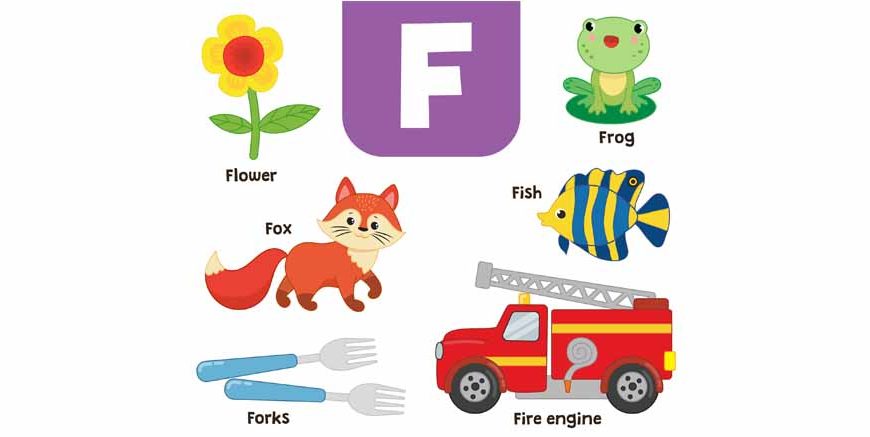
Gently rest your top teeth on your bottom lip and blow a quick puff of air. That soft, breezy sound is the magic of the letter ‘F’! When teaching phonics to early readers, using physical movements helps anchor the alphabet in their growing minds. As they master this specific sound, an entirely new section of the dictionary opens up to them.
Exploring F words gives children the essential vocabulary to describe their family, their feelings, and their favourite foods. Whether you are a parent helping with homework or a teacher planning a spelling test, we have put together a comprehensive guide. Let us dive into some engaging ways to teach these words to our kids, with a master vocabulary list to build a strong foundation for reading ahead.
Spotting F Letter Objects Around the House
To make new vocabulary stick permanently, you have to connect words that start with F to the physical world. Hunting for things that start with the letter F turns a boring spelling lesson into an exciting, active game.
You can walk around the house and point out common F letter objects. Show them the cold Floor they sit on, the shiny Fork they use at the dinner table, or the spinning Fan on the ceiling. Connecting these tangible, everyday items to the breezy sound they just learned helps lock the letter into their memory without the pressure of staring at a blank piece of paper.
Read More – Simple Action Words For Kids
The Master List: 30 F Words for Kids
Breaking down F letter words by their size makes them much easier for young brains to process and memorize. Here is a curated list of exactly 30 essential F words for kids, complete with simple, kid-friendly meanings.
4 Letter Words Starting With F
Once children move past three-letter phonics, 4 letter words starting with F are the perfect stepping stone. They are short, snappy, and highly common in beginner storybooks.
- Face: The front part of your head that holds your eyes, nose, and mouth.
- Fact: A true piece of information that can be proven.
- Fade: To slowly lose bright colour or loudness over time.
- Fail: To not succeed at a task, which simply teaches us to try again.
- Fair: Treating everyone equally and playing nicely by the rules.
- Fall: When things drop down to the ground, or the breezy season before winter.
- Farm: A large piece of land where crops grow and animals live.
- Fast: Moving very quickly, just like a zooming race car.
- Fear: The scary feeling you get when you are frightened by something.
- Feel: To experience an emotion or touch something soft with your hands.
- Find: To discover something that was lost or hidden away.
- Fire: The bright, hot flames that keep us warm on a cold night.
- Fish: An animal with gills and fins that swims underwater.
- Flag: A colourful piece of cloth that represents a country or a team.
- Food: The yummy things we eat to grow strong and healthy.
- Fork: A handy tool with small prongs used to pick up bites of dinner.
- Frog: A small, green, jumping animal that loves sitting near ponds.
- Full: Holding as much as possible, with absolutely no empty space left.
5 Letter Words Starting With F
As their confidence grows, you can challenge them with 5 letter words starting with F. These words help kids describe actions, stories, and abstract ideas much more accurately.
- Fable: A short, fun story that teaches a helpful moral lesson.
- Fairy: A tiny, magical creature often found in bedtime storybooks.
- Fancy: Something that looks highly decorated, special, or elegant.
- Feast: A massive, delicious meal eaten during a big celebration.
- Field: A wide, open area of grass where children can run and play sports.
- Fight: A disagreement or physical struggle between people.
- Flock: A large group of birds flying or resting closely together.
- Floor: The flat, solid surface of a room that you walk and stand on.
- Flute: A long, thin musical instrument you blow into to make sweet sounds.
- Focus: To pay very close attention to one specific task or thing.
- Force: A strong push or pull that makes heavy objects move.
- Funny: Something that makes you smile, giggle, and laugh out loud.
Read More – List of 3 Letter Words in English
Conclusion
To wrap up our vocabulary guide, teaching children this breezy letter greatly expands their ability to describe their daily lives. By starting with tangible objects around the kitchen and slowly introducing four and five-letter words, you build their reading confidence step by step without making it feel like a chore.
Reviewing these lists leaves us with a fascinating perspective on language. A single letter holds the power to express completely different parts of the human experience. The exact same letter that gives us the terrifying concept of “Fear” also provides the wonderful joy of “Family,” “Friends,” and feeling completely “Free.” Giving your child these spelling tools means handing them the ultimate key to understand and communicate their complex, beautiful world.
To read more fun and educational articles, check out the EuroKids Blog, and visit our website for details on EuroKids Preschool Admission.
FAQs
What is the easiest way to teach a toddler the ‘F’ sound?
Have them look in a mirror, place their top teeth over their bottom lip, and blow gently. Feeling the air on their chin helps them physically understand how the sound is produced.
Why do some words sound like ‘F’ but start with ‘PH’?
The English language borrows heavily from ancient Greek. Words like “Phone” or “Photo” use ‘PH’ to make the exact same sound, which is a great rule to teach kids once they master basic spelling.
At what age should children start learning five-letter words?
Every child learns at their own pace, but most are ready to tackle five-letter words around age five or six, right after they become highly comfortable sounding out three and four-letter words.
How can I make learning these spelling words more fun?
Skip the paper and pencils! Let your child use a playdough to shape the letters on the table, or use a stick to write the words in the mud or sand while playing outside.