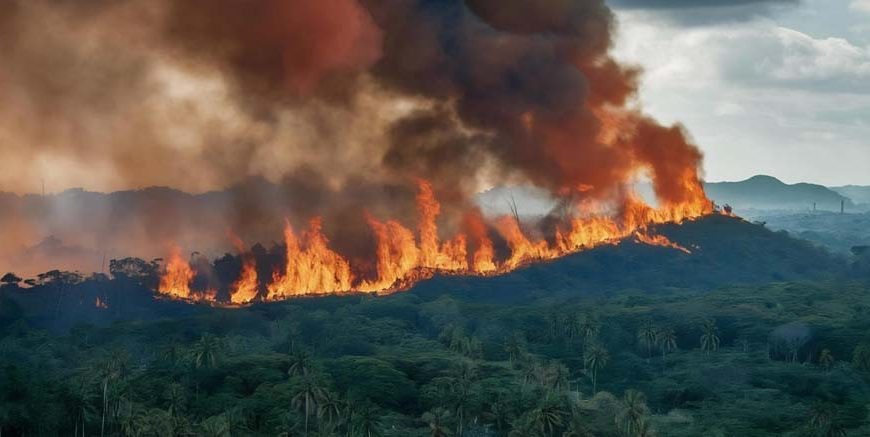
Imagine a blazing hot summer day. The sun is beating down on the woods. You step on a pile of brown leaves, and they crunch loudly under your sneakers like dry potato chips. The soil is incredibly dusty, and the trees look completely thirsty. In conditions exactly like this, the woods are basically sitting there like a giant, dry sponge waiting for a single, tiny spark.
When that spark finally happens, a quiet, peaceful forest can turn into a roaring wall of heat in just a few minutes. This isn’t an exaggerated scene from a summer action movie. It happens in real life all over the globe, and it changes the landscape forever. Let’s look closely at how these massive fires start, what they do to the animals living in the woods, and how brave people fight to stop them.
What Exactly Is It?
Before we look at the causes, we need to get our facts straight with a clear wildfire definition. If a teacher asks you to define wildfire, you can simply tell them it is a massive, uncontrolled fire that spreads rapidly across nature. It doesn’t happen in the middle of a busy city street or inside an office building. Instead, it tears aggressively through wild areas like thick woods, wide-open grassy plains, or dry, brush-covered hills. Because the rushing wind can carry the flames from the very tops of tall trees down to the dry grass below, a wildfire is incredibly unpredictable. It can jump completely over wide rivers and paved highways, making it a terrifying force of nature to deal with.
Read More – What Is Deforestation?
Nature vs. Human Mistakes
A lot of kids naturally wonder: is forest fire a natural disaster? The answer is actually a mix of yes and no. A wildfire natural disaster happens when nature itself strikes the match. Have you ever stood by your window and watched a massive thunderstorm where lightning flashes aggressively across the sky? If a super-hot lightning bolt strikes an old, dry, dead tree in the middle of nowhere, it can easily set the wood on fire. When the flames spread across the land without any human help at all, we call those events natural disasters forest fire.
However, the scary truth is that the vast majority of these fires are actually started by people making simple, careless mistakes. A family might leave a tiny, smoldering campfire burning when they pack up their tents and go home. A passing car might toss something hot out the window into the dry grass. Or, someone might be playing with matches near dry bushes. When humans trigger the flames through carelessness, it becomes a man-made fire disaster that could have easily been avoided.
The Massive Environmental Impact
If you ever have to write a detailed forest fire essay for a school project, you definitely need to talk about the huge impacts these events have on the local environment.
A forest fire disaster leaves a massive, dark mark on the ecosystem. Think about all the animals living quietly in the woods. Deer, rabbits, birds, and thousands of tiny bugs all have to run or fly away as fast as their legs and wings can carry them to escape the thick smoke and heat. Many of them lose their cozy homes, their hidden nests, and their daily food supplies. The flames also burn down thousands of beautiful, ancient trees that took hundreds of years to grow to their current height. Even the rich soil gets scorched so badly that new seeds struggle to sprout for a very long time.
Fighting the Flames
But there are brave people whose entire job is to stop this kind of destruction. This is where the intense science of forest fire disaster management steps in.
Imagine a team of real-life superheroes wearing heavy yellow and orange gear. These are the wildland firefighters. They don’t just use standard water hoses like city firefighters do. Instead, they hike deep into the woods and dig deep, wide trenches in the dirt using heavy shovels, axes, and bulldozers. Why? Because fire needs fuel, like dry grass and crunchy leaves, to keep moving forward. If the rolling fire hits a wide ditch of plain, bare dirt, it starves and stops.
Sometimes, giant airplanes and helicopters fly directly over the roaring flames, dropping thousands of gallons of bright red, fire-retardant liquid to cool the area down. It is a massive, dangerous, and highly coordinated team effort to protect the woods and any nearby neighborhoods.
Read More – Fun and Engaging Fire Safety Facts for Kids
Wrap Up
It is pretty wild to think about how a tiny, invisible spark can completely rewrite the map of a giant forest. Fire is a powerful, greedy force that doesn’t care what stands in its way. But nature has a surprising, magical secret. Even after the worst flames completely die down and the ground looks like black, dusty charcoal, life eventually finds a way to come back.
Tiny green shoots push fiercely through the dark ashes. In fact, certain pine cones actually need the extreme, blazing heat of a fire to pop open and drop their seeds into the dirt. The forest slowly rebuilds itself over the years, proving to us that even after a massive, destructive disaster, hope and new life are always waiting quietly just beneath the surface.
To read more fun, engaging, and educational articles, check out the EuroKids Blog, and visit our website for details on EuroKids Preschool Admission.
FAQs
How do firefighters know where a fire will move next?
They study the weather! Wildfires are heavily driven by the wind, the temperature, and how dry the air is. By tracking the wind direction, firefighters can guess where the flames will jump next.
Do all the animals get hurt during a fire?
Thankfully, no. Most animals have amazing survival instincts. Birds simply fly away, fast animals run ahead of the smoke, and many small critters dig deep underground where the heat cannot reach them.
What is the best way to prevent man-made fires?
Never play with matches, and always make sure that campfires are completely drowned in water and totally cold to the touch before leaving a campsite!
Can smoke from a wildfire reach my town?
Yes. The wind can carry thick clouds of smoke hundreds of miles away from the actual fire, which is why the sky sometimes looks hazy or smells like a campfire even if you live far away from the woods.