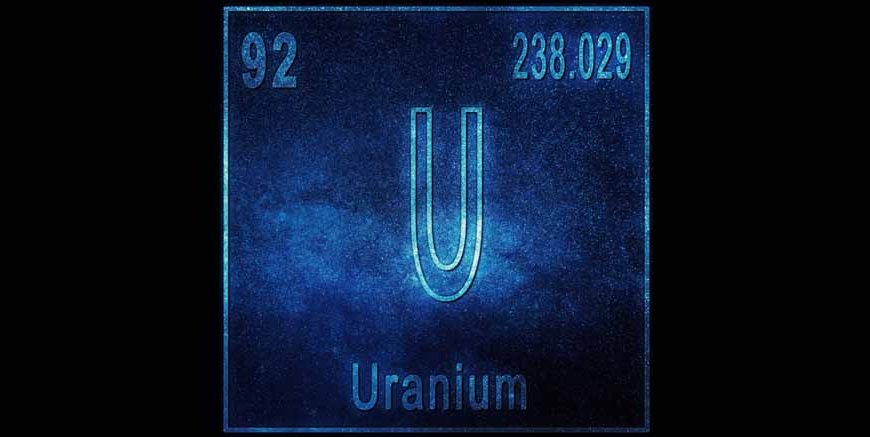
Uranium is one of the most important elements studied in science due to its role in energy production, national security, and technological development. In India, uranium holds special significance because it supports nuclear power generation, which helps meet the country’s growing electricity needs.
Here, we will explain in detail what uranium is, its properties, its discovery, mining, uses, and key facts, in a simple, structured way for students.
What Is Uranium?
Uranium is a naturally occurring chemical element found in the Earth’s crust. It is a heavy, radioactive substance mainly used as fuel in nuclear power plants.
To define uranium, it can be described as a radioactive metal that releases a large amount of energy when its atoms split in a controlled nuclear reaction.
- Uranium meaning: A naturally occurring radioactive element used as a source of nuclear energy
- Uranium meaning in English: A heavy metal element used for producing atomic energy
So, when students ask what uranium is, the simplest explanation is that it is an element that helps generate electricity through nuclear power.
Read More – How Do You Make Science Interesting for Kids?
Uranium Element and Atomic Structure
The uranium element belongs to the actinide series in the periodic table.
Basic Atomic Details
- Symbol: U
- Atomic number: 92
- Uranium atom: Contains 92 protons and is naturally unstable
- Valency of uranium: Commonly 4 and 6
Because of its unstable atomic structure, uranium undergoes radioactive decay, releasing energy.
Is Uranium a Metal?
Yes, uranium is a metal and is classified as a metallic element.
Metallic Characteristics
- High density
- Silvery-grey appearance
- Conducts heat
- Solid at room temperature
However, unlike iron or copper, uranium is radioactive, which makes it unique among metals.
Discovery of Uranium
Uranium was discovered by German chemist Martin Heinrich Klaproth in 1789.
He named the element after the planet Uranus, which had been discovered a few years earlier. Initially, uranium was used for colouring glass and ceramics, not for energy production.
Properties of Uranium
Understanding the properties of uranium helps explain why it is useful in nuclear technology.
Physical Properties of Uranium
- Colour: Silvery-grey
- Very heavy and dense
- High melting point
- Solid at normal temperatures
Chemical Properties of Uranium
- Reacts with oxygen
- Forms uranium oxides
- Highly radioactive
These properties enable efficient use of uranium in nuclear reactors.
Read More – Science Quiz Questions and Answers for Kids
How Is Uranium Formed?
Uranium was formed billions of years ago during the formation of the Earth.
It originated from stellar explosions (supernovae) before the Earth was formed and later became part of the Earth’s crust. Hence, uranium is a naturally occurring element and not man-made.
Uranium Mineral and Ore
Uranium is not found freely in nature. It occurs in rocks as an ore of uranium.
Uranium Ore Name
- Carnotite – Carnotite is an ore of uranium
- Pitchblende
- Uraninite
These ores are mined and processed to extract usable uranium.
Uranium Stone
In simple terms, uranium stone refers to rocks that contain uranium minerals. These stones are usually found underground and require scientific methods for safe extraction.
Where Is Uranium Readily Found?
- Australia
- Kazakhstan
- Canada
- Russia
Uranium in India
Uranium is found in several regions of India, making the country partially self-reliant in nuclear fuel.
Major locations include:
- Jaduguda, Jharkhand
- Tummalapalle, Andhra Pradesh
- Telangana
- Rajasthan
Uranium Mining
Uranium mining involves safely and responsibly extracting uranium ore from the Earth.
Uranium Mining in India
Uranium mining in India is carried out by Uranium Corporation of India Limited (UCIL) under strict safety guidelines.
Steps involved:
- Identifying uranium-rich areas
- Extracting uranium ore
- Processing and refining
Mining is carefully regulated because uranium is radioactive.
Read More – Fascinating Facts About Earth for Kids
Uranium as an Energy Resource
Uranium plays a crucial role in energy production.
- Uranium is a dash energy resource → Non-renewable
- Uranium is a dash energy resource → Non-renewable
It cannot be replaced quickly once used, but a small amount of uranium produces a large amount of energy.
What Is Uranium Used For?
Uranium Uses
The most important uses of uranium are in nuclear energy.
H4 – Major Uses of Uranium
- Fuel in nuclear power plants
- Production of electricity
- Scientific research
- Medical radioisotopes
- Defence applications
What Is Uranium Used For in India?
In India, uranium is mainly used to:
- Support nuclear energy programmes
- Reduce dependence on fossil fuels
- Promote clean energy
Thus, uranium is used primarily for electricity generation.
Real Uranium and Safety
Real uranium is radioactive and must be handled only by trained professionals. Strict safety measures are followed during mining, transport, and use to protect people and the environment.
How EuroKids Builds Strong EVS Foundations
When Environmental Studies (EVS) is introduced through observation, storytelling, nature walks, and hands-on exploration, young learners begin to understand their surroundings in a meaningful and lasting way. Instead of memorising facts about plants, animals, or seasons, children learn by experiencing and questioning the world around them. This is why structured early education programs focus on experiential and inquiry-based learning rather than rote memorisation.
At EuroKids, foundational EVS concepts are nurtured through the HEUREKA – Visible Thinking Curriculum. This approach encourages children to explore themes such as “My Family,” “My Community,” “Plants and Animals,” “Seasons and Weather,” and “Good Habits” through interactive discussions, thematic projects, role play, outdoor exploration, and guided observation.
The Visible Thinking framework helps children observe carefully, think deeply, and express their ideas confidently. Through activities like nature-based learning, environmental awareness projects, sensory exploration, and group conversations, children develop curiosity about how things grow, how communities function, and how they can care for the environment.
With a child-centric and play-based methodology refined over 20+ years and implemented across 1600+ preschools, EuroKids focuses on building awareness, responsibility, and curiosity first, allowing knowledge, empathy, and critical thinking skills to develop naturally over time.
Important Facts About Uranium
Here are some key facts students should know:
- Uranium is one of the heaviest naturally occurring elements
- It produces large amounts of energy from small quantities
- Uranium is found in rocks and soil worldwide
- It is essential for nuclear power generation
Summary: About Uranium
To summarise uranium:
- Uranium is a radioactive metallic element
- It is a non-renewable energy resource
- Found in uranium ore such as carnotite
- Used mainly for electricity generation
Understanding uranium helps students learn about modern energy sources and India’s role in nuclear technology.
To explore more learning ideas, simple explanations, and early childhood resources, parents
can visit the EuroKids Blog. Those who wish to understand the preschool journey better or
explore enrolment options can find complete information on the EuroKids Preschool Admission
Page, where learning is designed to be joyful, engaging, and child-friendly.