National Science Day is a wonderful opportunity to introduce young children to the magic of science. For young kids, science is not about formulas or textbooks. It’s about curiosity, colours, bubbles, and fun discoveries. Younger children learn best when they can touch, see, and explore. Simple hands-on activities help them ask questions like:
- Why does this float?
- How did the colours mix?
- Where did the water go?
In this blog, we will share some fun and exciting kids’ science experiments. But first, let’s understand why parents/teachers must celebrate Science Day with experiments.
Why Celebrate National Science Day with Experiments?
For young children, science experiments:
- Build curiosity
- Improve observation skills
- Encourage problem-solving
- Make learning joyful
National Science Day becomes more meaningful when children actively participate instead of just listening.
Easy Kids Science Experiments for Young Kids
Here are 10 easy kids science experiments which can be executed at home or a school:
1. Rainbow Milk Magic
Age Group: Preschool – Class 2
Materials Required:
- Milk
- Food colours
- Dish soap
- Cotton bud
Pour milk into a shallow plate. Add drops of different food colours. Dip a cotton bud in dish soap and touch the milk.
What Happens?
The colours start swirling and moving!
What Kids Learn:
- Soap breaks the surface tension of milk, causing the colours to move.
- It’s colourful, magical, and perfect for little learners.
2. Water Walking Rainbow
Age Group: Preschool – Class 2
Materials Required:
- Clear cups
- Water
- Food coloring
- Paper towels
Fill some cups with colored water and leave some empty. Place folded paper towels between cups like bridges.
What Happens?
The colored water “walks” into the empty cups and mixes to form new colours.
What Kids Learn:
Water can travel through paper, just like plants absorb water through roots.
3. Balloon Rocket
Age Group: Class 1–2
Materials Required:
- Balloon
- Straw
- String
- Tape
Thread the string through a straw and tape it to a balloon. Release the air.
What Happens?
The balloon zooms forward like a rocket!
What Kids Learn:
Air rushing out pushes the balloon forward.
4. Water Cycle in a Bag
Age Group: Preschool – Class 2
Materials Required:
- Ziplock bag
- Water
- Tape
- Sunny window
Tape a water-filled bag to a window and observe for a few days.
What Happens?
Water droplets form inside the bag.
What Kids Learn:
Water evaporates and comes back as droplets, just like rain.
5. Floating Egg
Age Group: Class 1–2
Materials Required:
- Egg
- Water
- Salt
Place the egg in plain water (it sinks). Add salt and stir.
What Happens?
The egg floats!
What Kids Learn:
Salt makes water denser, helping the egg float.
6. Dancing Raisins
Age Group: Class 1–2
Materials Required:
- Raisins
- Soda
- Becker/Glass
Drop raisins into soda.
What Happens?
Raisins move up and down like they’re dancing.
What Kids Learn:
Gas bubbles lift raisins up, and when bubbles burst, they sink again.
7. Sink or Float Game
Age Group: Preschool – Class 2
Give children objects like:
- Stone
- Leaf
- Plastic spoon
- Coin
And let them guess what will sink or float.
What Kids Learn:
Different objects behave differently in water. This is a great way to introduce the scientific method:
- Predict
- Test
- Observe
8. Invisible Ink
Age Group: Class 2 (with supervision)
Write with lemon juice. Heat gently to reveal the message. Children feel like little scientists discovering secrets.
9. Rainbow in a Jar
Age Group: Class 1–2
Layer honey, dish soap, water, and oil in a jar. And let kids observe how liquids stay in separate layers.
10. Homemade Slime
Age Group: All early primary
Mix glue and liquid starch. And let children explore textures and learn how materials can behave like both solids and liquids.
Read More – Friendly Science Experiments
Simple Science Models for Young Kids
Besides doing science experiments with kids, parents or teachers can also make some miniature, real-life-inspired science models with their little ones. Demonstration is a great way to teach kids about science. Here are some simple science models you can introduce, or rather make with kids, on National Science Day or later:
- Volcano: You can use everyday ingredients like baking soda and vinegar to create bubbling volcanoes. Just put these ingredients into a clear glass or a flat-surfaced bowl and teach kids about chemical reactions.
- Solar System Model: Use thermocol balls or clay to create planets. Then share interesting facts about each planet with your little ones. This helps children understand space visually, which enhances learning and ensures your little one never forgets what they have learned.
- Water Filtration Model: Layer stones, sand, and cotton in a bottle to clean dirty water.
This science experiment teaches the importance of clean water.Read More – Solar System Project For Kids
How to Celebrate a Fun National Science Day Celebration at Home or School
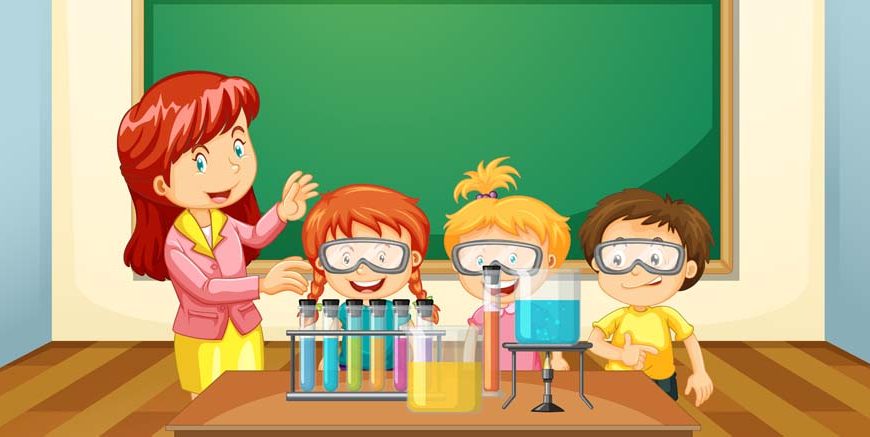
National Science Day doesn’t need a laboratory, fancy equipment, or a big event. For preschoolers and young children, the goal of celebrating this day is simply to spark curiosity and make science feel like play.
Whether you are a parent planning a fun afternoon at home or a teacher organising a small classroom celebration, a simple science setup can create lifelong memories. Here are some ways to organise a fun and exciting Science Day celebration:
Create Mini Science Stations
Instead of doing one long activity, set up small experiment corners. Children have short attention spans, so rotating between stations keeps them excited and engaged. You can create water experiment stations or a creative science section as you like.
Organise a Mini Science Fair at Home or School
Parents often think science fairs are only for big schools. But even a tiny living-room science fair feels magical to a child. You can:
- Ask your child to demonstrate one experiment to family members
- Let siblings participate
- Invite cousins or neighbours
Give your child a small role:
- “Science helper”
- “Junior scientist”
- “Experiment presenter”
This boosts confidence and makes the day special.
Create a Science Poster Corner
Young children love drawing and colouring. Set up a corner with crayons and chart paper. This turns art into learning without pressure.
Safety Guidelines for Parents and Teachers
Safety should always come first, especially with preschoolers. Here are some ways to ensure safety for the little scientists:
- Always supervise experiments
- Children love exploring but may not understand risks. Stay nearby and guide each activity.
- Avoid fire-based experiments for young kids
- Experiments involving flames or heat should be skipped or done only as teacher demonstrations for older children.
- Use safe household materials
- Choose simple items such as:
- Water
- Food coloring
- Paper towels
- Balloons
- Soap
- Salt
- Avoid chemicals or sharp tools.
- Keep experiments simple and mess-friendly
Conclusion
National Science Day is the perfect chance to show young children that science is not difficult. It is exciting, colourful, and everywhere around us. By organising easy science experiments for kids on National Science Day, you can help children fall in love with learning.
You can also visit the EuroKids blog for more insightful and fun articles on your baby’s growth, health, and learning. Don’t forget to check out EuroKids Preschool Admission for the perfect foundation to kickstart your little one’s learning journey.