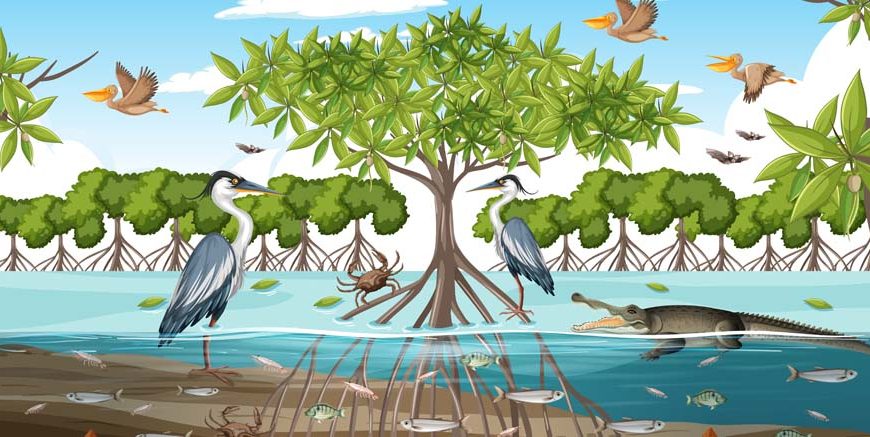
Mangrove forests are one of the most unique and important ecosystems on Earth. Found along tropical and subtropical coastlines, these forests grow in salty, muddy, and waterlogged conditions where most plants cannot survive. In India, mangrove forests play a vital role in protecting coastlines, supporting biodiversity, and sustaining local livelihoods.
Here, we will explain in detail what a mangrove forest is, its meaning, definition, vegetation, adaptations, animals, examples, characteristics, and uses, with special reference to India and Class 9 geography.
What Is a Mangrove Forest?
Mangrove Forest Meaning
A mangrove forest is a forest ecosystem composed of salt-tolerant trees and shrubs that grow in coastal areas, river deltas, and tidal regions.
Define Mangrove Forest
Mangrove forest definition:
A mangrove forest is a coastal forest found in saline or brackish water regions, dominated by mangrove trees that are specially adapted to survive in tidal, waterlogged, and salty conditions.
In simple words, mangrove forests grow where land meets sea.
Read More – About Forests for Kids
About Mangrove Forests in India
India has one of the largest mangrove areas in the world.
Where Is Mangrove Forest Mainly Found in India?
Mangrove forests are mainly found in:
- Sundarbans (West Bengal) – the largest mangrove forest in the world
- Andaman and Nicobar Islands
- Odisha coast
- Andhra Pradesh
- Tamil Nadu
- Gujarat (Gulf of Kutch)
So, when asked where a mangrove forest is mainly found in India, the most important answer is the Sundarbans delta.
It is famous for:
- Royal Bengal Tiger
- Dense mangrove vegetation
- Tidal waterways
Mangrove Forest Vegetation
Mangrove Vegetation
Mangrove vegetation consists of trees and shrubs that can tolerate:
- High salinity
- Low oxygen in soil
- Daily flooding by tides
Mangrove Forest Vegetation Features
- Thick roots
- Evergreen leaves
- Special breathing roots
This makes mangrove forest vegetation very different from other forests.
Mangrove Forest Trees
Mangrove Trees Names
Some common mangrove tree names found in India include:
- Sundari
- Rhizophora
- Avicennia
- Bruguiera
- Sonneratia
These are important trees found in a mangrove forest.
Read More – Facts About Jungle
Mangrove Plants Name and Examples
Mangrove Plants Examples
- Sundari tree (mangrove plant example)
- Red mangrove
- Black mangrove
- White mangrove
These are common names for mangrove plants taught in school geography.
Types of Mangroves
There are mainly three types of mangroves based on their position:
- Red Mangroves – grow closest to water
- Black Mangroves – grow slightly inland
- White Mangroves – found farthest from the coast
These different types of mangroves help stabilise coastal ecosystems.
Characteristics of Mangrove Forest
The main characteristics of mangrove forests include:
- Found in tidal coastal areas
- Grow in saline or brackish water
- Have special root systems
- Dense and evergreen vegetation
These features of mangrove forests help them survive harsh conditions.
Characteristics of Mangroves (Plants)
Some important characteristics of mangroves are:
- Salt tolerance
- Viviparous seeds (seeds germinate on the tree)
- Breathing roots (pneumatophores)
- Strong root systems
These characteristics make mangroves unique.
Mangrove Adaptations
Mangrove adaptations are special features that help plants survive in salty, muddy, and low-oxygen environments.
Key adaptations include:
- Aerial roots for breathing
- Salt-excreting leaves
- Prop roots for support
- Vivipary for seed survival
Mangrove Tree Habitat
The mangrove tree habitat includes:
- Coastal deltas
- Estuaries
- Backwaters
- Tidal mudflats
This shows that mangrove forests can thrive in areas where land and sea interact.
Read More – Helping Kids Understand the Importance of Trees
Rainfall of Mangrove Forest
Mangrove Forest Precipitation
The rainfall of the mangrove forest is generally:
- Moderate to heavy
- Between 100 and 250 cm annually
High precipitation in mangrove forests supports dense vegetation.
Mangrove Forest Animals
Mangrove forest animals are specially adapted to live in waterlogged and tidal environments.
Mangrove Forest Animals in India
Some famous mangrove forest animals in India are:
- Royal Bengal Tiger (Sundarbans)
- Estuarine crocodile
- Fishing cat
- Monitor lizard
- Mudskippers
These animals depend on mangrove ecosystems for survival.
Mangrove Animals Adaptations
Mangrove animals show adaptations such as:
- Ability to breathe in muddy water
- Climbing roots and trees
- Camouflage
- Tolerance to changing tides
This allows mangrove animals to survive harsh coastal conditions.
Information About Mangrove Forest (Quick Facts)
Here is some key information about mangrove forests:
- Protect coastlines from erosion
- Reducethe impact of cyclones and tsunamis
- Support fisheries
- Act as carbon sinks
Uses of Mangrove Forest
The uses of mangrove forests are very important:
Coastal Protection
- Prevents soil erosion
- Reduces storm damage
Biodiversity Support
- Habitat for animals
- Nursery for fish
Livelihood Support
- Fishing
- Honey collection
Environmental Benefits
- Carbon storage
- Climate regulation
About Mangroves and Climate Change
Mangroves help fight climate change by:
- Absorbing carbon dioxide
- Protecting coasts from rising sea levels
This makes mangroves a crucial topic today.
How EuroKids Builds Strong EVS Foundations
When Environmental Studies (EVS) is introduced through observation, storytelling, nature walks, and hands-on exploration, young learners begin to understand their surroundings in a meaningful and lasting way. Instead of memorising facts about plants, animals, or seasons, children learn by experiencing and questioning the world around them. This is why structured early education programs focus on experiential and inquiry-based learning rather than rote memorisation.
At EuroKids, foundational EVS concepts are nurtured through the HEUREKA – Visible Thinking Curriculum. This approach encourages children to explore themes such as “My Family,” “My Community,” “Plants and Animals,” “Seasons and Weather,” and “Good Habits” through interactive discussions, thematic projects, role play, outdoor exploration, and guided observation.
The Visible Thinking framework helps children observe carefully, think deeply, and express their ideas confidently. Through activities like nature-based learning, environmental awareness projects, sensory exploration, and group conversations, children develop curiosity about how things grow, how communities function, and how they can care for the environment.
With a child-centric and play-based methodology refined over 20+ years and implemented across 1600+ preschools, EuroKids focuses on building awareness, responsibility, and curiosity first, allowing knowledge, empathy, and critical thinking skills to develop naturally over time.
About Mangrove Forest: Summary
To summarise the mangrove forest:
- Mangroves are salt-tolerant forests
- Found along coastlines
- Support rich biodiversity
- Essential for India’s coastal ecology
Mangrove forests are among the most valuable and unique ecosystems in the world. With their special mangrove adaptations, dense mangrove forest vegetation, and diverse mangrove forest animals, they protect coastlines, support wildlife, and help fight climate change.
In India, mangrove forests like the Sundarbans are not only natural treasures but also lifelines for millions of people.
Understanding mangrove forests helps students appreciate nature and the importance of conserving fragile ecosystems.
To explore more learning ideas, simple explanations, and early childhood resources, parents
can visit the EuroKids Blog. Those who wish to understand the preschool journey better or
explore enrolment options can find complete information on the EuroKids Preschool Admission
Page, where learning is designed to be joyful, engaging, and child-friendly.