Watch a toddler sit in a sandbox for just five minutes, and you will witness a fascinating, highly focused science experiment. They scoop handfuls of gritty dirt into a bright plastic bucket, pat the top down firmly, and then immediately tip the bucket over to pour every last grain back out. They will happily repeat this exact cycle dozens of times. This repetitive action is not just random, messy play. It is a young child actively trying to understand volume, capacity, and physical space.
Long before children ever look at a ruler or a measuring cup, they rely on visual cues to understand how the physical world operates. Today, we are going to explore how early learners process spatial awareness, how to properly introduce these vocabulary words, and why pointing out these simple states of matter is so important for their growing brains.
How Do We Define Full?
When teaching young kids, keeping the language simple and relatable is the golden rule. If a curious child looks at a cookie jar and asks you to define it full, you can tell them it simply means holding as much as possible.
You can explain that when a container cannot take even one more drop of liquid, one more wooden block, or one more tiny crumb without spilling completely over the edge, it has reached its absolute physical limit. It is packed completely to the top, leaving zero room for anything else to squeeze inside.
The Core Difference: Full and Empty
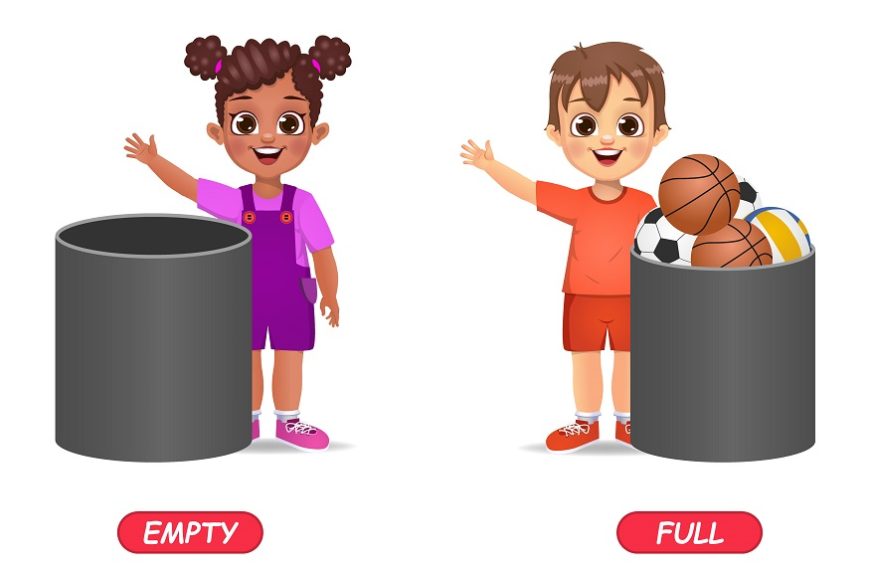
To truly grasp this idea, children need to see the extremes side-by-side. The physical relationship between full and empty is a classic, foundational lesson in basic opposites.
Think of a shiny glass of orange juice at the breakfast table. When a parent first pours the juice, the sweet liquid rises to touch the very rim of the glass. The container is completely packed. But after the child takes several big, thirsty gulps, there is absolutely nothing left inside except a few sticky orange bubbles resting at the bottom. The glass is now completely void of any liquid. Showing these two drastic, completely different states together helps young brains instantly recognize the stark contrast between having “maximum capacity” and having “absolutely nothing.”
Educational Importance: The Full and Empty Concept for Kindergarten
You might wonder why early educators spend dedicated time pointing out something that seems so obvious to adults. However, mastering the full and empty concept for kindergarten is actually a critical stepping stone for early mathematics and logical reasoning.
Before a child can eventually add big numbers together or carefully measure cups of baking flour for a cake, they have to understand basic capacity. This early foundational lesson teaches them crucial observation skills. It helps them visually compare quantities, estimate physical space, and build their descriptive vocabulary. They learn to evaluate the world around them by looking at a heavy toy chest and deciding if more cars can fit inside, or looking at their dinner plate to easily communicate if their food is all gone.
Read More – Teaching Top, Bottom, and Middle Concepts to Preschoolers
Moving Beyond the Basics: The Middle Ground
Once a child masters the absolute extremes, the learning process naturally evolves. They start to realize that the physical world isn’t just black and white.
If a water bottle is not filled to the very brim, but it also isn’t completely dry, what do we call it? This is the perfect opportunity to introduce intermediate descriptive words like “half,” “some,” “partially,” or “almost.” By learning these middle-ground terms, children develop a much more precise, accurate way to communicate their daily needs. If they want just a tiny sip of milk before bedtime, they learn to ask for a “little bit” rather than a cup that is packed to the top.
Read More – Basic Geometric Concepts and Formulas for Students
Fun Everyday Examples for Kids
The absolute best way to teach spatial lessons is through hands-on, messy, interactive play. Kids learn best when they can physically touch the materials. Here are some real-life scenarios that make learning these opposites incredibly fun:
- The Toy Box Test: Ask your child to pack their wooden building blocks into a small cardboard box until not a single extra block fits. Point out that the box has reached its maximum limit. Then, have them dump the box upside down on the rug to show the exact opposite state.
- The Bath Time Pour: Give your child two plastic cups during their evening bath. Let them scoop warm, soapy water into one cup to the very top, and then pour it completely into the other empty cup. They can physically feel the heavy cup turn as light as a feather as the water transfers from one place to the other.
- The Hungry Tummy: Use their own bodies as a fantastic biological example! Before dinner time, their tummy might feel completely rumbling and hollow. After eating a big bowl of delicious spaghetti, their tummy feels perfectly stuffed, heavy, and happy.
Summary
Teaching spatial opposites is about much more than just identifying the water level in a drinking glass. It is about helping a rapidly growing mind measure, categorize, and organize the physical universe. By scooping sand, pouring bathwater, and packing away their favorite toys, children learn exactly how things fit together and how much physical space everyday objects truly take up.
But here is a beautiful, inspiring idea to reflect on today. While a plastic beach bucket or a glass pitcher has a very strict physical limit, a young child’s capacity to learn is entirely different. Their minds are the only containers in the entire world that can never, ever be overfilled. The more knowledge, vocabulary, love, and curiosity you pour into them, the more space they magically create to hold it all.
To read more fun, engaging, and educational articles, check out the EuroKids Blog, and visit our website for details on EuroKids Preschool Admission.
FAQs
At what age do children usually grasp this spatial concept?
Most toddlers begin to naturally understand these basic opposites between the ages of two and three, especially if they are encouraged to play frequently with water, dirt, and sand.
How does learning this concept help with fine motor skills?
When children practice pouring water from a heavy pitcher into a hollow cup without spilling it, they are actively strengthening their hand-eye coordination and the small muscles in their wrists.
What is the best household item to teach this lesson?
A clear plastic pitcher or a transparent water bottle is absolutely perfect. Because the plastic is clear, the child can easily see the water level rising to the very top and dropping all the way down to the bottom.