Grab a blank piece of paper and a crayon. Draw the biggest, roundest circle you possibly can. Now, walk over to your toy box, dig around, and pull out a bouncy ball.
Look at both of them side by side. They are both perfectly round, right? But they behave in completely different ways. The circle you drew is permanently trapped flat on that piece of paper. You can’t pick it up, you can’t spin it on your finger, and you certainly can’t bounce it down the hallway. The bouncy ball, however, takes up space in your hand. It has weight, form, and you can throw it to a friend.
That simple comparison between a drawing on a page and a toy in your hand, is the absolute best way to jump into the fascinating world of geometry. We are surrounded by shapes every single second of our lives. Let’s break down the hidden rules of 2d shapes and 3d shapes, figure out what makes them unique, and learn how to spot them hiding in your own house.
The Flat World: What Are 2 Dimensional Shapes?
Before we start naming names, we need to understand what the word “dimensional” actually means. Think of a dimension as a direction that you can measure with a ruler.
When we talk about 2 dimensional shapes, we are talking about things that only have two directions to measure: length and width. Because they only have two directions, these shapes are entirely flat. They do not have any thickness or depth. If you turn them sideways, they practically disappear!
A great way to understand this is to look at your shadow on the sidewalk on a sunny day. Your shadow has a length (how tall it is) and a width (how wide it stretches across the concrete). But it has zero thickness. You cannot grab your shadow. It is just a flat image.
Some of the most common flat shapes you probably already know include:
- Squares: Four equal sides, like the face of a window.
- Circles: A perfectly round loop, like a ring drawn on a chalkboard.
- Triangles: Three straight sides, like a drawing of a mountain peak.
- Rectangles: Like a square, but stretched out, similar to the shape of a piece of printing paper.
Even though these 2 dimensional objects are completely flat, they are incredibly important. Every time you paint a picture, write a letter, or play a video game on a flat television screen, you are playing in a 2D world.
Read More –List of Geometric Shapes Name for Kids
Exploring 3D Geometric Shapes
Now, let’s add a little bit of magic to the mix. What happens when you take a flat shape and pump it up with air so it pops out into the real world? You get the third dimension!
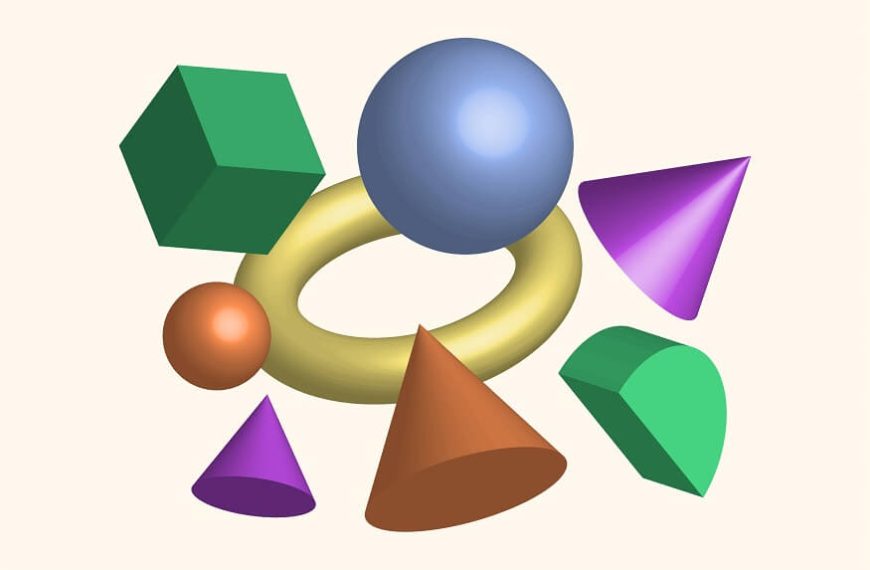
3d geometric shapes have three measurable directions: length, width, and height (or depth). Because they have that magical third dimension, these shapes are not flat. They take up physical space. You can hold them, stack them, kick them, and drop them. They have volume, which means you can usually fill them up with something else, like water or sand.
Think about your daily routine. The cereal box on your breakfast table, the tires on the school bus, the ice cubes in your water glass, and even the house you live in are all massive 3D shapes.
Difference Between 2D and 3D Shapes
Sometimes, kids get a little confused because flat shapes and solid shapes share very similar names and look somewhat alike from certain angles. Let’s clearly define the difference between 2d and 3d shapes.
The easiest trick is the “Touch Test.” If you can rest your entire hand completely flat against it and not feel anything popping up to poke your palm, it is 2D. If you have to wrap your fingers around it to hold it, it is 3D.
Another huge difference between two dimensional and three dimensional things is how we interact with them. You can draw a 2D shape, but you have to build a 3D shape. A flat shape can only ever be a picture of a thing, while a 3D shape is the actual, physical thing itself.
Spotting the Difference Between 2D and 3D Shapes With Examples
To really lock this concept into your brain, let’s pair them up. Seeing the difference between 2d and 3d shapes with examples right next to each other is the best way to learn how they are secretly related. Think of 2D shapes as the flat shadows of their thicker 3D cousins.
- The Square vs. The Cube: A square is a flat drawing with four equal sides. But if you glue six flat squares together into a box, you create a Cube! A Rubik’s cube, a wooden building block, and a pair of dice from a board game are all perfect cubes.
- The Circle vs. The Sphere: A circle is a flat ring. If you inflate that ring until it is perfectly round in every single direction, it becomes a Sphere. A drawing of the moon is a circle, but the actual, physical moon floating in outer space is a massive sphere. Basketballs, marbles, and oranges are all spheres.
- The Triangle vs. The Pyramid or Cone: A triangle is a flat drawing with three sharp points. If you give a triangle a flat, solid base and let it stand up tall, it transforms. If it has a round bottom, it becomes a Cone (like a delicious ice cream cone or an orange traffic cone). If it has a square bottom, it becomes a Pyramid (like the giant stone pyramids in Egypt).
Read More – Fun Shapes Activities for Kindergarten
A Thought-Provoking Conclusion
When you finally understand the secret rules of geometry, the entire world around you suddenly looks like a giant, interactive puzzle. You start realizing that absolutely everything you own is just a collection of different shapes stacked together.
But here is something really wonderful to think about today. We live our entire lives in a physical, 3D world. We interact with solid objects every single day. Yet, almost every single big, amazing 3D thing started as a tiny, flat 2D idea. Before a builder can construct a towering, 3D skyscraper out of steel and glass, an architect has to draw a flat, 2D blueprint on a piece of paper. You cannot have the solid, heavy reality without the flat, creative imagination coming first. So keep drawing those flat circles and squares, because one day, you might just figure out how to build them into something that changes the world.
For more engaging learning concepts, helpful parenting tips, and fun insights, check out the EuroKids Blog, and visit our website for all the details on EuroKids Preschool Admission.
FAQs
1. Can a piece of paper be considered a 2D shape?
Technically, no! While paper feels incredibly flat, it does have a microscopic amount of thickness. However, in a math classroom, we often use paper as a physical representation of 2D objects to make learning easier.
2. What is a cylinder?
A cylinder is a 3D shape that has two flat, circular ends connected by a curved tube. Think of a can of baked beans, a fresh battery, or a brand-new stick of chalk.
3. How do you find the area of a shape?
For flat 2D shapes, you find the area by multiplying the length by the width. This tells you exactly how much flat surface space the shape takes up on the paper!