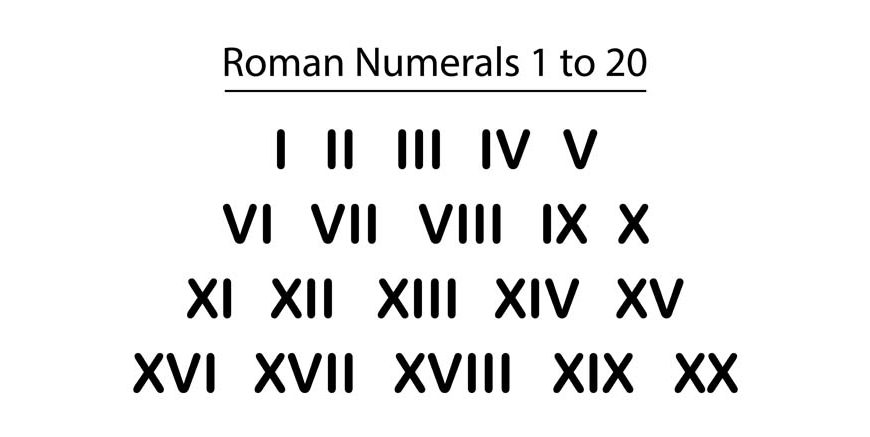
Roman numerals are one of the oldest number systems in history. Although modern mathematics uses digits such as 1, 2, and 3, Roman numerals are still widely taught in schools and used in everyday life. Students often learn them in early mathematics classes to understand number patterns and historical counting systems.
One common Roman numeral students encounter is XIX. Many learners ask about the Roman numeral XIX and what it represents in the standard number system. The Roman numeral XIX represents the number 19.
In this article, we will explain the XIX meaning, how to convert XIX into numbers, the rules of Roman numerals, examples of nearby numbers, and how Roman numerals are used in India and around the world.
What Are Roman Numerals?
Roman numerals are a numbering system that originated in ancient Rome. Instead of using digits 0-9 as in the modern number system, Roman numerals use letters of the Latin alphabet.
The basic Roman numeral symbols are:
|
Roman Symbol |
Value |
|
I |
1 |
|
V |
5 |
|
X |
10 |
|
L |
50 |
|
C |
100 |
|
D |
500 |
|
M |
1000 |
These symbols can be combined according to certain rules to represent many numbers.
For example:
- VIII = 8
- XV = 15
- XIX = 19
XIX Roman Number
The xix roman number is written using three Roman symbols:
XIX
To understand its value, let us break it down.
Roman Symbols in XIX
- X = 10
- IX = 9
So:
10 + 9 = 19
Therefore:
XIX = 19
Read More – Teaching Kids About Roman Numerals
XIX Meaning
The xix meaning is simply the number 19.
This number is formed using the addition and subtraction rules of Roman numerals.
Step-by-Step Explanation
- X represents 10
- IX represents 9
So:
10 + 9 = 19
Thus:
XIX in numbers = 19
How to Write XIX in Numbers
Converting XIX into numbers is simple when you understand Roman numeral rules.
Step 1: Identify the Symbols
XIX contains:
- X
- I
- X
Step 2: Apply the Subtraction Rule
The pair IX means:
10 – 1 = 9
Step 3: Add the Values
10 + 9 = 19
So the final answer is:
XIX = 19
Roman Numeral Chart Around XIX
Understanding nearby numbers helps students recognise patterns in Roman numerals.
|
Number |
Roman Numeral |
|
16 |
XVI |
|
17 |
XVII |
|
18 |
XVIII |
|
19 |
XIX |
|
20 |
XX |
This chart helps students see how Roman numerals change as numbers increase.
Read More – Roman Numerals 1 to 50 for Kids
Rules for Writing Roman Numerals
To understand numbers like XIX, students should know the main rules of Roman numerals.
Rule 1: Addition Rule
When a smaller value follows a larger value, the numbers are added.
Example:
XI = 11
X (10) + I (1)
Rule 2: Subtraction Rule
When a smaller number appears before a larger number, subtraction occurs.
Example:
IV = 4
V (5) – I (1)
In XIX, the pair IX follows this subtraction rule.
Rule 3: Repetition Rule
Some Roman symbols can be repeated up to three times.
Example:
XXX = 30
However, symbols like V, L, and D cannot be repeated.
Why XIX Uses the Subtraction Rule
The Roman numeral IX represents 9 using subtraction.
Instead of writing:
VIIII (which would mean 5 + 1 + 1 + 1 + 1)
Romans used a shorter form:
IX = 10 – 1
So XIX becomes:
10 + 9 = 19
This method makes Roman numerals shorter and easier to read.
Roman Numerals in Indian Education
Roman numerals are taught in Indian schools as part of early mathematics lessons.
Students learn Roman numerals to:
- Understand number patterns
- Improve mental calculations
- Recognise historical numbering systems
Examples often used in classrooms include:
- X = 10
- XV = 15
- XIX = 19
Teachers also use charts and worksheets to help students practice Roman numerals.
Roman Numerals in Historical Context
Roman numerals were widely used throughout the Roman Empire for trade, construction, and record keeping.
Examples include:
- Dates on monuments
- Numbering in architecture
- Military organization
Even today, many historic buildings around the world show dates written in Roman numerals.
For instance:
A building constructed in 1919 might display:
MCMXIX
Read More – How to Write XXI in Numbers?
Practice Questions for Students
Students can practice Roman numeral conversions to improve their understanding.
Question 1
Write XIX in numbers.
Answer: 19
Question 2
Write 18 in Roman numerals.
Answer: XVIII
Question 3
Write 20 in Roman numerals.
Answer: XX
Practice helps students remember Roman numeral patterns easily.
How EuroKids Builds Strong Math Foundations
When mathematics is introduced through storytelling, real-life objects, and engaging hands-on activities, young learners understand concepts like addition and sums more naturally. This is why structured early education programs prioritise activity-based learning over rote methods.
At EuroKids, foundational math concepts are taught using playful learning materials, visual tools, and interactive number-based activities aligned with the HEUREKA curriculum. This approach ensures children experience math in a way that feels enjoyable and meaningful.
Ideas such as addition and understanding sums are reinforced through relatable, everyday situations so that children truly comprehend the concept rather than simply memorising it. With a child-focused, play-driven methodology refined over 20+ years and implemented across 1600+ preschools, EuroKids emphasises building confidence first, allowing speed and accuracy to develop gradually.
Common Mistakes When Writing XIX
Students sometimes make errors when converting Roman numerals.
Incorrect Example
XIX = 21
This is incorrect.
Correct Answer
XIX = 19
Remember:
IX = 9
So:
X + IX = 10 + 9 = 19
Quick Summary
Here is a quick recap of the key points.
- XIX roman number = 19
- X = 10
- IX = 9
- 10 + 9 = 19
Therefore:
XIX = 19
Understanding this pattern helps students easily convert many Roman numerals.
Conclusion
Roman numerals are an ancient numbering system that continues to be used in education and everyday life. Learning how to convert Roman numerals helps students understand number patterns and historical counting systems.
The Roman numeral XIX represents the number 19. By understanding the rules of Roman numerals, students can easily convert them to standard numbers.
With regular practice, learners can quickly recognise Roman numerals such as XIX, XVIII, and XX, thereby building confidence in mathematics and general knowledge.
To explore more learning ideas, simple explanations, and early childhood resources, parents can visit the EuroKids Blog. Those who wish to understand the preschool journey better or explore enrolment options can find complete information on the EuroKids Preschool Admission