When a drop of water is observed under a microscope, different types of microorganisms can be seen. These microorganisms are living organisms that are too small to be visible to the naked eye. One such microorganism is the amoeba. Amoeba is a unicellular organism that lives in watery and moist environments. Although it consists of only one cell, it performs all basic life processes such as movement, nutrition, respiration, growth, excretion, and reproduction. This shows that even a single cell can function as a complete living organism.
So, what is amoeba and why is it such an important topic for students? In simple terms, an amoeba is a living organism made of just one cell. The amoeba definition tells us that it is a unicellular organism that belongs to the group of protozoa. When children learn to define amoeba, they begin to understand that life does not always need a complex body. A single cell can carry out all life functions on its own.
Learning about amoeba is often a child’s first step into the fascinating world of biology. It introduces ideas like cells, movement, feeding, and reproduction in a way that is simple and easy to observe.
What is Amoeba?
To understand what an amoeba is, we must first understand what a unicellular organism is. Unicellular means single-celled. An amoeba is made of only one cell, but that one cell performs all life activities. When students define amoeba, they usually say that it is a microscopic organism that can move, eat, grow, and reproduce on its own.
The amoeba definition in biology describes it as a protozoan that belongs to the kingdom Protista. This means it is not a plant, not an animal, and not a bacterium. It forms its own special group of living beings. Learning about amoeba helps students understand how life can exist in its simplest form.
Read More – Exploring the Living World
Where Amoeba is Found in Nature
Many students wonder where amoeba is found. Amoeba lives in moist and watery environments. It is commonly found in ponds, lakes, rivers, puddles, and even in damp soil. Any place that has water and organic matter can be a home for amoeba.
When scientists talk about a real amoeba, they mean the actual living organism observed under a microscope. A real amoeba looks like a tiny, jelly-like structure that slowly changes its shape. Children are often fascinated when they see videos or images of how a real amoeba moves and eats.
Amoeba Proteus: The Most Famous Species
Among all types, amoeba proteus is the most commonly studied species in schools and laboratories. Amoeba proteus is larger than many other amoebas, which makes it easier to observe under a microscope.
Because of its size and clear structure, amoeba proteus helps students understand the structure of amoeba better. It shows all the main parts clearly and demonstrates how a single cell can behave like a complete living organism.
Read More – Toddler Food Allergies
Amoeba Cell: A Living Unit by Itself
The amoeba cell is a complete living unit. Unlike human cells, which depend on other cells, an amoeba cell works independently. It takes in food, digests it, removes waste, moves around, and reproduces.
This is why learning about the amoeba cell is so important. It shows students how powerful a single cell can be. It also builds the foundation for understanding more complex organisms later.
Structure of Amoeba
The structure of amoeba is simple yet fascinating. It does not have a fixed shape. Instead, it keeps changing its form as it moves and feeds. This changing form is known as the amoeba shape.
One of the most important ameba characteristics is this ability to change shape. The body of the amoeba is soft and flexible, allowing it to extend and retract parts of its body whenever needed. This makes the structure of amoeba very different from most other organisms.
Read More – Not Just ‘Still Water’: A Deep Dive into the Pond Ecosystem
Amoeba Diagram and Its Importance
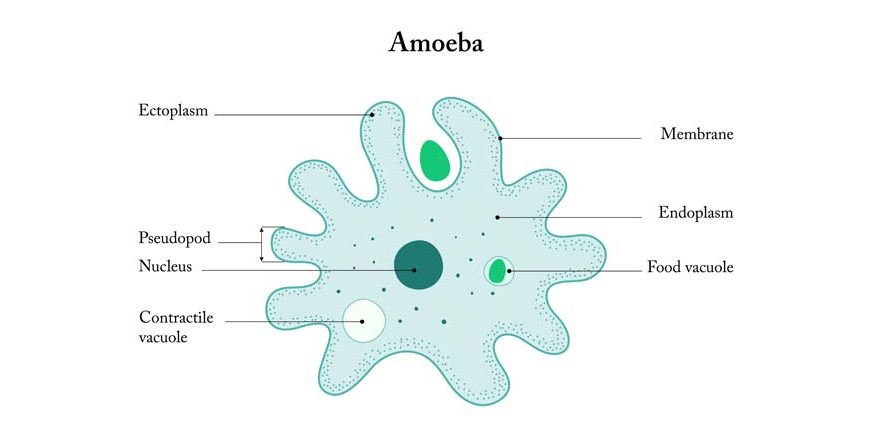
An amoeba diagram is a visual representation of the amoeba showing all its main parts. Sometimes it is also written as an ameba diagram, and both terms mean the same thing.
Studying an amoeba diagram helps students understand where each part is located and how it functions. A well-labelled ameba diagram makes learning easier and more interesting, especially for visual learners.
Parts of Amoeba and Their Functions
The structure of amoeba includes several important parts that work together.
The cell membrane forms the outer boundary. It protects the amoeba cell and controls what enters and leaves it.
The cytoplasm is the jelly-like substance inside the cell. It holds all the internal parts and helps in movement.
The nucleus controls all activities of the amoeba. It plays a key role in reproduction and growth.
Pseudopodia are finger-like projections. They help in movement and in catching food. These are responsible for the changing amoeba shape.
The food vacuole stores and digests food.
The contractile vacuole removes excess water and waste from the body.
Together, these parts make the structure of amoeba complete and efficient.
Amoeba Characteristics
The amoeba characteristics make it unique among living organisms. Some important ameba characteristics include:
- It is unicellular
- It can change shape
- It moves using pseudopodia
- It feeds by engulfing food
- It reproduces by binary fission
These amoeba characteristics show how even the simplest organisms can have complex life processes.
Amoeba Shape and Its Importance
The amoeba shape is not fixed. It keeps changing as the organism moves and eats. This helps it adapt to its surroundings. The flexible amoeba shape allows it to capture food particles easily and move through water smoothly.
Amoeba Protozoa and Amoeba Bacteria: Understanding the Difference
Many students confuse amoeba protozoa with amoeba bacteria, but they are not the same. Amoeba belongs to protozoa, while bacteria belong to a different group of organisms.
An amoeba protozoa has a nucleus and complex cell structure. Amoeba bacteria, on the other hand, do not have a true nucleus. This difference helps students understand how diverse microscopic life can be.
Why Students Learn About Amoeba
Learning about amoeba helps children understand the basic unit of life, which is the cell. It builds curiosity, improves observation skills, and develops scientific thinking. It also makes biology less intimidating and more enjoyable.
Conclusion: Learning Science the EuroKids Way
Understanding the amoeba, its structure, and its functions helps students realise that even the smallest living beings play an important role in nature. Learning about amoeba builds the foundation for studying biology and encourages curiosity about the natural world.
The EuroKids Blog is designed to support parents and students by making complex topics simple and enjoyable. It brings science closer to children through engaging stories and clear explanations.
For those who dream of being a part of early childhood education, the EuroKids Franchise offers a rewarding opportunity. With its strong reputation, research-backed HEUREKA Curriculum, and child-centred learning approach, EuroKids continues to shape young minds across India. Becoming a part of the EuroKids family means contributing to a brighter, smarter, and more curious generation.
Frequently Asked Questions
1. What is amoeba in simple words?
An amoeba is a tiny living organism made of one cell that can move, eat, and grow on its own.
2. Where amoeba is found naturally?
Where amoeba is found includes ponds, lakes, rivers, and damp soil.
3. Is amoeba harmful to humans?
Most amoebas are harmless, but some types can cause illness if they enter the human body.
4. Why is amoeba called a unicellular organism?
Because its entire body is made of just one cell.
5. What is amoeba proteus used for?
Amoeba proteus is used in laboratories to study cell structure and movement.
You May Also Read:
- Microscope Parts and Functions for Students
- Lungs Diagram Structure Working Importance
- Mitochondria Definition Structure and Function
- Circulatory System Explained for Kids
- Best Body Parts Activities for Preschoolers