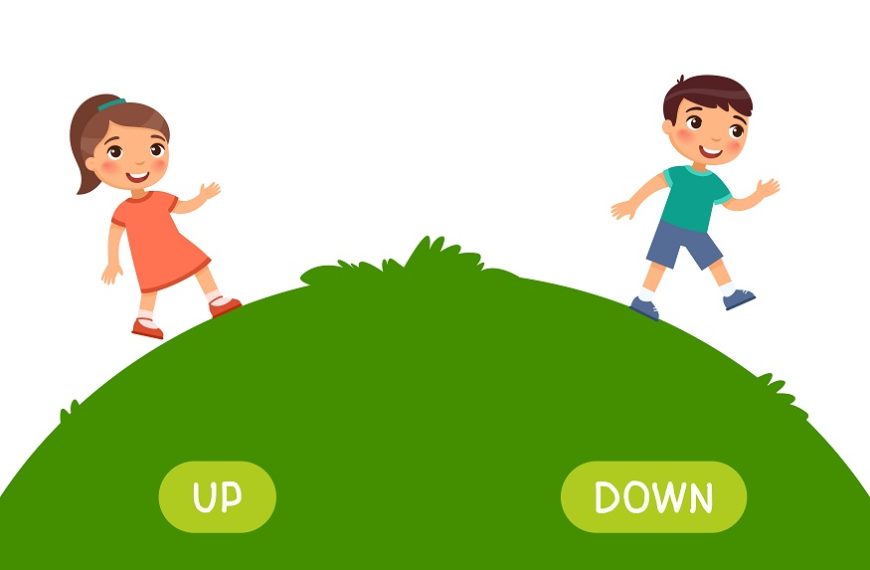
Gravity is a fascinating thing to observe through the eyes of a child. Before a little one even knows how to form a full sentence, they are already testing the limits of physics. They reach as high as their little arms can stretch to grab a floating soap bubble, and they joyfully drop their cereal bowl over the edge of the highchair just to watch it hit the floor.
These everyday moments are not just random acts of play; they are the very first lessons in spatial awareness. Understanding where our bodies exist in physical space is a fundamental building block of early education. Today, we are going to dive into how children learn to navigate their vertical world. We will explore why these directional words are so important, how to make the learning process incredibly fun, and the specific ways this knowledge prepares young minds for big school milestones.
What Is the Up and Down Concept?
At its core, the up and down concept is all about understanding vertical direction. It teaches a child the relationship between their own body, the sky above them, and the ground beneath their feet.
To adults, this feels like absolute second nature. We don’t even think about it. But for a young child, abstract words need to be firmly attached to physical movements. If you want a preschooler to truly grasp the idea of “up,” you cannot just point to a flashcard. They need to tilt their chin back, stretch their neck, and look at the clouds or the ceiling. To understand “down,” they need to drop their gaze to their shoes or crouch into a tiny ball on the carpet. Connecting the vocabulary to gross motor movements makes the abstract idea a concrete reality.
Read More – Teaching Top, Bottom, and Middle Concepts to Preschoolers
Introducing the Up and Down Concept for Nursery
When children are in their earliest years of schooling, their brains are like little sponges absorbing sensory information. Introducing the up and down concept for nursery students should be entirely focused on high-energy, full-body play. At this age, you are simply planting the seeds of spatial awareness.
You can start by narrating their natural movements. When they are at the park, say, “You are climbing up the tall ladder! Now you are sliding down to the dirt.” You can also use nature to your advantage. Take a walk outside and point out the birds flying high up in the branches, and then look for tiny ants marching down on the sidewalk. This helps nursery-aged children realize that these directional rules apply to everything in the world, not just their own bodies.
Why the Concept of Up and Down for Kindergarten Matters
As children grow a bit older, the expectations shift. You might wonder why early educators spend so much dedicated time on something as simple as directions. The truth is, mastering the concept of up and down for kindergarten is a massive stepping stone for advanced academic tasks, particularly reading and writing.
Think about how a child first learns to write the alphabet. When they learn to write the letter ‘t’ or ‘l’, their pencil must start at the top of the lined paper and pull straight down to the bottom. If they do not understand vertical space, forming legible letters becomes incredibly frustrating. Furthermore, early reading requires their eyes to track words across a page without wandering up or down into the wrong sentences. Beyond academics, understanding the command “get down!” during a game of tag or dodgeball is a crucial playground safety skill.
Fun Games to Teach Up Down at Home
The best classroom for a child is usually the living room floor. You do not need expensive toys to teach the up down relationship; you just need a little bit of creativity and a willingness to be silly. Here are a few fantastic activities to try with your kids:
- The Elevator Game: Tell your child that their body is a busy elevator inside a giant skyscraper. When you shout, “Going up!” they have to stand on their tiptoes and reach for the ceiling. When you shout, “Going down!” they must shrink into the smallest, lowest ball possible on the floor.
- Balloon Keep-Away: Blow up a colorful party balloon. The only rule of this game is that the balloon must stay up in the air. You and your child have to keep tapping it toward the ceiling, working together to make sure it never travels down to touch the carpet.
- Parachute Play: Grab a large bedsheet and hold one end while your child holds the other. Count to three and lift the sheet high up into the air to create a colorful tent, then quickly pull it down to the floor to trap the air inside.
- Staircase Counting: If you have a safe set of stairs in your home, use them for a dual lesson. Count out loud as you take each step up to the second floor, and then count backward as you safely step down to the bottom.
Read More – Introducing the Concept of Rectangles to Preschool Children
Summary
Teaching young children how to navigate their physical world is about far more than just giving them a set of vocabulary words. By playing games, climbing playground equipment, and reaching for the sky, children learn to map out the physical universe around them. Mastering spatial opposites gives them the independence and confidence to explore their environment safely, while simultaneously laying the hidden groundwork for writing their very first words.
Here is a wonderful thought to reflect on today: teaching spatial directions is a beautiful metaphor for life itself. Childhood is filled with energetic, bouncing highs and quiet, sleepy lows. By teaching our kids how to confidently navigate the literal ups and downs of the playground, we are slowly building the foundation they need to navigate the inevitable ups and downs of life with resilience, curiosity, and joy.
To read more fun, engaging, and educational articles to help your child grow, check out the EuroKids Blog, and visit our website for details on EuroKids Preschool Admission.
FAQs
At what age do children usually understand these directional words?
Most toddlers begin to grasp basic directional opposites like up, down, in, and out between the ages of two and three, especially if you pair the words with fun physical movements.
What is the best way to correct my child if they mix up the directions?
Never turn it into a stressful quiz! If they look at the ceiling when you say “down,” simply laugh gently, point to your own feet, and say, “Oops! The floor is down here. Let’s touch our toes together!”
Do songs and rhymes help with teaching spatial awareness?
Absolutely. Classic nursery rhymes with hand motions, like “The Itsy Bitsy Spider” or “The Grand Old Duke of York,” are incredibly effective tools for locking directional concepts into a young child’s memory.