Imagine you are standing in your kitchen holding an empty plastic wrapper from your favorite snack. What do you do with it? Usually, we just toss it into the trash can without a second thought. Out of sight, out of mind, right? But the truth is, that little wrapper does not just magically disappear. It goes on a long journey to a massive pile of garbage called a landfill. Now, picture every single person on the planet throwing away a wrapper on the exact same day. That is a whole mountain of trash!
Our planet is like a giant, beautiful house that we all share. Just like you have to clean your bedroom, we all have to work together to keep the Earth clean. The good news? You do not need to be a superhero with a cape to save the world. You just need to learn a secret code. Today, we are going to explore a special set of vocabulary words that will turn you into an official Earth Protector.
What Are The Three Rs?
When you first start learning the English alphabet, you focus on the A, B, and Cs. But when we talk about taking care of nature, we focus entirely on the letter ‘R’.
So, what are the three Rs? They stand for Reduce, Reuse, and Recycle.
If you look closely at these three English words, you will notice something really interesting. They all start with the exact same prefix: “Re-“. In the English language, putting “re-” at the beginning of a word usually means doing something again or going backward. For example, if you “replay” a video, you play it again. If you “rewrite” a messy sentence, you write it again.
By learning the three Rs, kids are not just figuring out how to help the environment; they are actually building a fantastic English vocabulary at the very same time. Let’s break down each of these magic words to see exactly how they work.
Read More – Teaching Kids the Importance of Recycling for a Greener Future
The First Rule: Reduce
The word reduce simply means to make something smaller or to use less of it. This is the very first and most important step in protecting our planet. If we create less garbage from the start, we have a lot less to clean up later!
How do we do this? It is actually incredibly easy.
- Water: When you stand at the bathroom sink brushing your teeth for two minutes, do you leave the water running the whole time? If you turn the tap off while you brush, you reduce the amount of water you waste.
- Electricity: When you leave your bedroom to go play outside, flip the light switch off. You are reducing the amount of electricity your house uses.
- Paper: If you are drawing a picture and make a tiny mistake, do not throw the whole paper away! Flip it over and draw on the back. You are reducing paper waste and saving trees.
The Second Rule: Reuse
The word reuse means exactly what it sounds like: using something again instead of throwing it in the garbage. This is where your creativity shines.
Before you drop something into the trash can, stop and ask yourself, “Can I use this for something else?”
- Instead of buying a new plastic water bottle every single day at school, get a sturdy metal bottle and fill it up again and again.
- When your parents bring home groceries in heavy cardboard boxes, don’t throw them out! A cardboard box can be painted and transformed into a spaceship, a robot helmet, or a cozy bed for your stuffed animals.
- If your favorite jeans get a hole in the knee, you don’t have to throw them away. Your parents can patch them up, or turn them into cool summer shorts!
The Third Rule: Recycle
Sometimes, we cannot reduce our use of something, and we cannot find a way to reuse it. That is when the third word steps in. Recycle is a fascinating word. It has the word “cycle” inside it, just like a bicycle wheel that spins around and around.
Recycling means taking old, broken, or empty junk and sending it to a special factory where it gets melted down and turned into something brand new.
- An empty glass jar of jam can be melted into a beautiful glass window.
- Old, soggy cardboard boxes can be mashed up to make fresh pages for your school notebooks.
- Here is the craziest one: if you recycle enough plastic water bottles, they can actually be spun into soft threads and used to make warm winter jackets!
Read More – Environmental Essay for Students
Making Reduce Reuse Recycle for Kids a Daily Habit
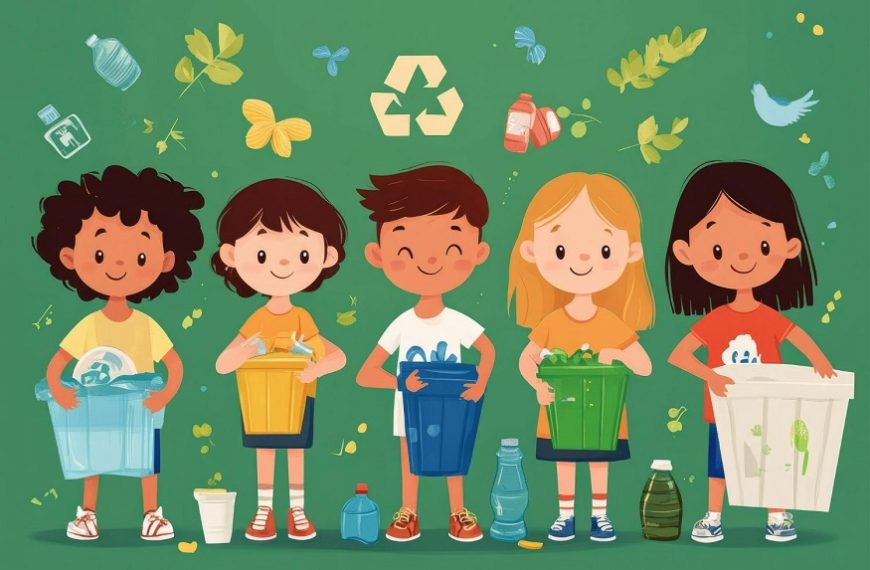
Teaching reduce reuse recycle for kids is all about turning these big concepts into fun, daily games. You can be the official “Light Switch Captain” of your house, making sure no empty rooms have lights left on. You can help your parents set up colorful sorting bins in the kitchen, one bin for paper, one for plastic, and one for regular trash.
When you practice these words every day, they stop being just an English lesson and start becoming a normal, healthy part of your daily routine.
Summary
Learning about the three Rs is one of the most exciting lessons a child can learn. It teaches us that words have incredible power. By simply understanding what Reduce, Reuse, and Recycle mean, we can change the way we interact with the world around us.
Here is something wild to think about today: Sometimes, when you are just one kid standing in a massive world, it feels like your small choices do not matter. You might think, “What difference does it make if I recycle just one single juice box?” But imagine if one million kids all had that exact same thought. That would be a mountain of a million juice boxes! Now, imagine if one million kids all decided to recycle. That tiny, simple choice suddenly changes the entire planet. Never forget that the biggest changes in history always start with one small person making one good choice.
To read more fun and educational articles, check out the EuroKids Blog, and visit our website for details on EuroKids Preschool Admission.
FAQs
1. Why is ‘Reduce’ the most important of the three Rs?
Reducing is the most important because it stops waste from being created in the first place! If we use less stuff, we don’t have to worry as much about finding ways to reuse or recycle it later.
2. Can everything be recycled?
No, not everything. Things like dirty pizza boxes, plastic wrap, and broken light bulbs usually cannot be recycled. It is always best to check the rules of your local recycling center!
3. What is ‘Upcycling’?
Upcycling is a super fun version of reusing! It means taking something old and useless and painting, building, or fixing it to make it even better and more beautiful than it was before.
4. How does learning these terms help my child’s English?
It introduces them to prefixes (like “re-“), expands their descriptive vocabulary, and helps them clearly communicate complex environmental ideas in everyday conversations.